


-
About UsHebei Derui Chemical Co., Ltd. (hereinafter referred to as Derui Chemical) was established in January 2006 with a registered capital of RMB 51.8 million. The company specializes in the production and sale of agrochemicals, with its main products including thiamethoxam technical grade, imidacloprid technical grade, spirotetramat technical grade, and related formulated products.

-
Product CenterThe company is committed to building and continuously improving its management systems, and in 2020 it obtained certifications under GB/T 19001-2016/ISO 9001:2015, GB/T 24001-2016/ISO 14001:2015, and GB/T 45001-2020/ISO 45001:2018. Derui Chemical has consistently upheld the corporate mission of “pursuing green development and serving global agriculture,” while adhering to the core values of “integrity, innovation, pragmatism, and gratitude.” The company is eager to collaborate with its partners to contribute to the advancement of global agriculture.
-
BlogThe company places great emphasis on standardized management and sustainable development, successfully obtaining certification for its three major management systems—quality, environment, and occupational health and safety—in 2020. These certifications align with GB/T 19001-2016/ISO 9001:2015, GB/T 24001-2016/ISO 14001:2015, and GB/T 45001-2020/ISO 45001:2018. Derui Chemical remains committed to its corporate mission of promoting green development and serving global agriculture, upholding the core values of “integrity, innovation, pragmatism, and gratitude.” We look forward to partnering with stakeholders from all sectors, pooling our strengths, and advancing together to support the steady growth of global agriculture.

World Food Day | Why is the waste rate of staple foods so stubbornly high? Throwing away half a serving: Let’s guard against food waste in staple dishes.
Release Date:
2023-10-16
Xinhua News Agency “Xinhua Viewpoint” reporter Liu Weizhen
At the waste‑recycling station outside an office building, many takeout main dishes still had nearly half their contents left; after a wedding banquet, numerous main courses remained untouched; and in the conference dining area, some boxed meals were discarded without even being opened… In everyday life, scenes of food waste—especially of staple foods—are truly alarming.
In recent years, as the “Clean Plate Campaign” has continued to gain momentum, a positive culture of food conservation has been steadily taking shape. However, a survey by Xinhua Viewpoint reporters reveals that staple foods such as rice and noodles still frequently lead to food waste in dining settings.
Staple foods are easily wasted.
Even after a satisfying meal at a restaurant, people often still order a staple dish, leaving more than half of it untouched on the table; and though their usual portion sizes are modest, takeout rice is frequently served in a generously filled box… Such scenarios—whether deliberate or unintentional—of wasting staple foods have become all too common.
According to the “China Urban Food Waste Report” released by the Institute of Geographic Sciences and Natural Resources Research of the Chinese Academy of Sciences and other institutions, a survey of school cafeterias in a certain city found that primary and secondary school students waste an average of approximately 130 grams of food per meal, with a waste rate of 22%. Among the types of food wasted, staple foods constitute one of the major categories, accounting for 45% of the total.
Takeout is one of the settings where food waste is particularly prevalent. A survey conducted by the Guangdong Province Research Group on Food Waste in Takeout Orders found that, among food categories, dishes such as fast‑food bento boxes and rice/noodle dishes—mainstays—account for 68.3% of all wasted items. Ms. Wei, a consumer from Tianjin, said she doesn’t eat much, so when ordering takeout, she often ends up eating only half of the staple dish and throwing the rest away. “The leftover rice gets soaked with sauce, and it’s not easy to deal with once I get home.”
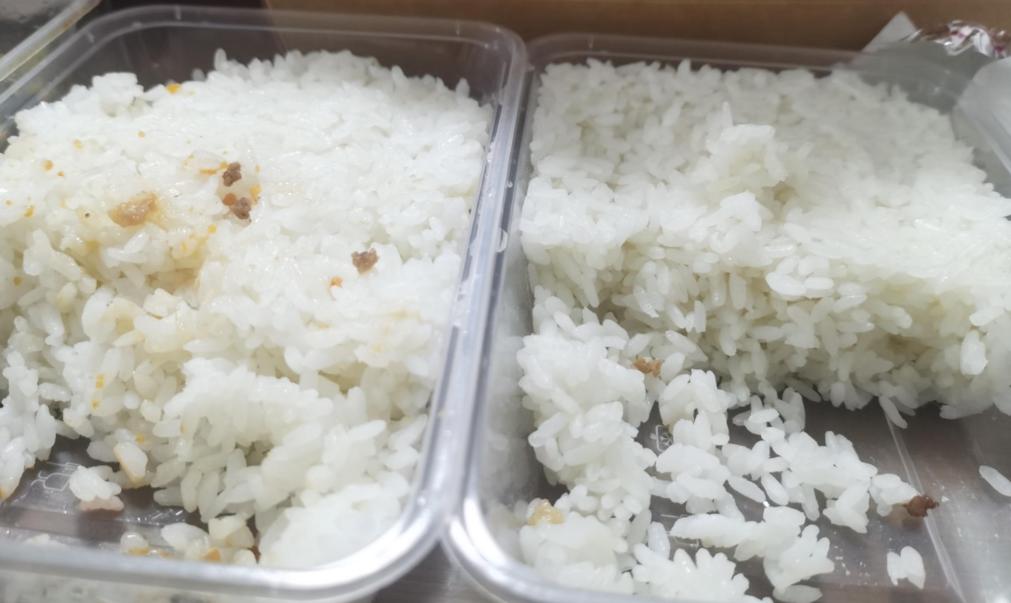
When ordering takeout, people often eat half of the staple dish and throw the rest away. (Photo provided by the interviewee)
Moreover, as business meetings and exhibition events gradually resume, the issue of staple‑food waste at venue catering deserves attention. “When attending conferences outside the office, some venues order hundreds of meal sets at a time; large quantities of staple foods sit untouched, only to be discarded beside the trash bins—such a waste is truly regrettable,” says Fu Yanbin, who has long been involved in office‑building property management and operations in Tianjin.
“Although China’s per capita grain availability has now surpassed the internationally recognized food‑security threshold of 400 kilograms, our country’s large population base means that, in recent years, extreme heat and drought, low‑temperature cold damage, and flooding have occurred from time to time, underscoring the need to remain constantly vigilant about food security,” said Du Jin, deputy director of the Department of Seed Science and Engineering at the College of Agronomy and Resource Environment, Tianjin Agricultural University. He added that some consumers lack a clear understanding of the nation’s grain‑production capacity and exhibit insufficient awareness of the importance of conservation.
Why is the food waste rate for staple foods “stubbornly high and difficult to reduce”?
A journalist’s investigation revealed that the longstanding problem of staple-food waste remains difficult to eradicate, owing both to lingering attitudes among some consumers and to existing issues in restaurant operations and the management of food-delivery platforms.
—To avoid negative reviews, it’s safer to just give more. A food-service worker in Tianjin said that for restaurants, serving too little of a staple dish can easily prompt customer complaints, while offering separate small and large portions would increase the kitchen’s workload. So it’s simpler—and more pleasing—to just serve extra across the board.
Some vendors note that, compared with dine-in customers, it’s harder to predict the portion sizes of takeout diners, so kitchens typically pre-portion meals in advance for delivery. “Not long ago, I ordered takeout from a chain fast-food brand and received more than 200 grams of rice per serving. Although I had already spoken with the staff before placing the order to ask for a smaller portion, they explained that the rice quantity is fixed and difficult to adjust,” said Kong Lingtao, vice president and secretary-general of the Tianjin Culinary Association.
— Showing off and valuing face: “feasts” have turned into “leftover banquets.” At business dinners and wedding receptions, staple dishes are often considered standard fare; yet after savoring the lavish array of courses, rice, noodles, and other staples frequently go largely untouched. “To save face, you can’t order fewer dishes, and there’s always a staple on the menu—leaving it off looks bad, and whether guests eat it is up to them. In the end, everyone eats very little of the staple, leaving plenty behind,” says Mr. Li, a manager at a company in Shaanxi Province.
— Pursuing “light eating” and greater flavor diversity. Du Jin notes that some consumers are adopting a “lighter” dining style, leading to a decline in demand for staple foods. The line between staples and non‑staples has also become increasingly blurred; certain salads, vegetables, and fruits can now serve as meal components. Meanwhile, excessive supplies of rice and noodles risk resulting in food waste.
In addition, some government agencies and school cafeterias adopt rather lax management practices, offering staple foods such as rice free of charge, which easily leads to food waste.
Joint Efforts to Prevent Staple Food Waste
Many government departments are closely monitoring the issue of staple food waste and actively promoting a new “food trend” of thrift and frugality. In March this year, the China Consumers Association, together with eight other associations, academic societies, and chambers of commerce, jointly issued an initiative calling for the accelerated adoption of smaller portions and half‑portion servings in takeout ordering, thereby better safeguarding consumers’ right to choose.
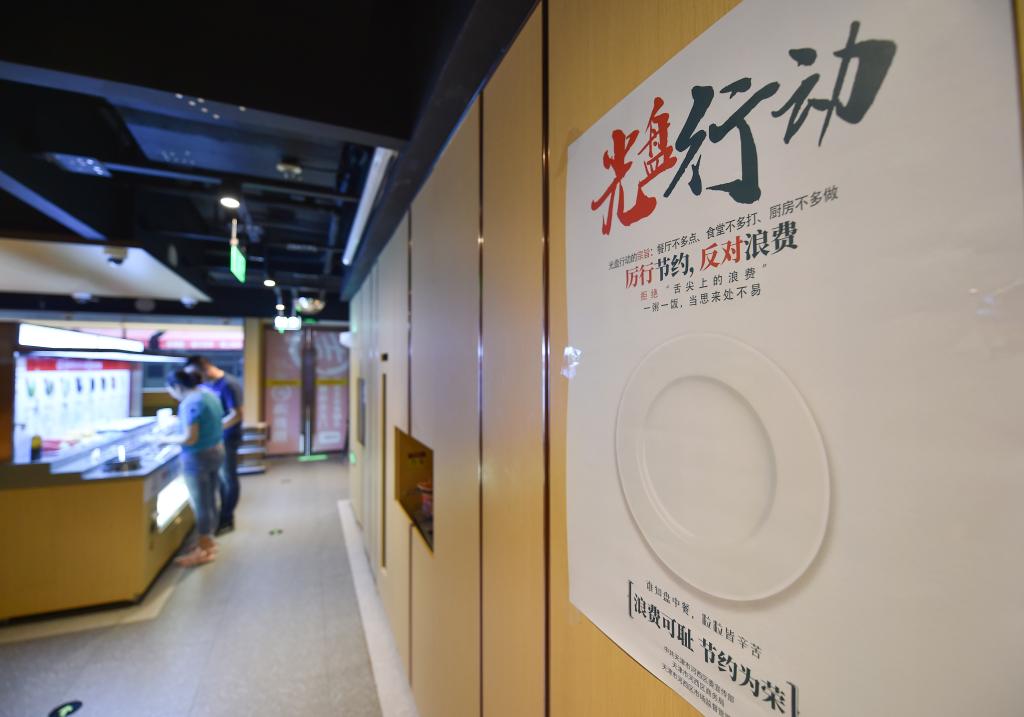
A poster promoting the “Clean Plate Campaign” displayed at a restaurant in Tianjin. (Photo by Xinhua News Agency reporter Sun Fanyue)
Wang Tiehan, Director-General of Food Safety at the State Administration for Market Regulation, stated that the phenomenon of food waste in the catering sector stems from several factors: the increasing abundance of material living standards has led to a neglect of grain‑saving practices, while shortcomings in the monitoring and evaluation system, difficulties in effectively addressing violations, and insufficient public awareness‑raising and guidance have also contributed. Several experts argue that, building on a shared societal consensus, businesses, consumers, and relevant authorities must work together to curb food waste and safeguard food security.
First, restaurants can clearly indicate portion sizes for staple dishes on their dine-in menus, offering customers a wider range of ordering options. Wang Xiaobo, an associate researcher at the Institute of Sociology of the Tianjin Academy of Social Sciences, suggests further refining and improving the labeling of staple‑dish portion specifications, while accelerating the promotion of medium‑ and small‑size servings and setting prices that are appropriately aligned with the portion sizes and cost of larger servings. Jiang Zijie, chairman of the Tianjin Aiyilai Xinjiang Restaurant, proposes that rice be ordered in “two‑portion” increments, allowing consumers to choose according to their appetite.
Secondly, further diversify staple food offerings, refine flavors, and emphasize meticulous preparation and attention to operational details. “Consumers today have increasingly high expectations for taste, so even staple foods need to evolve—rice, for example, can be steamed into rice or transformed into fermented rice wine, rice cakes, and other dishes,” said Kong Lingtao. He added that some restaurants could pilot “smart electronic menus” that automatically calculate and total the portion sizes of customers’ orders, along with their content of protein, carbohydrates, vitamins, and other nutrients, helping diners make more balanced meal choices.
A relevant official from the China Consumers Association recommends that dining settings such as wedding banquets, buffets, and workplace cafeterias should strengthen refined, people‑centric management to curb food waste, promptly monitor and assess dining patterns, and provide meals on demand with scientifically balanced menus.
In addition, it is essential to strengthen public education and awareness-raising efforts to firmly instill a culture of food conservation throughout society. Industry experts, including Du Jin, recommend enhancing science communication to increase public understanding of topics such as the origins of grain, China’s per capita grain availability, the nutritional value of grains, and balanced dietary practices. School teachers and parents should also help children develop an early appreciation for and commitment to conserving food, ensuring that the “Clean Plate Campaign” becomes deeply ingrained in people’s minds.
[Editor-in-charge: Qiu Lifang]
Source: Xinhua Net
Tags:
More information
Contact Us
Address:
No. 1, No. 1, New District Road No. 1, Gaocheng District, Shijiazhuang City, Hebei Province
WeChat/WhatsApp:
Phone:
Email:
