


-
About UsHebei Derui Chemical Co., Ltd. (hereinafter referred to as Derui Chemical) was established in January 2006 with a registered capital of RMB 51.8 million. The company specializes in the production and sale of agrochemicals, with its main products including thiamethoxam technical grade, imidacloprid technical grade, spirotetramat technical grade, and related formulated products.

-
Product CenterThe company is committed to building and continuously improving its management systems, and in 2020 it obtained certifications under GB/T 19001-2016/ISO 9001:2015, GB/T 24001-2016/ISO 14001:2015, and GB/T 45001-2020/ISO 45001:2018. Derui Chemical has consistently upheld the corporate mission of “pursuing green development and serving global agriculture,” while adhering to the core values of “integrity, innovation, pragmatism, and gratitude.” The company is eager to collaborate with its partners to contribute to the advancement of global agriculture.
-
BlogThe company places great emphasis on standardized management and sustainable development, successfully obtaining certification for its three major management systems—quality, environment, and occupational health and safety—in 2020. These certifications align with GB/T 19001-2016/ISO 9001:2015, GB/T 24001-2016/ISO 14001:2015, and GB/T 45001-2020/ISO 45001:2018. Derui Chemical remains committed to its corporate mission of promoting green development and serving global agriculture, upholding the core values of “integrity, innovation, pragmatism, and gratitude.” We look forward to partnering with stakeholders from all sectors, pooling our strengths, and advancing together to support the steady growth of global agriculture.

China’s Contributions to Global Food and Agricultural Development
Release Date:
2023-07-03
ROME, July 2 (Xinhua) — (International Observation) China’s Contributions to the Global Development of Food and Agriculture
Xinhua News Agency reporter Zhou Xiaotian
On the 2nd, the 43rd Session of the United Nations Food and Agriculture Organization Conference was held in Rome, the capital of Italy, to elect a new Director-General. The Chinese candidate, incumbent Director-General Qu Dongyu, secured re-election with an overwhelming majority.
China is one of the founding member states of the Food and Agriculture Organization. Since its establishment, China has actively fulfilled its obligations as a member and has extensively participated in and supported FAO activities. Officials and experts from numerous countries have stated that China is an active participant and staunch supporter of FAO affairs, translating its Global Development Initiative into concrete actions. In advancing global poverty reduction and agricultural development, China has made significant contributions, providing valuable lessons for developing countries in implementing the United Nations 2030 Agenda for Sustainable Development.
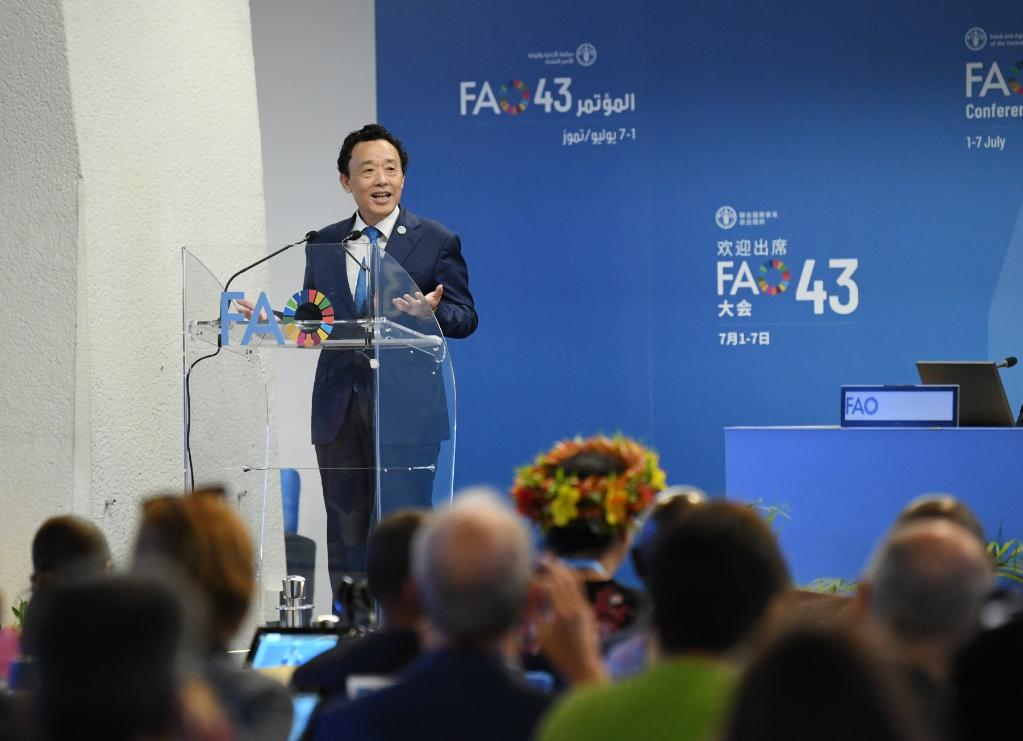
On July 2, at the headquarters of the Food and Agriculture Organization of the United Nations in Rome, Italy, Qu Dongyu delivered a speech following his re-election. Photo by Xinhua News Agency reporter Jin Mamengni.
Winning Trust, Re-elected by a Landslide
At the 43rd session of the FAO Conference, the various… The member states elected a new Director-General. Qu Dongyu secured 168 votes, winning re-election and will begin his second term on August 1.
In June 2019, Qu Dongyu was elected Director-General at the 41st Session of the FAO Conference, becoming the first Chinese national to hold this position in the history of the Food and Agriculture Organization.
Founded in 1945 and headquartered in Rome, the Food and Agriculture Organization of the United Nations is the specialized agency within the UN system responsible for cooperation in the field of food and agriculture, wielding significant influence worldwide in areas such as the exchange of agricultural policies, the development of standards, and the collection and dissemination of statistical information.
The Food and Agriculture Organization currently has 194 member countries, one member organization, and two associate members. The Conference is the Organization’s highest governing body, responsible for reviewing the global food and agriculture situation, examining major international food and agricultural issues, and electing and appointing the Director-General, among other functions. The Director-General heads the Secretariat, the Organization’s executive arm, and serves a four-year term.
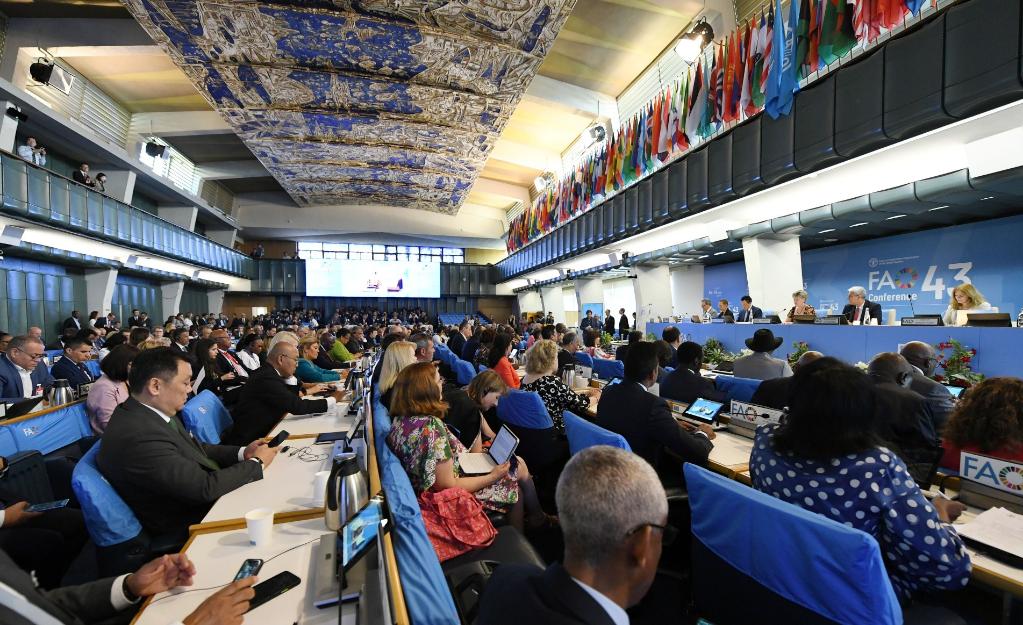
On July 2, the election of the new Director-General of the Food and Agriculture Organization of the United Nations was held at FAO headquarters in Rome, Italy. Photo by Xinhua News Agency reporter Jin Mamengni.
Take proactive action and teach people how to fish.
Since China regained its seat at the Food and Agriculture Organization in 1973, it has been a member of the Organization’s Council. From 1978 to the present, FAO has implemented nearly 500 national, regional, and international projects in China. At the same time, China has actively fulfilled its obligations as a member state and has participated in and supported FAO activities across a broad range of areas.
Since its official establishment in 2009, the China–FAO South-South Cooperation Trust Fund has enabled the implementation of numerous South-South cooperation projects. Through these initiatives, more than 300 Chinese experts have shared their expertise and technologies, “teaching others how to fish” and helping other developing countries further enhance their food security and overall agricultural productivity.
In September 2020, China announced the establishment of the third phase of the China–FAO South-South Cooperation Trust Fund. In December 2021, China and FAO signed the Fund’s Master Agreement.
“China has consistently been a key participant and staunch supporter of FAO’s South–South and Triangular Cooperation,” said Boubaker Ben Belhassen, Director of the Markets and Trade Division at FAO. He added that the FAO–China South–South Cooperation Program is currently being implemented in approximately 20 countries, benefiting more than 100,000 people.
In December 2022, the Food and Agriculture Organization of the United Nations (FAO) also signed an implementation agreement for the FAO–CAAS Innovation Platform with the Chinese Academy of Agricultural Sciences. FAO Representative in China, Wen Kangnong, stated that the FAO and Chinese institutions have established a long-standing and robust partnership in the field of international agricultural cooperation, and that the signing of this innovation platform implementation agreement will further strengthen their collaborative ties.
China’s role is highly anticipated.
In an interview with Xinhua News Agency, Chinese Minister of Agriculture and Rural Affairs Tang Renjian stated that Qu Dongyu’s successful re-election reflects the widespread recognition by FAO member states of his work during his first term, as well as the international community’s high regard for China’s steadfast commitment to multilateralism and its efforts to advance global development.
Affected by a confluence of factors—including geopolitical conflicts and extreme weather—global food security is currently facing severe challenges. The recently released Global Food Crisis Report indicates that in 2022, approximately 258 million people across 58 countries and regions experienced acute food insecurity, significantly higher than the 193 million recorded in 2021 across 53 countries and regions. Belhassen noted that protracted conflicts, climate change, and economic slowdowns or recessions are the primary drivers of global hunger and food insecurity. Preliminary estimates suggest that the number of undernourished people worldwide could rise by 8 to 13 million between 2022 and 2023, with the most pronounced increases expected in the Asia-Pacific region, followed by sub-Saharan Africa, and the Near East and North Africa.
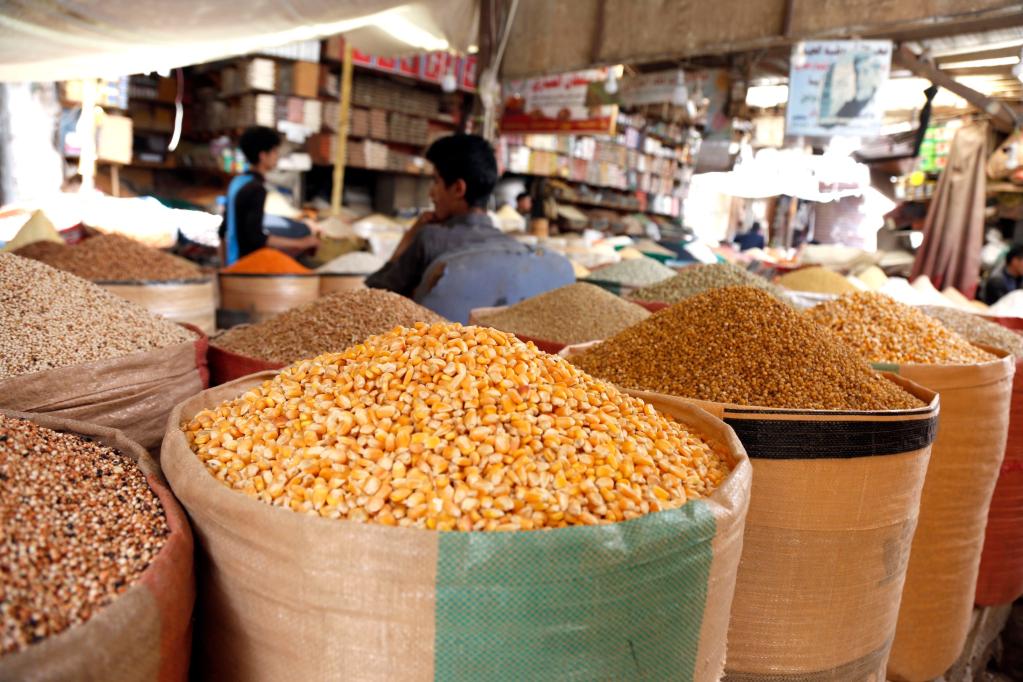
This is a stall selling food, photographed in Sanaa, Yemen, on June 29, 2022. Xinhua News Agency photo by Muhammad Muhammad.
Against this challenging backdrop, the international community is increasingly looking to strengthen cooperation with China and the Food and Agriculture Organization of the United Nations under frameworks such as the Global Development Initiative and the Belt and Road Initiative, working together to build agricultural and food systems that are more efficient, inclusive, resilient, and sustainable, and striving to advance the achievement of the 2030 Agenda for Sustainable Development.
Belhassen stated that the FAO–China South-South Cooperation Program will continue to support developing countries, contributing to global poverty reduction, emergency response, and the transformation of agricultural and food systems, as well as to achieving food security and improving nutrition by 2030.
Thana Watthanasin, Director of the Animal Production and Health Division at the Food and Agriculture Organization, stated that he has witnessed China’s profound transformation in its livestock production systems and is confident that China’s valuable experience in these agricultural sectors can offer guidance and inspiration to many other countries.
[Editor-in-charge: Xu Haizhi]
Source: Xinhua Net
Tags:
More information
Contact Us
Address:
No. 1, No. 1, New District Road No. 1, Gaocheng District, Shijiazhuang City, Hebei Province
WeChat/WhatsApp:
Phone:
Email:
