


-
About UsHebei Derui Chemical Co., Ltd. (hereinafter referred to as Derui Chemical) was established in January 2006 with a registered capital of RMB 51.8 million. The company specializes in the production and sale of agrochemicals, with its main products including thiamethoxam technical grade, imidacloprid technical grade, spirotetramat technical grade, and related formulated products.

-
Product CenterThe company is committed to building and continuously improving its management systems, and in 2020 it obtained certifications under GB/T 19001-2016/ISO 9001:2015, GB/T 24001-2016/ISO 14001:2015, and GB/T 45001-2020/ISO 45001:2018. Derui Chemical has consistently upheld the corporate mission of “pursuing green development and serving global agriculture,” while adhering to the core values of “integrity, innovation, pragmatism, and gratitude.” The company is eager to collaborate with its partners to contribute to the advancement of global agriculture.
-
BlogThe company places great emphasis on standardized management and sustainable development, successfully obtaining certification for its three major management systems—quality, environment, and occupational health and safety—in 2020. These certifications align with GB/T 19001-2016/ISO 9001:2015, GB/T 24001-2016/ISO 14001:2015, and GB/T 45001-2020/ISO 45001:2018. Derui Chemical remains committed to its corporate mission of promoting green development and serving global agriculture, upholding the core values of “integrity, innovation, pragmatism, and gratitude.” We look forward to partnering with stakeholders from all sectors, pooling our strengths, and advancing together to support the steady growth of global agriculture.

Implementing the Spirit of the Two Sessions: Hebei Accelerates Development by Aligning with and Serving Beijing and Tianjin
Release Date:
2023-03-23
SHIJIAZHUANG, March 22 (Xinhua) — Headline: Hebei: Accelerating Development Through Integration with and Service to Beijing and Tianjin
Xinhua News Agency reporter
At the closing session of the First Meeting of the 14th National People’s Congress, General Secretary Xi Jinping emphasized, “We must unswervingly promote high-quality development” and “We must fully, accurately, and comprehensively implement the new development philosophy.”
In implementing the spirit of the Two Sessions, Hebei Province has embraced the new development philosophy, firmly focusing on the relocation of non-capital functions from Beijing as the key priority. It has refined concrete measures to carry out the tasks outlined in this year’s Government Work Report, such as “promoting coordinated development among Beijing, Tianjin, and Hebei” and “building the Xiongan New Area to high standards and with high quality.” By aligning itself with and serving Beijing and Tianjin, Hebei is accelerating its development and continuously advancing the coordinated development of the Beijing–Tianjin–Hebei region in both breadth and depth.
Shortly after the conclusion of the Two Sessions, the Xiong’an New Area hosted a series of events aimed at taking on the relocation of non-capital functions from Beijing. On March 18, at the Xiong’an Business Service Center, the Xiong’an International Forum on Smart Transportation and the China Communications Construction Future Science and Technology City Industrial Development Conference were held, during which 86 innovative enterprises signed agreements to establish operations on site, spanning fields such as digital technology, network communications, new‑energy development, and aerospace engineering. This marked the largest-ever cluster‑level signing of innovative enterprises since the New Area’s establishment, and a vivid illustration of Xiong’an’s efforts to absorb Beijing’s non‑capital functions and advance high‑quality development.
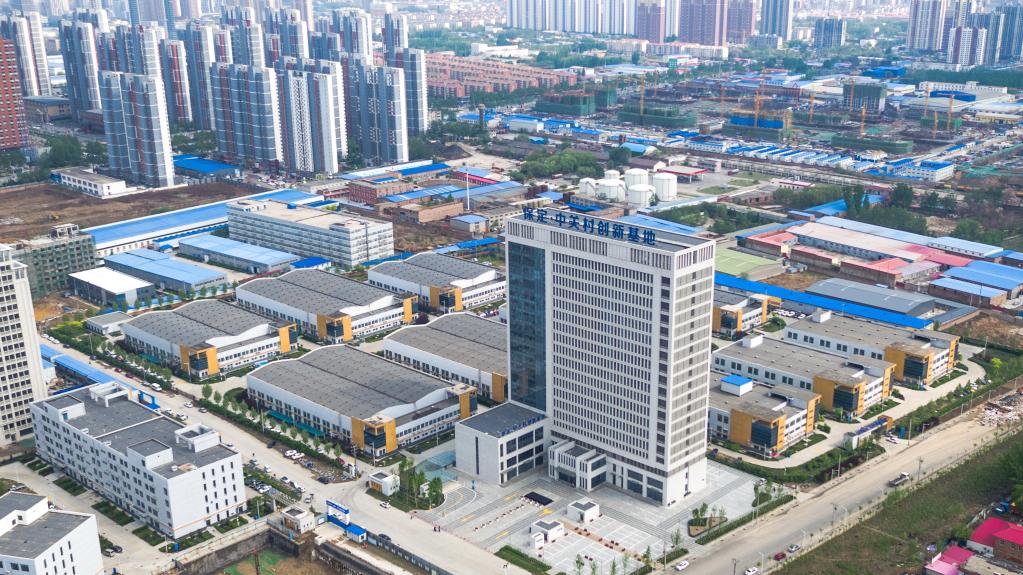
This is an exterior view of the Baoding Zhongguancun Innovation Base, captured by drone. Photo by Xinhua News Agency reporter Zhao Hongyu.
“General Secretary Xi Jinping emphasized at the Two Sessions that private enterprises must embrace the new development philosophy, while the Government Work Report called for ‘building the Xiongan New Area to high standards and with high quality.’ Our company will seize the momentum of the Xiongan New Area to vigorously advance its own high‑quality development,” said Qi Xiangdong, a member of the National Committee of the Chinese People’s Political Consultative Conference, Vice Chairman of the All-China Federation of Industry and Commerce, and Chairman of Qianxin Technology Group. He added that since the group’s Xiongan subsidiary moved into the Xiongan Business Service Center, its confidence in growth has grown even stronger. Xiongan is a brand‑new city, brimming with vast digital use cases and a favorable innovation ecosystem—everywhere presents opportunities. The company plans to establish its Digital City Security Headquarters in Xiongan, set up a Research Institute for Digital City Cybersecurity and a talent‑training base for cybersecurity professionals, and actively participate in the new area’s digital‑city development, thereby contributing to Xiongan’s high‑quality growth.
Recently, a group of Tangshan officials conducted in-depth field research at key Beijing–Tianjin–Hebei cooperation platforms, including Caofeidian, to implement the spirit of the Two Sessions. During these on-the-ground visits, Zhang Yuexian, a member of the National Committee of the Chinese People’s Political Consultative Conference and Vice Mayor of Tangshan, emphasized that, particularly during critical phases of urban development, it is essential to thoroughly grasp General Secretary Xi Jinping’s call—made at the Two Sessions—to “fully, accurately, and comprehensively apply the new development philosophy.” Focusing on industrial chain collaboration, Tangshan will continue to enhance the capacity of the Beijing–Tianjin–Hebei Caofeidian Collaborative Development Demonstration Zone and the Tianjin–Hebei (Lutai–Hanggu) Collaborative Development Demonstration Zone. Centered on the city’s 15 priority industries, Tangshan will align with second- and third-tier subsidiaries of central state-owned enterprises and resources from Beijing-based firms, fostering and strengthening leading industrial clusters to accelerate high-quality development.
One Zhongguancun, with new opportunities blossoming in multiple locations. The Baoding–Zhongguancun Innovation Center continues to attract science-and‑technology‑driven enterprises, facilitating the localization and commercialization of Beijing’s cutting-edge innovations in Baoding. According to Zhang Shuguang, head of the center, this year’s government work report—highlighting the “in-depth implementation of the innovation‑driven development strategy and the promotion of industrial structure optimization and upgrading”—has energized entrepreneurs. “In recent days, we have leveraged salons, WeChat groups, video conferences, and other formats to thoroughly study the spirit of the Two Sessions, while actively planning to bring in the advanced technological and industrial resources of Beijing and Tianjin, thereby driving the digital and intelligent transformation and upgrading of Baoding’s traditional sectors—power, machinery, textiles, and automotive.”
At present, the “Beijing–Tianjin R&D, Hebei Transformation” innovation collaboration model is flourishing across multiple locations, injecting a powerful dose of innovation into Hebei’s economic development. Following her return to Baoding after the conclusion of the Two Sessions, National People’s Congress deputy and Baoding Mayor Yan Jihong has been deeply reflecting on how to leverage the abundant science and technology resources of Beijing and Tianjin to accelerate high-quality development.
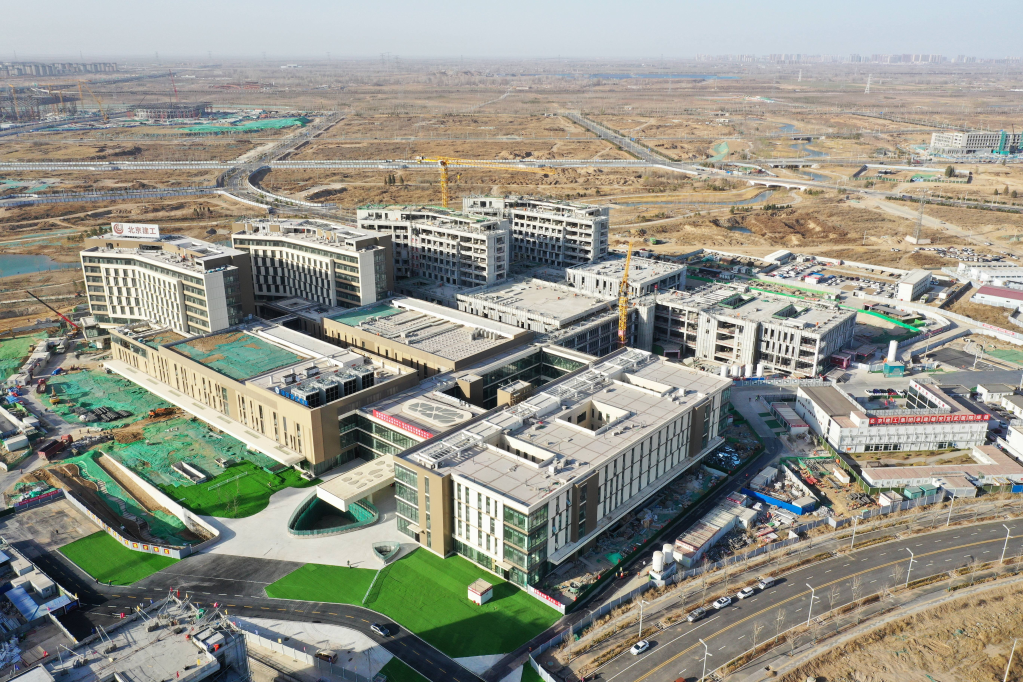
The construction site of the Xiong’an Xuanwu Hospital, located in the Startup Area of the Xiong’an New Area (drone photo). Photo by Xinhua News Agency reporter Zhu Xudong.
“Baoding is vigorously implementing an innovation-driven development strategy, working hand in hand with Beijing and Tianjin to build a collaborative innovation community, thereby truly putting into practice General Secretary Xi Jinping’s call—emphasized at the closing session of the First Meeting of the 14th National People’s Congress—to ‘make concerted efforts to enhance our capacity for scientific and technological self-reliance and strength,’” said Yan Jihong. At present, Baoding is accelerating the construction of major projects such as the China Minmetals Zhuozhou Science and Technology Industrial Park and the China Agricultural University’s research platform on model animal phenotypes and genetics. It has also introduced a new “listing‑and‑appointment” mechanism, encouraging research institutions from Beijing, Tianjin, and other regions to showcase their scientific and technological achievements in Baoding and to facilitate their practical application and commercialization.
Since the approval in 2022 of the Beijing Tongzhou District–Langfang Northern Three Counties Integrated High-Quality Development Demonstration Zone, Beijing and Hebei have continuously strengthened integration and coordination across transportation, industry, ecology, and other sectors.
To advance balanced regional development, transportation serves as the “vanguard.” At the construction site of the Changbai River Bridge on the Changtong Road—a key project under the Beijing–Tianjin–Hebei coordinated development initiative—work on the main bridge’s pile foundations is proceeding around the clock to ensure completion of the substructure before the flood season arrives. Once open to traffic, Changtong Road will become a vital link between Langfang’s northern three counties and Beijing’s urban sub-center, cutting travel time from Dachang Hui Autonomous County to the core area of Beijing’s urban sub-center by nearly half an hour.
“General Secretary Xi Jinping pointed out during his participation in the deliberations of the Jiangsu delegation, ‘We must always grasp, assess, and advance development by upholding the intrinsic unity of innovation, coordination, green development, openness, and shared benefits.’ The construction of the Beijing Tongzhou District–Langfang North Three Counties Integrated High‑Quality Development Demonstration Zone must fully implement this requirement,” said Li Guoyong, a deputy to the National People’s Congress and Mayor of Langfang. He added that the three northern counties of Langfang will strengthen cooperation with Beijing’s Tongzhou District, streamline the integrated transportation network, foster an integrated industrial structure, elevate the level of integrated public services, establish an integrated ecological barrier, and create an integrated business environment.
This year, Langfang will accelerate the construction of major transportation projects, including the Hebei section of Beijing’s Pinggu Line and the Changtong Road project. It will collaborate with Beijing to host project promotion and matchmaking events, strengthen cooperation with central and Beijing‑based enterprises such as the Beijing Investment Group, and strive to secure the signing and implementation of more projects. At the same time, Langfang will actively attract high‑quality educational, medical, and elderly‑care resources from Beijing, introduce “Beijing‑standard services” to participate more deeply in municipal infrastructure development, management, and operations, and advance the next‑generation upgrade of the “cross‑regional one‑stop service” for government affairs. (Reporters Zhang Tao, Qi Lejie, Zhao Hongyu, and Du Yifang)
Tags:
More information
Contact Us
Address:
No. 1, No. 1, New District Road No. 1, Gaocheng District, Shijiazhuang City, Hebei Province
WeChat/WhatsApp:
Phone:
Email:
