


-
About UsHebei Derui Chemical Co., Ltd. (hereinafter referred to as Derui Chemical) was established in January 2006 with a registered capital of RMB 51.8 million. The company specializes in the production and sale of agrochemicals, with its main products including thiamethoxam technical grade, imidacloprid technical grade, spirotetramat technical grade, and related formulated products.

-
Product CenterThe company is committed to building and continuously improving its management systems, and in 2020 it obtained certifications under GB/T 19001-2016/ISO 9001:2015, GB/T 24001-2016/ISO 14001:2015, and GB/T 45001-2020/ISO 45001:2018. Derui Chemical has consistently upheld the corporate mission of “pursuing green development and serving global agriculture,” while adhering to the core values of “integrity, innovation, pragmatism, and gratitude.” The company is eager to collaborate with its partners to contribute to the advancement of global agriculture.
-
BlogThe company places great emphasis on standardized management and sustainable development, successfully obtaining certification for its three major management systems—quality, environment, and occupational health and safety—in 2020. These certifications align with GB/T 19001-2016/ISO 9001:2015, GB/T 24001-2016/ISO 14001:2015, and GB/T 45001-2020/ISO 45001:2018. Derui Chemical remains committed to its corporate mission of promoting green development and serving global agriculture, upholding the core values of “integrity, innovation, pragmatism, and gratitude.” We look forward to partnering with stakeholders from all sectors, pooling our strengths, and advancing together to support the steady growth of global agriculture.

Stirring Up a Clean and Upright Atmosphere, Uniting the Party and the People—An Account of the CPC Central Committee with Comrade Xi Jinping at its Core Implementing the CPC Central Committee’s Eight-Point Decision on Improving Party and Government Conduct and Advancing Style of Work
Release Date:
2022-12-09
|
Xinhua News Agency reporters Sun Shaolong, Fan Sixiang, and Zhang Yan
|
|
On December 4, 2022, the Central Committee’s Eight-Point Decision on Improving Party and Government Conduct marked its tenth anniversary. Over the past decade, we have built trust through concrete actions. The Party Central Committee with Comrade Xi Jinping at its core has tackled the issue head-on by formulating and implementing the Eight-point Decision on Improving Party and Government Conduct. Leading by example, it has pressed ahead with efforts to strengthen Party conduct across the board—without slackening, without pausing, and setting out anew—curbing longstanding unhealthy tendencies that had long gone unchecked and rectifying deep-rooted problems that had persisted for years. Over the past decade, under the steady and resolute efforts of the entire Party, rigorous measures have been implemented with unwavering determination, ensuring that every step taken leaves a lasting mark. The building of a clean and honest Party and government has advanced in depth, and the spirit of the Eight-point Decision on Improving Party and Government Conduct has taken firm root, bringing about a fresh look to both Party and government conduct and fostering a sustained improvement in social and public ethos. As a result, the people have witnessed tangible results and meaningful changes. The Eight-point Decision on Improving Party and Government Conduct has revealed the people’s sentiments, consolidated the Party’s governing foundation, and has become a “golden hallmark” of the CPC’s style-of-work building, as well as a defining slogan that has transformed the Party’s conduct, government practices, and the broader social ethos in China.
Consistently and tirelessly maintain vigilance. On October 25, 2022, just three days after the conclusion of the 20th National Congress of the Communist Party of China, General Secretary Xi Jinping presided over a meeting of the Political Bureau of the CPC Central Committee to deliberate and make arrangements for studying, publicizing, and implementing the spirit of the 20th National Congress. An important item on the agenda of the meeting was the deliberation of the “Detailed Rules for Implementing the CPC Central Committee Political Bureau’s Regulations on Upholding Integrity and Frugality.” Five years ago, on October 27, 2017—just three days after the conclusion of the 19th National Congress of the Communist Party of China—General Secretary Xi Jinping presided over a meeting of the Political Bureau of the 19th CPC Central Committee, which reviewed and adopted the “Detailed Rules for Implementing the CPC Central Committee’s Eight‑Point Decision on Improving Party and Government Conduct.” These rules aimed to consolidate and expand the achievements made in implementing the spirit of the Eight‑Point Decision, further refining and improving relevant provisions while setting even higher standards. The clock turns back ten years. On December 4, 2012, less than a month after the conclusion of the 18th National Congress of the Communist Party of China, General Secretary Xi Jinping presided over a meeting of the Political Bureau of the CPC Central Committee, which reviewed and adopted the Eight-Point Decision on Improving Party and Government Work Styles and Strengthening Ties with the Masses. In just over 600 words, the Eight-Point Decision sets forth rules to strengthen conduct and work style across eight areas, including investigation and research, meetings, and activities. It was at this very meeting that General Secretary Xi Jinping took the lead in making a commitment and issuing a call, setting forth clear expectations for the members of the new Central Political Bureau: “In building a sound work style and clean governance, we must start with leading cadres; and among them, we must begin with the central leadership. As the saying goes, ‘If one’s own conduct is not upright, how can one expect to set others right?’”
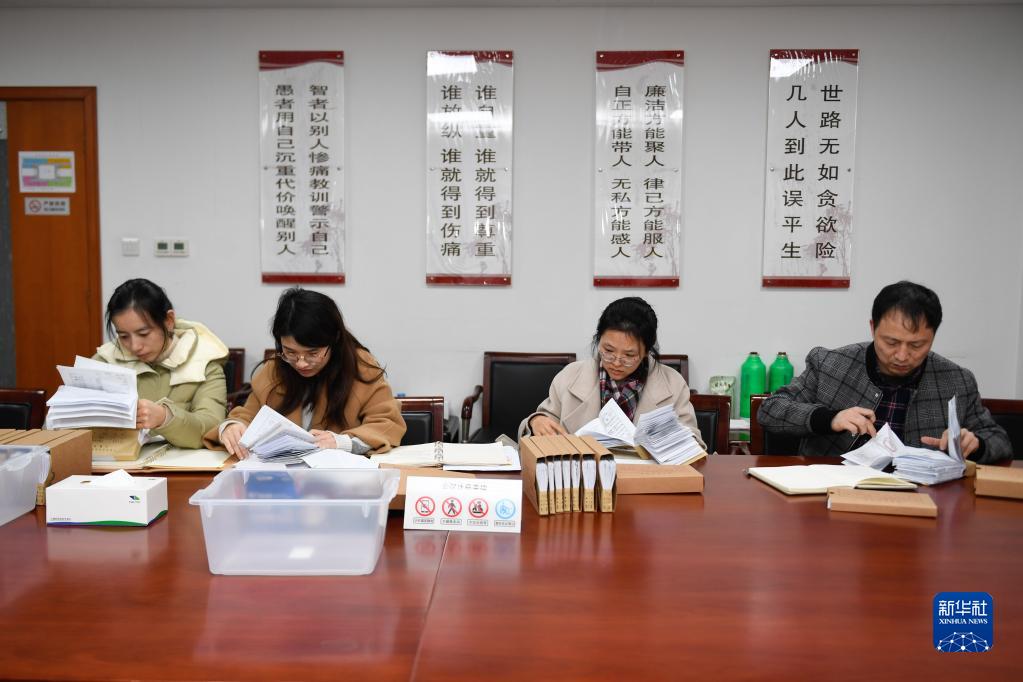
Staff members of the Discipline Inspection Commission of Beilun District, Ningbo City, Zhejiang Province, inspect official‑funded expense receipts from 2019 at the Beilun District Big Data Development and Management Center to identify any violations (photo taken on January 8, 2020). Photo by Xinhua News Agency reporter Huang Zongzhi Such an arrangement is by no means a coincidence— From the very outset, the 18th CPC Central Political Bureau set clear norms for improving Party conduct and work style; subsequently, both the 19th and 20th CPC Central Political Bureaus addressed the same issues at their inaugural meetings, further refining and elaborating them. This sends a resolute signal: unwavering commitment to implementing the CPC Central Committee’s Eight-Point Decision on Improving Party and Government Conduct, and seeing the drive to strengthen Party conduct through to the end. Problems of work style bear on the people’s support and the very survival of the Party. Since the 18th National Congress of the Communist Party of China, General Secretary Xi Jinping, from the political standpoint of consolidating the Party’s ruling position and upholding its original aspiration and mission, has put forward a series of important expositions on steadfastly implementing the spirit of the CPC Central Committee’s Eight‑Point Decision on Improving Party and Government Conduct and on deepening efforts to improve work style. These contributions have endowed the campaign to improve work style with new contemporary significance and have deepened our understanding of the underlying principles governing this endeavor. Unwavering political consciousness— “The Party’s style of work and its image are vital to its creativity, cohesion, and combat effectiveness, and they determine the success or failure of the Party and the country’s undertakings.” “The CPC Central Committee’s Eight-point Decision on Improving Party and Government Conduct is not a regulation for five or ten years; it is a long‑term, ironclad rule and an unshakable standard.” “The greater the risks, the more challenges we face, and the heavier the tasks at hand, the more we must strengthen the Party’s conduct and work style.” Political demands must be firm and clear— “It is imperative to strengthen the Party’s political development, ensuring the entire Party remains centralized and unified, with orders carried out without fail.” “To improve the Party’s conduct across the board, we must first focus on strengthening the conduct of the CPC Central Committee.” “Our leading cadres must not only set a high standard themselves but also exercise strict oversight over their family members and staff, earnestly fulfill their responsibilities for upholding integrity and clean governance in their respective areas of responsibility, and resolutely combat all forms of unhealthy tendencies and corruption.” Strategic deployment is highly focused— “We must continue to exert sustained, rigorous, and meticulous efforts, closely monitoring new trends and manifestations of hedonism and extravagance, and resolutely preventing any resurgence or recurrence.” “We must regard curbing formalism and bureaucratism as a key task.” “We must strike at the first sign of unhealthy tendencies such as hedonism and extravagance, and remain ever vigilant against the emerging, hidden, and evolving forms of the ‘Four Winds’ problems.” Our original aspiration and mission will never fade— “We must prioritize preventing and defusing risks that could lead to detachment from the people and undermine our foundations, and always maintain the close ties between the Party and the people.” “We must continue to address corruption and misconduct at the grassroots level, ensuring that the people gain a stronger sense of fulfillment from our efforts to combat corruption and root out petty corruption.” “All issues strongly raised by the public must be taken seriously and addressed with utmost diligence, and any conduct that harms the interests of the people must be resolutely rectified.” …… Purify the impure and promote the pure, with sustained effort over the long term.
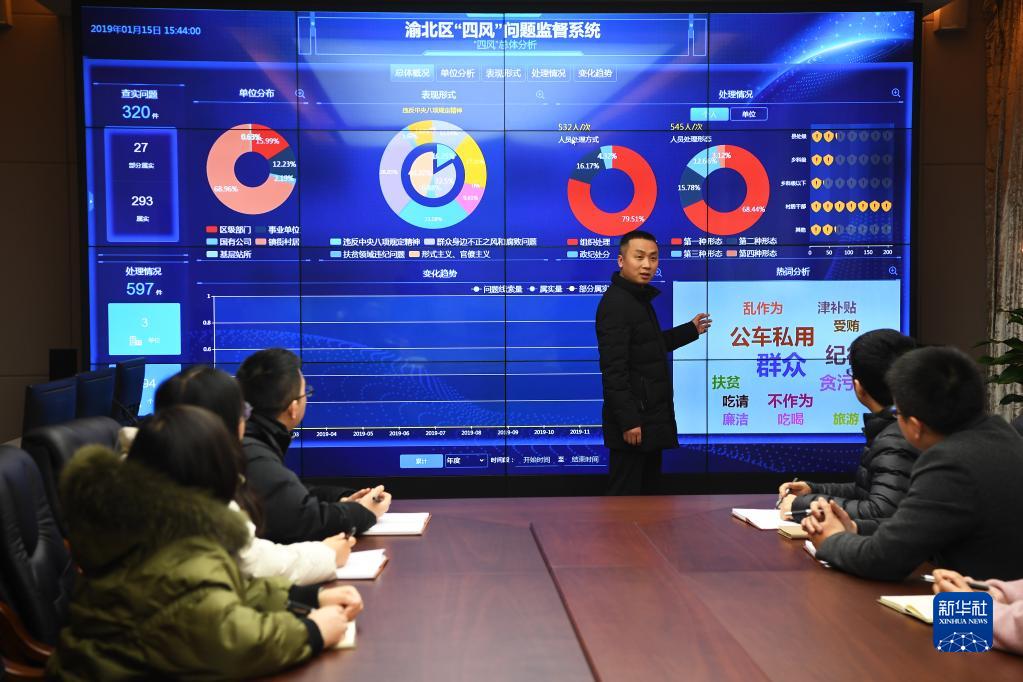
Staff members of the Commission for Discipline Inspection and Supervision of Yubei District, Chongqing, used the “Four Undesirable Trends” oversight system to conduct lead analysis (photographed on January 15, 2019). Photo by Xinhua News Agency reporter Wang Quanchao The Political Bureau of the CPC Central Committee convenes annual democratic life meetings to hear reports on the implementation of the Eight-point Decision and to conduct criticism and self-criticism. At important meetings held annually, such as the Central Committee Plenary Sessions and the CPC Central Commission for Discipline Inspection Plenary Sessions, General Secretary Xi Jinping has consistently issued specific directives and set forth clear requirements for implementing the CPC Central Committee’s Eight-point Decision on Improving Party and Government Conduct and for strengthening conduct‑building efforts. From the Party’s mass-line education and practice campaign, the thematic education on “Three Stricts and Three Earnests,” and the study-and-education campaign on “Two Studies, One Action,” to the thematic education on “Staying True to Our Original Aspiration and Keeping Our Mission Firmly in Mind” and the Party‑history study and education, the successive rounds of Party‑wide concentrated education have all set forth clear requirements for improving work style and strengthening ties with the people… On October 16, 2022, the Great Hall of the People shone with dazzling lights as the 20th National Congress of the Communist Party of China opened. Addressing more than 2,000 delegates gathered in the hall and speaking to the entire Party, the armed forces, and the people of all ethnic groups across the country, General Secretary Xi Jinping’s gaze was resolute and his words were firm— “We will steadfastly implement the spirit of the CPC Central Committee’s Eight-point Decision on Improving Party and Government Conduct, continue to deepen efforts to rectify the ‘Four Undesirables,’ with a particular focus on addressing formalism and bureaucratism, and resolutely eradicate notions of privilege and privileged practices.” Embark on a new journey and showcase a fresh outlook. On October 27, 2022, during his first official engagement outside Beijing since the conclusion of the 20th National Congress of the Communist Party of China, General Secretary Xi Jinping led the newly elected members of the Standing Committee of the 20th CPC Central Political Bureau to Yan’an to pay tribute to this sacred site of the Chinese revolution. At the Yan’an Revolutionary Memorial Hall, the General Secretary paused for a long time before the display panel titled “Ten ‘No’s’ During the Yan’an Period.” At the top of the list was, fittingly, “No corrupt officials or corrupt practices.” “Back then, Comrade Mao Zedong and other veteran revolutionaries in Yan’an lived in cave dwellings, subsisted on coarse grains, and wore plain cloth; with the ‘Yan’an style,’ they defeated the ‘Xi’an style.’” General Secretary Xi Jinping stated firmly, “All Party members must carry forward and uphold the glorious traditions and fine conduct left by the older generation of revolutionaries and Communists, courageously advance the Party’s self‑revolution, unswervingly promote comprehensive and strict Party governance, and always maintain the Party’s advanced nature and purity, ensuring that the Party remains the strong leadership core of the cause of socialism with Chinese characteristics.”
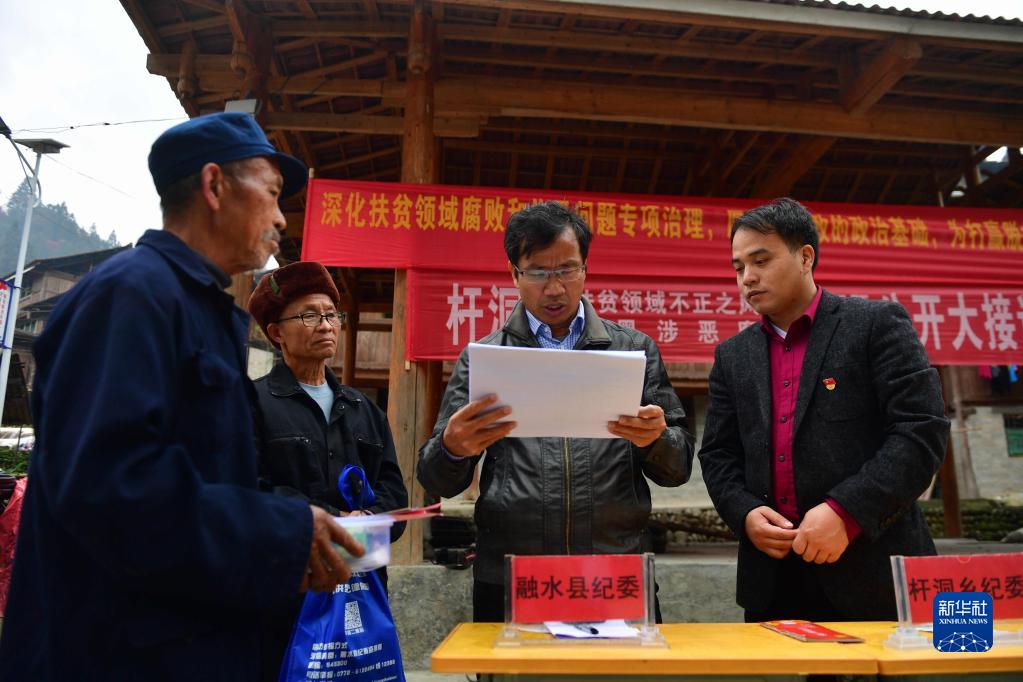
In Wuying Miao Village, Gandong Township, Rongshui Miao Autonomous County, Guangxi, discipline inspection and supervision officials (far right and second from right) are assessing the implementation of poverty‑alleviation industrial subsidy funds. Photo taken on November 16, 2019. Photo by Xinhua News Agency reporter Huang Xiaobang
Lead by example and set a personal standard. “Let’s see how our fellow villagers are faring now that they’ve shaken off poverty, what challenges they still face, and how we can advance rural revitalization.” On October 26, 2022, General Secretary Xi Jinping inspected Nangou Village in Ansai District, Yan’an City, Shaanxi Province. It is the height of autumn, and the apple orchards on the mountain are laden with fruit. General Secretary Xi Jinping inquired about this year’s apple harvest from the farmers picking on site, engaged in warm conversation with local villagers, and picked a large, red apple. The bright red apples of northern Shaanxi reflect the General Secretary’s deep concern for the all‑round advancement of rural revitalization, and are imbued with the sincere affection of the people’s leader for the masses. Mountains high, rivers far; through wind and rain, we walk side by side. Though the road stretches ten thousand miles, we never forget our original aspiration. Over the past decade, General Secretary Xi Jinping has conducted more than a hundred on-site inspections and field investigations across the country. On each occasion, he personally reviews and approves the itinerary, eschewing artificial scheduling in favor of tightly packed, well‑structured visits designed to ensure that his engagements are grounded in the realities of the people and deliver tangible, efficient results. He went deep into the front lines of poverty alleviation, engaging in face-to-face conversations with grassroots cadres and local residents, discussing their daily lives and carefully reviewing their finances, while insisting that no one should be left behind in the pursuit of moderate prosperity and that “we will not lay down our arms until we achieve complete victory.” He went to local areas to conduct research and provide guidance on the thematic education campaign titled “Remain True to Our Original Aspiration and Keep Our Mission Firmly in Mind,” emphasizing that the mass perspective and the mass line must be integrated into every stage of work and concrete actions, so as to make it more convenient and reassuring for the people to get things done. At a critical juncture in the fight against the epidemic, he flew to Wuhan, emphasizing the need to “resolutely win the battles to defend Hubei and defend Wuhan,” thereby bolstering the confidence of cadres and the general public that victory was assured. ……
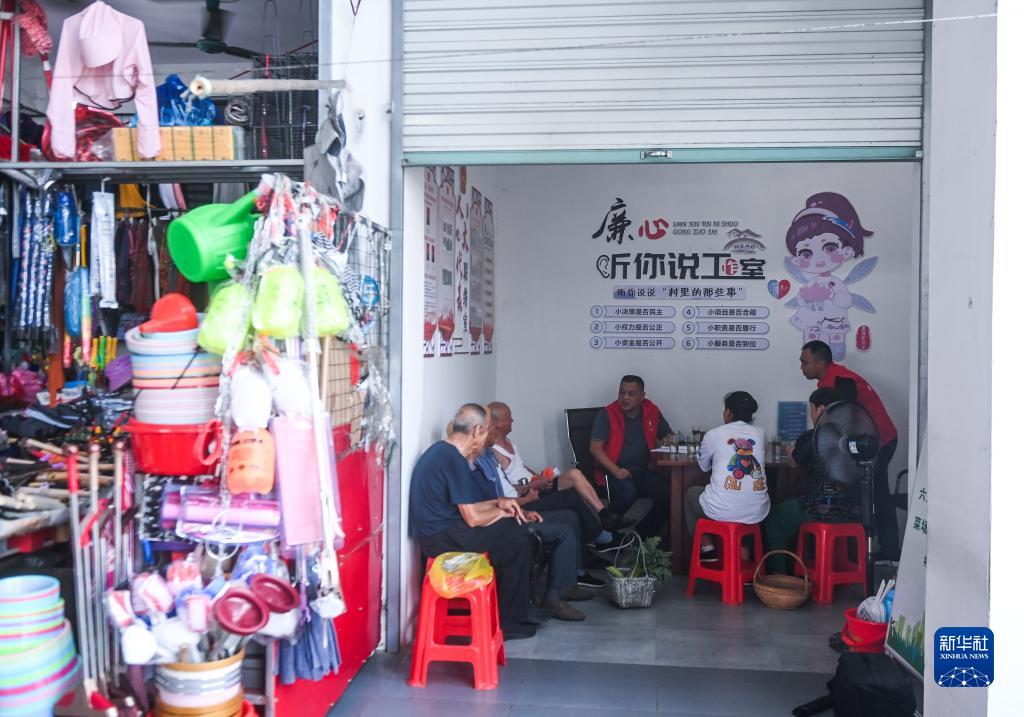
In the “Lianxin” workspace at the vegetable market in Yaojiaqiao Village, Huaxi Subdistrict, Changxing County, Huzhou City, Zhejiang Province, local villagers voice their concerns (photographed on August 18, 2022). Photo by Xinhua News Agency reporter Xu Yu. From the southeastern coast to the northwestern interior, from the snow-covered plateaus to the grasslands and forested regions, over the past decade, General Secretary Xi Jinping has listened to the people’s voices, understood their conditions, and sought their opinions; he has traversed the land of our country with his footsteps, earnestly heeded the people’s aspirations, and fulfilled his solemn commitments through concrete action. “Four hot dishes: braised chicken pieces, Fuping stew, stir-fried pork belly with garlic chives, and pounded garlic with garland chrysanthemum; one winter melon soup with pork meatballs; and for staple foods, dumplings, flower rolls, rice, and mixed-grain porridge. Please note that alcoholic beverages are not included.” In the online exhibition hall of the National Museum of China, a dinner menu from General Secretary Xi Jinping’s inspection visit to Fuping County, Hebei, in late 2012 has drawn particular attention. A menu reveals one’s style. Simple, home-style meals and the strict “four dishes and one soup” reflect the Communist Party members’ political character of frugality and simplicity, as well as their fine traditions. Since the 18th National Congress of the Communist Party of China, whether conducting domestic inspections and research or undertaking overseas visits, General Secretary Xi Jinping has consistently led by example, setting a high standard for all. He has personally and rigorously enforced the CPC Central Committee’s Eight-point Decision on Improving Party and Government Conduct, using his actions as a silent call to action and his personal conduct as a model for implementation, thereby providing powerful momentum for the entire Party to improve its work style. When traveling, he has always kept his entourage light and unobtrusive. On his first trip outside Beijing to Guangdong for an inspection since the 18th National Congress of the Communist Party of China, he refrained from blocking roads, closing off routes, or laying out red carpets, instead engaging directly with the public and holding cordial exchanges. As for accommodations, arrangements were kept as simple as possible. During the inspection tour to Fuping County in Hebei Province, we stayed in a 16-square-meter room. In the Lushan earthquake‑stricken area of Sichuan, we lodged in temporary prefabricated housing. At mealtime, the food was all home‑style fare. In Gutian, Fujian, he shared lunch with grassroots representatives, enjoying red rice and pumpkin soup. In Liangjiahe, in northern Shaanxi, he dined with local villagers, savoring buckwheat liangpi, fried flatbread, and millet porridge. During overseas visits, he repeatedly instructed that the number of hotel nights for delegations be carefully calculated, with every effort made to cut costs and avoid waste; accommodations should not be luxurious—clean and comfortable is sufficient… Every word and deed reflects a resolute stance in taking the lead in implementing the CPC Central Committee’s Eight-point Decision; in every small gesture, the profound affection of the people’s leader for the people is vividly demonstrated. On a day in April 2021, General Secretary Xi Jinping visited Maozhushan Village in Quanzhou County, Guangxi, and went into the home of villager Wang Deli. From the living room to the bathroom, and from the kitchen to the woodshed where cured meats are smoked, the General Secretary carefully inspected every corner of the home, pausing now and then to ask whether there was hot water for bathing, whether electricity was expensive, and where the tap water came from. “General Secretary, you’re so busy every day, yet you still took the time to visit us—thank you truly,” Wang Deli said from the bottom of his heart. “I’m busy with these very matters—after all, the paramount concern of our country is the people’s happy life,” the General Secretary replied with a smile. Simple, heartfelt words vividly demonstrate the sense of responsibility and leadership of a major party and a major country. Over the past decade, working day and night, attending to countless matters, has become the norm in General Secretary Xi Jinping’s daily routine. In 2014, during an exclusive interview with Russian television, General Secretary Xi Jinping quipped: “During this year’s Spring Festival, there was a Chinese song called ‘Where Has All the Time Gone?’ As for me, the question is: where has all my personal time gone?” The answer is: “It’s all consumed by work.” He told the reporter, “With a job like mine, there’s virtually no time left for myself.” From Beijing, flying southward across rivers, lakes, and seas, you arrive at Bali, situated at the confluence of the Indian and Pacific Oceans, then continuing straight north to Bangkok, perched on the shores of the Gulf of Thailand on the Indochinese Peninsula… From November 14 to 19, 2022, General Secretary Xi Jinping’s tour of Southeast Asia drew worldwide attention. Over six days and five nights, the General Secretary attended more than 30 events in rapid succession, with his schedule growing increasingly packed, vividly demonstrating the selfless work ethic of a leader of a major country. “Do you enjoy your work? Is it tiring?” In 2019, students in the Chinese class at North Niles High School in Illinois, USA, posed these curious questions in a letter to General Secretary Xi Jinping. “My job is to serve the people—it’s exhausting, but deeply rewarding,” General Secretary Xi Jinping replied in his letter. Those who lead by example inspire; those who teach by words invite disputes. Over the past decade, the Party Central Committee with Comrade Xi Jinping at its core has rigorously implemented the CPC Central Committee’s Eight-point Decision on Improving Party and Government Conduct and its detailed rules for enforcement, leaving no room for compromise or deviation, and setting a clear example for the entire Party through concrete actions.
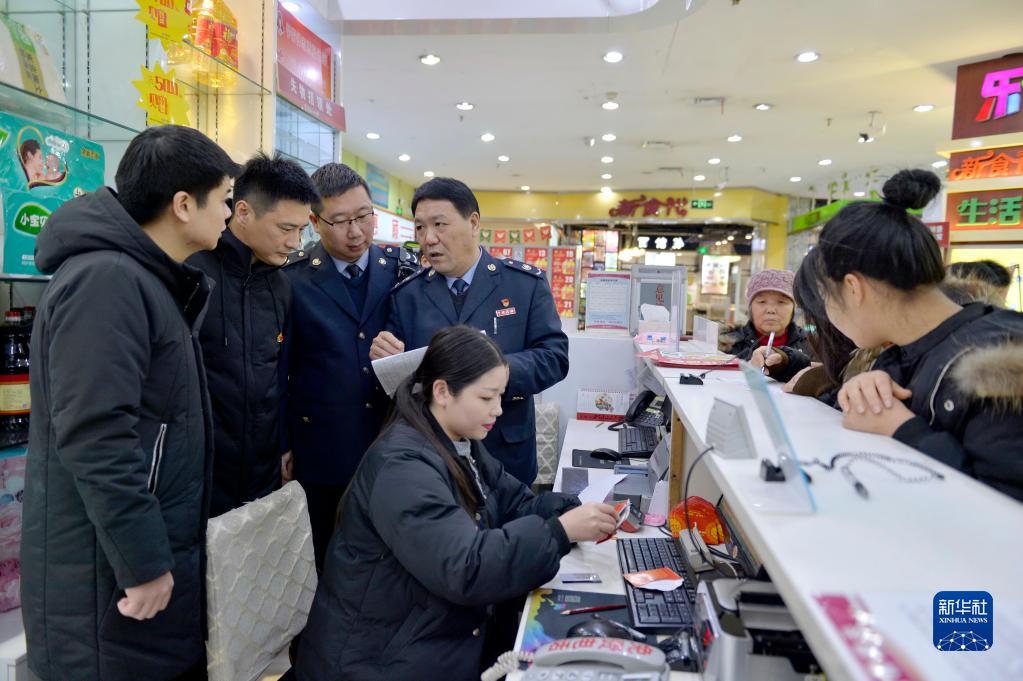
Disciplinary inspection officials and tax auditors from Ningjin County, Hebei Province, inspected a local supermarket to determine whether any organizations had used public funds to purchase gift cards (photo taken on December 29, 2018). Photo by Xinhua News Agency reporter Mou Yu.
Unite hearts and minds, achieve remarkable results. “The Eight-point Decision has changed China!” This is a heartfelt praise from the people. Over the past decade, the Party Central Committee with Comrade Xi Jinping at its core has taken the Eight-point Decision on Improving Party and Government Conduct as both a starting point and a rallying call, tackling problems head-on and addressing both symptoms and root causes, thereby setting off a sweeping transformation in conduct that has swept across the land. — The “Four Undesirable Trends” have been effectively rectified, and a political environment characterized by integrity and incorruptibility has been steadily consolidated. Dayang Town in Jiande City, Zhejiang Province, is situated along the Lanjiang section at the confluence of three rivers, and its local specialty, Dayang crab, is well renowned. “Hello, how have sales of crab cards and crab vouchers been this year? Could you please show us the sales records…” This National Day, local discipline inspection and supervision authorities, in collaboration with relevant functional departments, formed a special inspection team that visited aquaculture farms and specialized Chinese mitten crab stores throughout the jurisdiction. They carefully inquired about the denominations, actual selling prices, and sales performance of “crab cards” and “crab vouchers,” thoroughly investigating and scrutinizing issues related to the “Four Undesirable Trends,” including Party members and cadres illegally accepting or giving such gifts. “Nodes” are, in essence, “key areas of focus.” Over the past decade, disciplinary inspection and supervision authorities across the country have kept a close watch on “holiday-related problems,” such as unauthorized banquets and the giving or receiving of gifts and money, conducting both overt and covert inspections, publicly exposing typical cases, and working to institutionalize and sustain improvements in conduct. “7,561 cases of violations of the spirit of the CPC Central Committee’s Eight-point Decision were investigated and dealt with, and 10,943 individuals were criticized, educated, assisted, or disciplined…” On October 27, 2022, the Central Commission for Discipline Inspection and the National Supervisory Commission released the monthly report on nationwide cases of violations of the spirit of the CPC Central Committee’s Eight-point Decision on Improving Party and Government Conduct for September this year. This marks the 109th consecutive month that the two bodies have published such monthly data. Address problems early and at their nascent stage, nipping them in the bud. From curbing “waste on the tip of the tongue” to putting a stop to “corruption on wheels,” tackling “unhealthy practices in private clubs,” and continuously addressing prominent issues of formalism, to deepening and expanding efforts to lighten the burden on the grassroots—through a spirit of relentless determination, we have corrected the “Four Undesirable Trends,” brought under control longstanding unhealthy tendencies, and tackled persistent, long‑standing ills that had remained unaddressed for years. — The work performance of Party members and cadres has continued to improve, and their enthusiasm for getting things done and starting businesses has been significantly boosted. Joint meetings, online public disclosure of information, and streamlined reporting requirements—over recent years, grassroots officials in Hulunbuir City, Inner Mongolia Autonomous Region, have undergone a series of “decluttering” measures, shedding the burdens of endless paperwork, countless meetings, inspection‑driven assessments, and the need to leave behind an abundance of activity‑related records, finally breathing a great sigh of relief. Take the public security authorities as an example: before the burden‑reduction measures, officers had to conduct community visits, respond to calls, and stand guard, while also preparing reports and undergoing inspections and performance assessments, leaving them physically and mentally exhausted. “In pastoral areas, where locations are far apart and routes long, every time we have to prepare materials for evaluations, we can’t even carry out our household‑visiting plans,” said Senbu, a police officer with the Public Security Bureau of the Ewenki Autonomous Banner in Hulunbuir City. He added that the key to grassroots police work lies in engaging with the community, and after the burden‑reduction initiative, he now has more energy to deliver tangible benefits to residents in his jurisdiction. Data show that, as of the end of 2021, the number of documents issued by central and state organs, as well as by provincial, regional, and municipal authorities, had decreased by more than 50% overall compared with 2018, while the number of meetings had fallen by over 65%. Streamlined, substantive communication has become the norm, and lengthy meetings are now held in shorter formats, with extended remarks condensed into concise presentations. Meanwhile, the number of inspection, oversight, and assessment activities conducted by central and state organs, as well as provincial, regional, and municipal authorities, has declined year after year, with an overall reduction exceeding 90 percent. Issues such as overlapping, arbitrary, excessive, and overly frequent inspections have been significantly curbed. Inspection, oversight, and assessment efforts now place greater emphasis on tangible results, are more outcome‑oriented, give greater weight to the views of cadres and the public, and focus more on helping grassroots-level entities address real‑world challenges. — The mass stance and mass consciousness have been steadily strengthened, further consolidating the Party’s governing foundation. “I never expected that I could obtain my business license right here at the Party and Mass Service Center, without even leaving town.” In Pubian Village, Jinxiang Town, Shanwei, Guangdong, villager Wu Zehuan benefited from the favorable policy of transferring approval authority for individual business licenses to the town and subdistrict level, enabling him to obtain a business license for his snack shop without leaving the town. According to reports, since last year, Shanwei has completed its town‑and‑subdistrict institutional reform, focusing on “empowering towns” and transferring 448 county‑level administrative enforcement powers to the town and subdistrict levels, thereby making it easier, faster, more convenient, and more cost‑effective for businesses and residents to get things done. This is a microcosm of how the vast majority of Party members and cadres have translated the requirements of improving work style into concrete actions that deliver tangible benefits to the people. Over the past decade, all regions and departments have gone deep into the grassroots, engaged with the masses, listened to the genuine concerns of the people, and addressed their most pressing, difficult, and urgent issues, enabling the public to witness real and measurable changes. Meanwhile, by rigorously addressing “petty corruption” in areas that directly affect people’s livelihoods and removing obstacles that hinder the implementation of policies designed to benefit the public, and by launching special campaigns to tackle issues that disregard or infringe upon the interests of the masses, tangible progress has been made in enhancing the people’s sense of gain, happiness, and security. Data show that since the 19th National Congress of the Communist Party of China, disciplinary inspection and supervision authorities nationwide have investigated and dealt with 532,000 cases of corruption and misconduct in areas related to people’s livelihoods, imposing disciplinary and administrative sanctions on 489,000 individuals. — The Party’s and the government’s conduct sets a positive example, guiding social and public morals toward goodness and progress, and fostering an ever‑stronger atmosphere of integrity and uprightness throughout society. In Sanmentang Village, Bencu Town, Tianzhu County, Qiandongnan Miao and Dong Autonomous Prefecture, Guizhou Province, the “Sanmentang Contract Canteen” is renowned far and wide. Entering the cafeteria, on the right-hand side, the kitchen is neatly organized into distinct functional zones, with bright, clean windows; on the left, a spacious dining area can accommodate 200 diners, its tables and chairs arranged in perfect order. Ascending to the second floor, several private rooms and a conference hall that seats over a hundred are tastefully decorated in a minimalist style, yet retain an elegant, time‑honored charm. “With the ‘Contracted Canteen,’ people no longer compete with one another.” This April, villager Peng Zewei held a funeral for his mother and, after applying to the village committee, hosted 15 tables of banquet dishes at the “Contracted Canteen”: “Eight people per table, with eight dishes and a hot pot—just enough to eat without any waste.” The transformation of social ethos stands as the clearest testament to the deepening public embrace of the principle of “practicing thrift and opposing waste.” Over the past decade, Party and government conduct has been thoroughly revitalized, societal and civic norms have continued to improve, and a culture of frugality and modesty—rejecting extravagance—has taken root. Meanwhile, the core socialist values have increasingly resonated with the people. “Smaller portions are more suitable,” and “Leftover food can be taken to go”—conversations in restaurants reflect a shift in public attitudes. Foods once distorted by exorbitant prices, such as zongzi, mooncakes, and Chinese mitten crabs, have returned to being affordable and accessible, once again becoming cherished seasonal delicacies for families celebrating the holidays. Many people remark, “In the past, we competed over whose car was nicer or had a bigger engine; now, on WeChat, we all vie to see who has more steps.” The power of conduct lies in the strength of individuals and the vitality of the spirit. By cultivating a healthy social mindset and fostering a sense of public responsibility, the changes in conduct brought about by the Eight‑Point Decision on Improving Party and Government Conduct are profoundly and concretely shaping the lives of the Chinese people. There is no end to improving work style; self-revolution is an ongoing journey. Practice has shown that the CPC Central Committee’s Eight-Point Decision on Improving Party and Government Conduct is not a five-year or ten-year measure, but a long-term, ironclad rule and an unshakable standard. Be vigilant and self‑reflective, and remain as diligent at the end as you were at the beginning. Under the strong leadership of the Party Central Committee with Comrade Xi Jinping at its core, the entire Party stands united, upholding a rigorous tone to strengthen conduct and discipline. Our Party will surely rally even greater strength through an exemplary work style, leading all the people to advance ever further toward new victories on the great journey toward the Chinese Dream of national rejuvenation! Poster Design: Pan Hongyu Video Reporters: Chen Xiaoyu, Ji Yang, He Chunhao, Zi Qiang, Yu Gang, Jin Jian, Bai Bin, Yue Wenting, Liu Xiaoyu Reporters: Wu Junmiao, Li Dong, Li Qingmei, Chen Liangwan, Song Shijia, Zhou Quan, Liu Shuangkun |
Tags:
More information
Contact Us
Address:
No. 1, No. 1, New District Road No. 1, Gaocheng District, Shijiazhuang City, Hebei Province
WeChat/WhatsApp:
Phone:
Email:
