


-
About UsHebei Derui Chemical Co., Ltd. (hereinafter referred to as Derui Chemical) was established in January 2006 with a registered capital of RMB 51.8 million. The company specializes in the production and sale of agrochemicals, with its main products including thiamethoxam technical grade, imidacloprid technical grade, spirotetramat technical grade, and related formulated products.

-
Product CenterThe company is committed to building and continuously improving its management systems, and in 2020 it obtained certifications under GB/T 19001-2016/ISO 9001:2015, GB/T 24001-2016/ISO 14001:2015, and GB/T 45001-2020/ISO 45001:2018. Derui Chemical has consistently upheld the corporate mission of “pursuing green development and serving global agriculture,” while adhering to the core values of “integrity, innovation, pragmatism, and gratitude.” The company is eager to collaborate with its partners to contribute to the advancement of global agriculture.
-
BlogThe company places great emphasis on standardized management and sustainable development, successfully obtaining certification for its three major management systems—quality, environment, and occupational health and safety—in 2020. These certifications align with GB/T 19001-2016/ISO 9001:2015, GB/T 24001-2016/ISO 14001:2015, and GB/T 45001-2020/ISO 45001:2018. Derui Chemical remains committed to its corporate mission of promoting green development and serving global agriculture, upholding the core values of “integrity, innovation, pragmatism, and gratitude.” We look forward to partnering with stakeholders from all sectors, pooling our strengths, and advancing together to support the steady growth of global agriculture.

In December, a batch of new regulations that affect you and me will come into effect.
Release Date:
2022-12-01
BEIJING, Nov. 30 (Xinhua) — Headline: In December, a batch of new regulations that affect you and me will come into effect.
Xinhua News Agency reporter Bai Yang
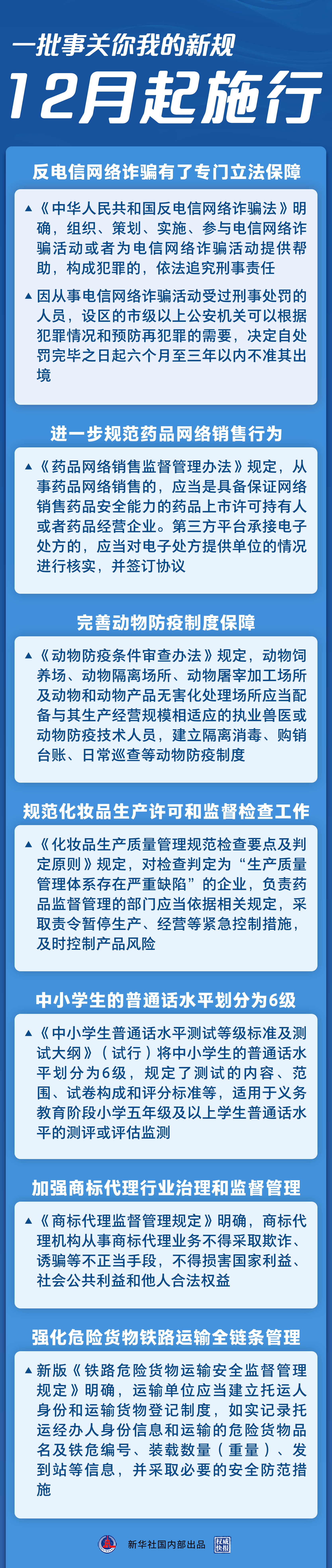
In the final month of 2022, a series of new regulations affecting both you and me came into effect. Anti‑telecommunications and online fraud now has dedicated legislative safeguards; standardized proficiency benchmarks have been established for primary and secondary school students’ Mandarin; and the responsibilities of online pharmaceutical sales platforms have been further strengthened… The rule of law is helping to build a better life.
“Targeted Measures” to Crack Down on Telecom and Online Fraud
The Anti-Telecommunications Network Fraud Law of the People’s Republic of China has been in effect since December 1, 2022.
The Anti‑Telecommunications and Online Fraud Law implements end-to-end governance across the entire illicit ecosystem—covering personnel, information, technology, and financial channels—and adopts a full‑process approach that encompasses front‑end awareness‑raising and prevention, mid‑stream monitoring and response, and back‑end enforcement. It strengthens the principal responsibility of regulatory authorities, holds enterprises accountable, establishes effective preventive and punitive measures against telecom and online fraud perpetrators, and rigorously cracks down on all forms of fraudulent black‑and‑gray industry activities.
The Anti-Telecommunications and Online Fraud Law stipulates that public security organs shall, in coordination with relevant departments and enterprises, establish an early-warning and dissuasion system to promptly implement appropriate preventive measures for identified potential victims.
For individuals traveling to areas with severe fraud-related risks and who are suspected of significant involvement in fraudulent activities, or who have previously been subject to criminal penalties for telecom and online fraud, the Anti‑Telecom and Online Fraud Law provides that exit‑restriction measures may be imposed as appropriate.
The Putonghua proficiency of primary and secondary school students is divided into six levels.
The “Standards for the Mandarin Proficiency Test Levels and Test Syllabus for Primary and Secondary School Students” (Trial) has been in effect since December 15, 2022. This standard classifies primary and secondary school students’ Mandarin proficiency into six levels and specifies the test content, scope, test paper structure, and scoring criteria, applying to the assessment, evaluation, and monitoring of Mandarin proficiency among students in the compulsory education stage from Grade 5 onward.
The newly revised “Table of Chinese Character Radicals” will also come into effect on December 15, 2022. While retaining the original 201 principal radicals, it adds and fine-tunes certain supplementary radicals, and provides the names of several commonly used radicals as well as their international encoding for information processing.
Strengthen the responsibilities of online pharmaceutical sales platforms.
The Measures for the Supervision and Administration of Online Sales of Drugs shall come into force on December 1, 2022.
The Measures clarify the qualifications and requirements for pharmaceutical enterprises engaged in online drug sales, and, in accordance with the law, stipulate that drugs subject to special state control—such as vaccines, blood products, narcotic drugs, and psychotropic drugs—may not be sold online.
The measures require that online sales of prescription drugs be conducted under a real-name system and that prescriptions be reviewed and dispensed in accordance with applicable regulations. They stipulate that prescription drugs and over-the-counter drugs must be displayed separately, and expressly prohibit the direct public display of packaging, labels, or other such information on the main page or homepage for prescription drug sales. Furthermore, prior to prescription verification, information such as package inserts may not be displayed, nor may any services related to the purchase of prescription drugs be provided.
Standardize the work of cosmetic production licensing and supervisory inspection.
The “Key Inspection Points and Judgment Criteria for the Good Manufacturing Practice of Cosmetics” shall come into effect as of December 1, 2022.
This principle specifies the particular circumstances and relevant criteria for on-site inspections conducted by drug regulatory authorities during production license issuance, post‑renewal inspections, and routine supervisory checks.
For enterprises whose inspections determine that “serious deficiencies exist in the production quality management system,” the competent drug regulatory authority shall, in accordance with relevant provisions, impose emergency control measures such as ordering a suspension of production or operations to promptly mitigate product risks. The enterprise shall complete corrective actions within the prescribed timeframe and submit a rectification report to the competent drug regulatory authority.
For enterprises whose inspections determine that “serious deficiencies exist in the production quality management system,” the competent drug regulatory authority shall, in accordance with relevant provisions, initiate an investigation.
Improve governance and regulation of the trademark agency industry.
The Regulations on the Supervision and Administration of Trademark Agency have been in effect since December 1, 2022, and they refine regulatory provisions to address issues such as low entry barriers, an excessive and disorderly proliferation of agencies, non-standardized business management, and uneven service quality in the trademark agency sector.
The regulations stipulate that trademark agencies shall establish and improve systems for managing business operations and maintaining client files, and strengthen training in professional ethics and disciplinary standards for their staff. In conducting trademark agency services, such agencies shall not employ fraudulent or deceptive practices, nor shall they infringe upon national interests, public interests, or the legitimate rights and interests of others.
Strengthening Safety Management of Railway Transportation of Dangerous Goods
The revised “Regulations on the Safety Supervision and Administration of the Transportation of Dangerous Goods by Rail” shall come into force as of December 1, 2022.
With regard to the illegal consignment of dangerous goods, the regulations establish systems covering the consignor’s responsibilities in areas such as determining the category of dangerous goods, implementing protective measures, designating specialized handling stations, submitting supporting documentation, completing waybills, and maintaining emergency contact information. As for the unauthorized carriage of dangerous goods, the regulations set up mechanisms for safety inspections, notification of non‑compliant consignments, and the conclusion of safety agreements.
Dangerous goods that meet the requirements regarding packaging, quantity, and hazardous substance content—such as consumer electronics containing lithium batteries, iodine tincture with an iodine concentration of less than 50%, and tetrachloroethylene for pharmaceutical use—may be transported without being classified as dangerous goods, provided certain conditions are satisfied.
Strengthen production safety and public health safety in the aquaculture industry.
The revised Measures for the Administration of Animal Quarantine and Measures for the Examination of Animal Disease Prevention Conditions shall come into force as of December 1, 2022.
The revised Measures for the Administration of Animal Quarantine stipulate that the agricultural and rural affairs authorities are responsible for the supervision and administration of animal quarantine, while animal disease prevention and control institutions provide relevant technical support. The regulations also revise the agencies authorized to accept quarantine applications for animals and animal products destined for disease-free zones, and clearly define the qualification requirements, appointment procedures, as well as training and assessment standards for official veterinarians.
The revised Measures for the Examination of Animal Disease Prevention Conditions stipulate that four types of facilities—animal breeding farms, quarantine facilities, slaughter and processing establishments, and harmless treatment facilities—must be staffed with licensed veterinarians or animal disease prevention technicians commensurate with their scale of production and operation. Personnel suffering from zoonotic infectious diseases are prohibited from directly engaging in relevant activities within these facilities.
Tags:
More information
Contact Us
Address:
No. 1, No. 1, New District Road No. 1, Gaocheng District, Shijiazhuang City, Hebei Province
WeChat/WhatsApp:
Phone:
Email:
