


-
About UsHebei Derui Chemical Co., Ltd. (hereinafter referred to as Derui Chemical) was established in January 2006 with a registered capital of RMB 51.8 million. The company specializes in the production and sale of agrochemicals, with its main products including thiamethoxam technical grade, imidacloprid technical grade, spirotetramat technical grade, and related formulated products.

-
Product CenterThe company is committed to building and continuously improving its management systems, and in 2020 it obtained certifications under GB/T 19001-2016/ISO 9001:2015, GB/T 24001-2016/ISO 14001:2015, and GB/T 45001-2020/ISO 45001:2018. Derui Chemical has consistently upheld the corporate mission of “pursuing green development and serving global agriculture,” while adhering to the core values of “integrity, innovation, pragmatism, and gratitude.” The company is eager to collaborate with its partners to contribute to the advancement of global agriculture.
-
BlogThe company places great emphasis on standardized management and sustainable development, successfully obtaining certification for its three major management systems—quality, environment, and occupational health and safety—in 2020. These certifications align with GB/T 19001-2016/ISO 9001:2015, GB/T 24001-2016/ISO 14001:2015, and GB/T 45001-2020/ISO 45001:2018. Derui Chemical remains committed to its corporate mission of promoting green development and serving global agriculture, upholding the core values of “integrity, innovation, pragmatism, and gratitude.” We look forward to partnering with stakeholders from all sectors, pooling our strengths, and advancing together to support the steady growth of global agriculture.

National Clean Production Promotion Plan for the 14th Five-Year Plan Period
Release Date:
2021-11-11
Notice of the National Development and Reform Commission and Other Departments on Issuing the “14th Five-Year Plan” National Clean Production Promotion Scheme, NDRC Environmental Protection and Resource Conservation [2021] No. 1524
To the People’s Governments of all provinces, autonomous regions, and municipalities directly under the central government, and to the relevant departments of the State Council:
The “14th Five-Year Plan for Promoting Clean Production Nationwide” has been approved by the State Council and is hereby circulated to you. Please implement it effectively in light of your specific circumstances.
National Development and Reform Commission
Ministry of Ecology and Environment
Ministry of Industry and Information Technology
Ministry of Science and Technology
Ministry of Finance
Ministry of Housing and Urban-Rural Development
Ministry of Transport
Ministry of Agriculture and Rural Affairs
Ministry of Commerce
State Administration for Market Regulation
October 29, 2021
Attachment:
Promoting clean production is an important measure for implementing the fundamental national policies of conserving resources and protecting the environment; it is a key means of achieving synergistic efficiency in pollution reduction and carbon mitigation, and an effective pathway for accelerating the development of green production practices and advancing the comprehensive green transformation of economic and social development. To implement the Law on Promoting Clean Production, the 14th Five-Year Plan, and the Outline for Long-Term Goals for 2035, and to expedite the promotion of clean production, this plan has been formulated.
I. General Requirements
(1) Guiding Principles. Guided by Xi Jinping Thought on Socialism with Chinese Characteristics for a New Era, we will comprehensively implement the spirit of the 19th National Congress of the Communist Party of China and the Second, Third, Fourth, and Fifth Plenary Sessions of the 19th CPC Central Committee; thoroughly apply Xi Jinping’s Thought on Ecological Civilization; and, in accordance with the decisions and arrangements of the CPC Central Committee and the State Council, proceed from the new stage of development, fully, accurately, and comprehensively uphold the new development philosophy, foster a new development pattern, and promote high-quality development. With the goals of conserving resources, reducing energy consumption, cutting pollution and carbon emissions, and improving quality and efficiency, we will take clean production audits as a key lever to systematically advance clean production across industry, agriculture, construction, services, and other sectors; actively carry out clean‑production upgrades; explore regionally coordinated approaches to promoting clean production; cultivate and strengthen the clean‑production industry; and contribute to achieving the carbon‑peak and carbon‑neutralization targets, thereby supporting the building of a Beautiful China.
(II) Main Objectives. By 2025, a basic institutional framework for promoting clean production will be in place; clean production will be fully implemented across the industrial sector; further progress will be made in advancing clean production in agriculture, services, construction, transportation, and other sectors; the overall level of clean production will see a substantial improvement; energy and resource efficiency will be significantly enhanced; emission intensity of major pollutants and carbon dioxide in key industries will be markedly reduced; and the clean‑production industry will continue to grow.
By 2025, industrial energy and water efficiency will have improved significantly compared with 2020 levels, with an additional 60 million mu of land under high-efficiency water-saving irrigation. Total emissions of chemical oxygen demand, ammonia nitrogen, nitrogen oxides, and volatile organic compounds (VOCs) will be reduced by at least 8%, 8%, 10%, and 10%, respectively, relative to 2020 levels. The national recovery rate for used agricultural plastic film will reach 85%, the comprehensive utilization rate of crop straw will remain stable at or above 86%, and the comprehensive utilization rate of livestock and poultry manure will exceed 80%. All newly constructed urban buildings will fully comply with green building standards.
II. Prioritize and strengthen industrial clean production.
(3) Strengthen the evaluation of clean production for high‑energy‑consumption and high‑emission projects. In alignment with energy‑saving, emission‑reduction, carbon‑peak, and carbon‑neutral goals, strictly control access to such projects; new, renovated, or expanded projects must adopt advanced, appropriate technologies and equipment, ensuring that unit‑product energy, material, and water consumption meet leading clean‑production standards. For industries including steel, cement clinker, flat glass, oil refining, coking, and electrolytic aluminum, newly built projects shall rigorously implement capacity replacement on an equivalent‑or‑reduced basis. High‑energy‑consumption and high‑emission projects that fail to comply with regional energy‑intensity and total‑consumption control requirements, or with policies on coal‑consumption reduction and substitution or regional pollutant‑emission reductions, shall be subject to suspension of approval and construction, and their unchecked expansion must be resolutely curbed.
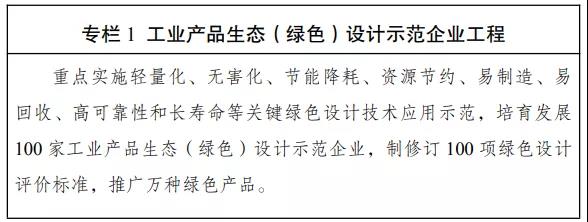
(4) Promote green design for industrial products. Improve the mechanisms for implementing green design in the industrial sector. Guide enterprises to refine and optimize product and packaging designs, thereby reducing the environmental impacts of products and packaging throughout their entire life cycle. In sectors with significant ecological and environmental impacts, broad product coverage, and high industry interconnectivity, establish demonstration enterprises for eco‑friendly (green) product design and explore industry‑specific pathways for green design. Strengthen the system of green‑design evaluation standards. Encourage industry associations to issue guidelines on green product design and disseminate best‑practice examples of green design.
(5) Accelerate the clean substitution of fuels and raw materials. Expand the promotion and application of clean energy, and increase the share of non‑fossil energy in industrial sectors. For industrial kilns and furnaces, captive coal‑fired power plants, and coal‑fired boilers that currently use coal, petroleum coke, heavy oil, residual oil, or semi‑coke as fuel, vigorously advance the replacement with clean, low‑carbon energy sources and industrial waste heat. Tailor measures to local conditions by implementing district‑level centralized heating models such as combined heat and power (CHP) with “one heat source per zone,” replacing small, scattered industrial coal‑fired boilers, reducing coal consumption, and achieving source‑level reductions in both air pollution and carbon dioxide emissions. Promote the substitution of hazardous substances with non‑hazardous alternatives; focusing on the raw and auxiliary materials required for production and on final products, reduce the use of chemicals listed in priority control lists and of persistent organic pollutants and other toxic and harmful substances. Encourage the use of low‑toxicity, low‑hazard, and non‑toxic, non‑harmful raw materials throughout the production process, lower the levels of toxic and harmful substances in finished products, and widely promote the use of inks, coatings, adhesives, and cleaning agents with low (or zero) volatile organic compound content.
(6) Vigorously advance clean and low‑carbon transformation in key industries. Strictly enforce laws, regulations, and standards related to quality, environmental protection, energy consumption, and safety, and accelerate the phase‑out of outdated production capacity. Conduct comprehensive clean‑production audits, evaluations, and certifications, and promote green transformation and upgrading—tailored to each industry—across priority sectors including energy, iron and steel, coking, building materials, nonferrous metals, petrochemicals, textile dyeing and printing, papermaking, chemical APIs, electroplating, agricultural and sideline food processing, industrial coating, and packaging and printing. Expedite systematic clean‑production upgrades for existing enterprises and industrial parks, focusing on energy conservation, water conservation, material efficiency, pollution reduction, and carbon emission cuts. On the basis of national unified planning, support eligible key industries in achieving peak carbon emissions ahead of others. Select 100 enterprises across the iron and steel, coking, building materials, nonferrous metals, and petrochemical sectors to implement clean‑production renovation projects, helping a number of leading enterprises reach internationally advanced levels of clean production.
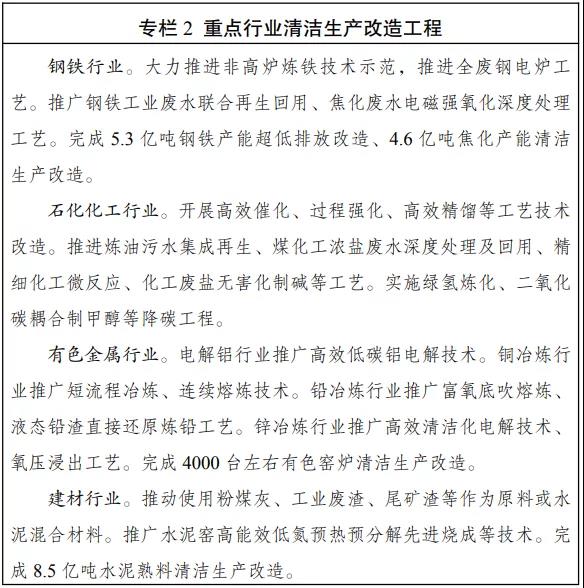
Steel industry: Vigorously advance demonstration projects for non‑blast‑furnace ironmaking technologies and promote the all‑scrap electric‑arc furnace process. Promote integrated wastewater regeneration and reuse in the steel industry, as well as advanced electromagnetic‑oxidation treatment for coking wastewater. Complete ultra‑low‑emission upgrades for 530 million tons of steel production capacity and clean‑production upgrades for 460 million tons of coking capacity.
III. Accelerate the Implementation of Clean Agricultural Production
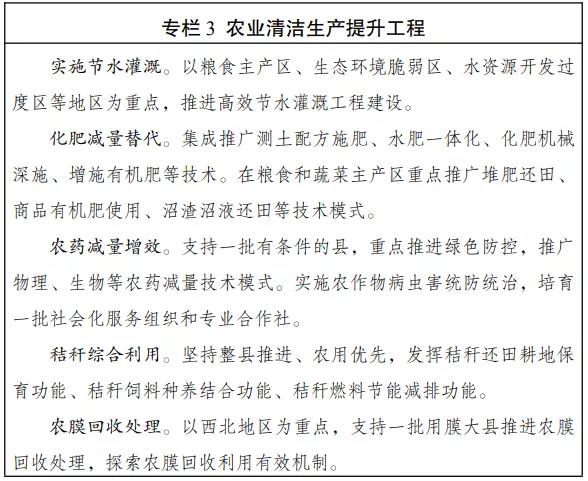
(7) Promote the reduction of agricultural input use. Strengthen oversight and management across all stages—production, distribution, and application—of agricultural inputs, ensuring their scientific and efficient utilization. Pesticide 、 Fertilizer Agricultural plastic mulch and feed additives help prevent the loss and residual accumulation of harmful substances, thereby reducing the input of agricultural production inputs. Major agricultural counties and cities are being organized to carry out pilot projects for comprehensive, green pest and disease management across the entire production cycle of fruits, vegetables, and tea, continuously increasing the coverage of green pest and disease control for major crops.
(8) Enhance the level of clean production in agriculture. Improve agricultural production technologies to establish efficient, clean farming practices. Strengthen management of irrigation water‑withdrawal plans, vigorously develop dryland farming, and comprehensively promote water‑saving technologies to continuously raise agricultural water‑use efficiency. Deepen soil testing and formula‑based fertilization, and widely adopt high‑efficiency fertilization methods such as side‑deep fertilization for rice. Fully disseminate healthy livestock‑raising techniques and encourage reductions in the use of veterinary antimicrobial agents. Accelerate the development of systems integrating crop cultivation, livestock and poultry farming, and… Aquaculture A clean production technology system for the aquaculture industry, with vigorous promotion of an integrated crop–livestock–processing development model.
(9) Strengthen the resource‑based utilization of agricultural waste. Improve the system for collecting, storing, and transporting straw, and actively promote its comprehensive utilization. Enhance management of agricultural mulch films, popularize standardized mulch films, and advance mechanized collection, specialized recycling, and resource‑based utilization, thereby effectively mitigating white pollution in farmland. Tailor approaches to local conditions—such as composting and returning decomposed material to fields, producing organic fertilizers, generating biogas and biomethane—and intensify efforts to harness livestock and poultry manure as a resource. In major grain‑producing areas and regions with significant livestock and poultry operations… Aquaculture In areas rich in agricultural waste resources—such as prime livestock‑raising zones, key facilities‑agriculture regions, and specialized agricultural product production areas—as well as in the peripheral zones of major river basins and reservoirs, including Dongting Lake, Danjiangkou Reservoir, Taihu Lake, and Wuliangsuhai, we will vigorously promote clean agricultural production and develop a number of exemplary cases that can be widely disseminated and replicated.
IV. Actively Promote Cleaner Production in Other Sectors
(10) Promote clean production in the construction industry. Continuously raise energy efficiency standards for new buildings, accelerate the large-scale development of ultra‑low‑energy, nearly zero‑energy, and low‑carbon buildings, and advance energy‑saving retrofits of existing urban buildings and municipal infrastructure. Expand the use of renewable energy in buildings and promote the electrification and decarbonization of building energy consumption. Strengthen source‑level control of construction waste and implement green construction practices throughout the entire project lifecycle. Encourage the use of recycled aggregates and recycled building materials to facilitate the resource‑based utilization of construction waste. Incorporate dust‑pollution prevention and control at housing construction and municipal engineering sites into the scope of clean production management for the construction sector.
(11) Promote clean production in the service sector. Taking clean production as a key lever, we will strive to raise the greenness of urban services. Service‑oriented enterprises—including those in catering, entertainment, accommodation, warehousing, wholesale, and retail—should adhere to the principles of clean production, adopt energy‑saving, water‑saving, and other environmentally friendly technologies and equipment, improve service procedures, and reduce the use of single‑use items. We will advance measures to ban or restrict single‑use plastic products in hotels and other similar establishments. Water consumption in high‑water‑intensive service sectors such as bathhouses, golf courses, and artificial ski resorts will be strictly controlled, with priority given to the use of reclaimed water, rainwater, and other non‑conventional water sources. Circular water‑use technologies and processes will be comprehensively promoted. In addition, we will strengthen the control of cooking fume emissions and promote the resource‑based utilization of food waste.
(12) Strengthen clean production in the transportation sector. Continuously optimize the transport structure, accelerate the development of an integrated, multi‑modal transportation network, increase the share of rail and waterway transport in the overall transport mix, and steadily reduce energy consumption and carbon dioxide emission intensity per unit of transport. Vigorously promote efficient transport modes such as intermodal transport, drop‑and‑hook operations, and collaborative delivery to enhance operational efficiency. Advance the development of smart transportation and encourage low‑carbon travel options. Intensify the deployment of new and clean energy sources in the transportation sector, expedite the green upgrading of inland vessels, and prioritize waters surrounding drinking water source areas by promoting the use of LNG‑powered, all‑electric, and other new‑ and clean‑energy vessels. Actively promote and apply energy‑saving and environmentally friendly technologies and products, including warm‑mix asphalt, intelligent ventilation systems, auxiliary power replacement, energy‑efficient lighting, and noise barriers.
V. Strengthening Technological Innovation in Cleaner Production and Fostering Related Industries
(13) Strengthen science and technology innovation as a driving force. Enhance both fundamental research and applied, innovative research in the field of clean production. Focusing on areas such as green product design, clean, efficient, low‑carbon, and safe energy utilization, wastewater resource recovery, water‑saving irrigation control in agriculture, synergistic reduction of multiple pollutants, and the resource utilization of solid waste, we will achieve breakthroughs in a number of core, critical technologies and develop a suite of major technological equipment.
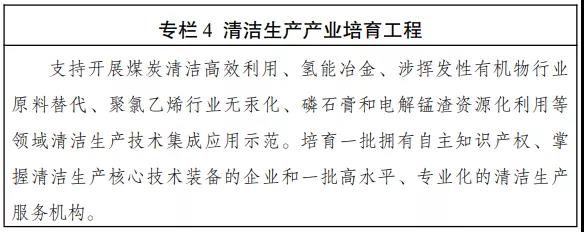
(14) Promote the industrialization of clean production technologies and equipment. Actively guide and support enterprises in developing clean production technologies and equipment with independent intellectual property rights, with a focus on enhancing supply capacity. Leverage the role of relevant associations and alliances as platforms to vigorously advance the application of clean production technologies and equipment—covering source reduction, process control, and end-of-pipe treatment—and accelerate the industrialization of key, cross‑cutting clean production technologies and equipment.
(15) Vigorously develop the clean production services sector. Innovate clean production service models and explore the establishment of a performance‑based payment mechanism for clean production services. Accelerate the development of a standardized market for clean production consulting services, encouraging competitive third‑party clean production service providers to offer users one‑stop, integrated solutions encompassing consulting, auditing, evaluation, certification, design, and retrofitting. Explore the establishment of a liability‑traceability mechanism for third‑party service providers and strengthen the clean production technology service system.
VI. Deepening Innovation in the Implementation Models of Cleaner Production
(16) Innovate the management model for clean production audits. Encourage localities to explore and implement a tiered management approach for enterprise clean production audits: rigorously conduct clean production audits for enterprises with high energy, water, and emissions consumption, as well as those whose production, use, or emissions involve chemicals listed in the Priority Control Chemicals Catalog; for other enterprises, audit procedures may be appropriately streamlined. Promote voluntary clean production assessment and certification; entities that pass such assessments and meet the requirements of clean production audits shall be deemed to have completed the audit. Actively facilitate the effective integration of clean production audits with other regulatory systems, including energy‑conservation reviews, energy‑conservation inspections, environmental impact assessments, and pollutant discharge permits. Encourage regions with suitable conditions to launch pilot programs for comprehensive audits at the industry, industrial park, and industrial cluster levels. Study the incorporation of carbon‑emission indicators into the clean production audit framework.
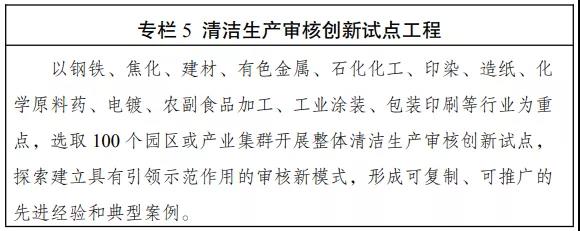
(17) Explore regionally coordinated promotion of cleaner production. As part of major regional development strategies such as the Beijing–Tianjin–Hebei Coordinated Development Initiative, establish a collaborative mechanism for advancing cleaner production, standardize evaluation, certification, and auditing requirements, jointly promote relevant technologies, and coordinate efforts to upgrade key industries toward cleaner production. In regions including Beijing–Tianjin–Hebei and its surrounding areas, the Fenwei Plain, the Yangtze River Delta, the Pearl River Delta, and the Chengdu–Chongqing region, prioritize clean‑production upgrades in sectors such as steel, petrochemicals, coking, packaging and printing, and industrial coating, thereby advancing the synergistic control of fine particulate matter (PM2.5) and ozone (O3). In river basins such as the Yangtze and Yellow Rivers, focus on implementing clean‑production transformations in industries including papermaking, textile dyeing, chemical APIs, and agricultural and sideline food processing, with the aim of reducing emissions of ammonia nitrogen and phosphorus pollutants.
VII. Organizational Support
(18) Strengthen organization and implementation. The National Development and Reform Commission shall enhance organizational coordination, fully leverage the inter‑departmental coordination mechanism for promoting cleaner production, and advance the implementation of this plan. The Ministry of Ecology and Environment, the Ministry of Industry and Information Technology, the Ministry of Science and Technology, the Ministry of Finance, the Ministry of Housing and Urban–Rural Development, the Ministry of Transport, the Ministry of Agriculture and Rural Affairs, the Ministry of Commerce, and the State Administration for Market Regulation shall, in accordance with their respective functions, ensure the effective execution of key tasks. Local governments shall assume primary responsibility, intensify efforts to encourage and promote cleaner production, identify region‑specific priority tasks based on local conditions, and formulate concrete measures for implementation.
(19) Improve laws, regulations, and standards. Promote the revision of the Law on the Promotion of Cleaner Production, strengthen alignment and coordination with relevant laws and regulations, and reinforce the rights and obligations of all relevant stakeholders. Encourage localities to formulate region-specific regulations that promote cleaner production, tailored to their own circumstances. Establish and refine a comprehensive standards system for cleaner production; organize the revision of the general provisions for developing the cleaner production evaluation indicator system; and conduct research to develop administrative measures for managing group standards on cleaner production. Compile and publish a catalog of advanced technologies for cleaner production.
(20) Strengthen policy incentives. Fiscal authorities at all levels should proactively explore effective measures to support clean production. In accordance with the law, they should implement and refine tax preferential policies related to energy and water conservation, environmental protection, and comprehensive resource utilization; enhance green‑finance support; and guide enterprises to increase investment in clean production. Efforts should be intensified to leverage the outcomes of clean‑production audits, assessments, and certifications, using them as a key basis for formulating and implementing differentiated policies—such as tiered electricity pricing, water‑use quotas, and performance‑based management during periods of severe pollution. A sound incentive system for clean production should be established, under which units and individuals that achieve outstanding results shall be commended and rewarded in accordance with relevant national regulations.
(21) Strengthen basic capacity building. Promote the development of an information-based public service platform for cleaner production. Leverage provincial-level cleaner production centers or relevant social organizations to enhance local capacities in this area. Encourage the establishment of a pool of cleaner production experts and the implementation of multi‑tiered training programs. Conduct in-depth publicity and education campaigns on cleaner production, actively foster a favorable societal environment in which all sectors jointly embrace cleaner production, and advance the adoption of green production and consumption patterns.
Source: National Development and Reform Commission Author: National Development and Reform Commission
Tags:
More information
Contact Us
Address:
No. 1, No. 1, New District Road No. 1, Gaocheng District, Shijiazhuang City, Hebei Province
WeChat/WhatsApp:
Phone:
Email:
