


-
About UsHebei Derui Chemical Co., Ltd. (hereinafter referred to as Derui Chemical) was established in January 2006 with a registered capital of RMB 51.8 million. The company specializes in the production and sale of agrochemicals, with its main products including thiamethoxam technical grade, imidacloprid technical grade, spirotetramat technical grade, and related formulated products.

-
Product CenterThe company is committed to building and continuously improving its management systems, and in 2020 it obtained certifications under GB/T 19001-2016/ISO 9001:2015, GB/T 24001-2016/ISO 14001:2015, and GB/T 45001-2020/ISO 45001:2018. Derui Chemical has consistently upheld the corporate mission of “pursuing green development and serving global agriculture,” while adhering to the core values of “integrity, innovation, pragmatism, and gratitude.” The company is eager to collaborate with its partners to contribute to the advancement of global agriculture.
-
BlogThe company places great emphasis on standardized management and sustainable development, successfully obtaining certification for its three major management systems—quality, environment, and occupational health and safety—in 2020. These certifications align with GB/T 19001-2016/ISO 9001:2015, GB/T 24001-2016/ISO 14001:2015, and GB/T 45001-2020/ISO 45001:2018. Derui Chemical remains committed to its corporate mission of promoting green development and serving global agriculture, upholding the core values of “integrity, innovation, pragmatism, and gratitude.” We look forward to partnering with stakeholders from all sectors, pooling our strengths, and advancing together to support the steady growth of global agriculture.

The Story of Expanding the Jianghuai Granary
Release Date:
2024-11-22
With the rice harvested and wheat seeds sown, the Jianghuai region in November presents a heartwarming scene of people busily working to “grow more grain and grow it well.”
During his inspection tour of Anhui this October, General Secretary Xi Jinping emphasized the need to build a modern grain industry system, production system, and management system; to advance high-standard farmland construction in a solid and steady manner; to develop the Jianghuai Granary; and to shoulder the responsibility of ensuring food security.
As a major grain-producing province, Anhui has continuously advanced the development of the Jianghuai Granary, implementing initiatives to promote high-quality farmland, superior seed varieties, advanced agricultural machinery, sound farming practices, robust supply chains, and empowered farmers, thereby firmly shouldering its responsibility to ensure food security.
This year, Anhui’s autumn grain harvest is already assured, and the total summer grain output has reached a new record high. Notably, over 80 percent of the wheat acreage is dedicated to high-quality, specialty varieties, helping the Jianghuai granary steadily expand its capacity and ensuring that “China’s bowl” holds more premium grain.

Plug in Wings of Technology
Rice yields exceeded 940 kilograms per mu! In Xiatang Town, Changfeng County, Hefei City, large-scale grain farmer Meng Xiangbao, basking in a bumper harvest, said with a smile that after more than a decade of farming, this year’s yield is the highest yet.
“In the past, farming relied on experience; today, it depends on technology—agricultural experts have been a tremendous help,” said Meng Xiangbao, summing up the “secret” to higher yields. His plot lies within the provincial-level demonstration field for green, high‑quality, high‑efficiency grain production in Changfeng County, where Professor Wu Liqian of Anhui Agricultural University, as head of the expert advisory team, provides hands‑on technical guidance.
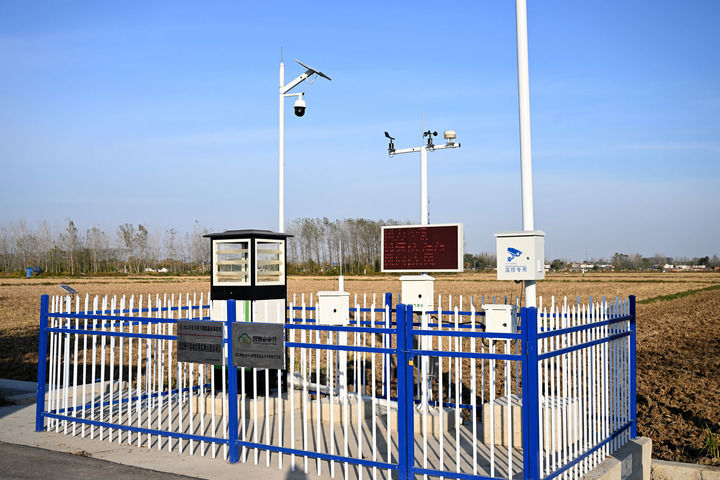
A smart agricultural monitoring facility at the field of large-scale grain farmer Meng Xiangbao, photographed on November 7, 2024, in Xiatang Town, Changfeng County, Hefei City, Anhui Province. Photo by Xinhua News Agency reporter Huang Bohan.
Increasing the number of basic seedlings per unit area and implementing targeted fertilizer and water management—Wu Li-quan meticulously outlined the key technical points of rice production. He noted that, in recent years, this technological approach has been deployed at multiple sites across rice-growing regions such as the Jianghuai area, yielding demonstration plots of over 100 mu with yields exceeding 900 kilograms per mu, thereby underpinning substantial increases in average rice yields across large acreages.
Ensuring that agricultural science and technology take root in the soil. Anhui has formulated and issued a series of technical guidelines to ensure stable and high yields, leveraging the provincial agricultural industry‑technology system and more than 13,000 grassroots agricultural extension workers to help farmers improve the adoption rate of key technologies, thereby ensuring that high‑yielding and productivity‑boosting practices are effectively implemented and deliver tangible results.
“Our primary focus is on stabilizing acreage, boosting yields, and enhancing profitability, while accelerating the development of the Jianghuai grain-producing region with an annual output of 100 billion jin,” said Pan Xin, Deputy Director of the Anhui Provincial Department of Agriculture and Rural Affairs.
While leading with science and technology, Anhui is also spearheading demonstration projects. The province is focusing on the independent innovation,成果转化 (translation and application), and integrated deployment of “four new” technologies—new grain varieties, new techniques, new models, and new equipment—accelerating the widespread adoption of advanced, practical technologies from isolated pilot initiatives to comprehensive, region-wide implementation. By leveraging its strengths in scientific and technological innovation, Anhui is continuously breaking new ground in grain production capacity.
Expanding grain storage capacity also hinges on achieving balanced, area-wide improvements through a targeted, point‑to‑area approach. This year, Anhui Province has allocated nearly 100 million yuan to further strengthen the construction of 25 jointly built command fields at the provincial, municipal, and county levels, as well as 125 demonstration sites for intensive, precision farming, concentrating resources on developing high‑quality, high‑yield model plots to drive widespread, balanced yield increases.
High yields require advanced techniques, as well as the right timing.
At the Huayanghe Farm Co., Ltd. of Anhui Provincial Agricultural Reclamation Group, located along the Yangtze River, this year marked the first-ever demonstration of mechanized rice transplanting and mechanical broadcasting on 3,500 mu of land. Compared with traditional direct seeding, yields per mu increased by nearly 150 kilograms. According to Yang Junsheng, the company’s deputy general manager, the adoption of advanced agricultural machinery such as precision broadcasters has delivered comprehensive benefits, including higher productivity; not only has the amount of seed required been reduced, but rice’s resistance to pests and diseases has also improved significantly.
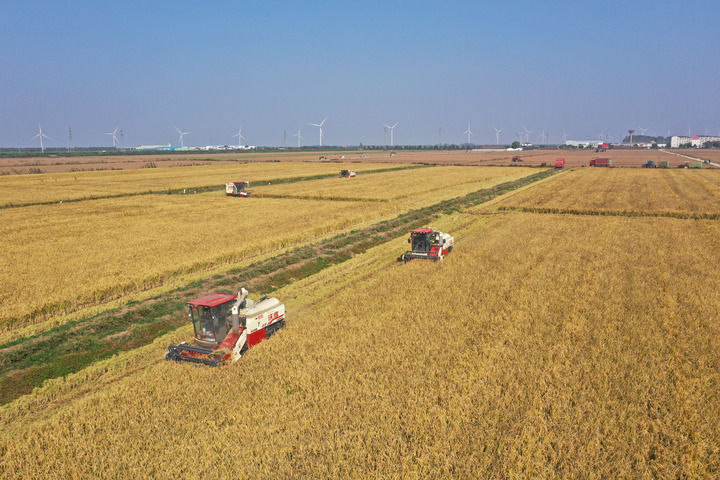
On November 2, 2024, a harvester reaps rice in the mechanized rice-transplanting demonstration field of Huayanghe Farm Co., Ltd., part of Anhui Provincial Agricultural Reclamation Group (drone photo). Xinhua News Agency.
Build digital farms to enable real-time monitoring of field management; strengthen the agricultural technology system and establish science-and‑technology demonstration stations focused on grain production; and vigorously advance the research, development, and deployment of medium- and large‑scale intelligent machinery as well as compact, lightweight equipment…
Anhui has seen a steady increase in the technological content of its agricultural sector. Last year, the contribution of agricultural scientific and technological progress reached 66.5%, about 3.3 percentage points above the national average. Meanwhile, the comprehensive mechanization rate for major crops stood at 85%, roughly 10 percentage points higher than the national average.

Unleash the momentum of reform
“In the past two years, farming has become much easier,” said Wang Jin, a large-scale grain farmer who has been leasing land in Zhouqiao Village, Hongyang Town, Wanzi District, Wuhu City, for 18 years.
In 2022, the 1,400 mu of farmland in Zhouqiao Village was consolidated through land‑consolidation measures—combining small plots into larger ones, short fields into longer ones, and straightening curved sections—transforming fragmented “palm‑sized” plots into neatly organized “large fields.” Local authorities also redesigned the farm roads and irrigation channels.
Wang Jin said, “With reduced machinery costs for plowing and harvesting and an increase in the area under effective cultivation, each mu of land now yields about 75 kilograms more grain than in previous years.”
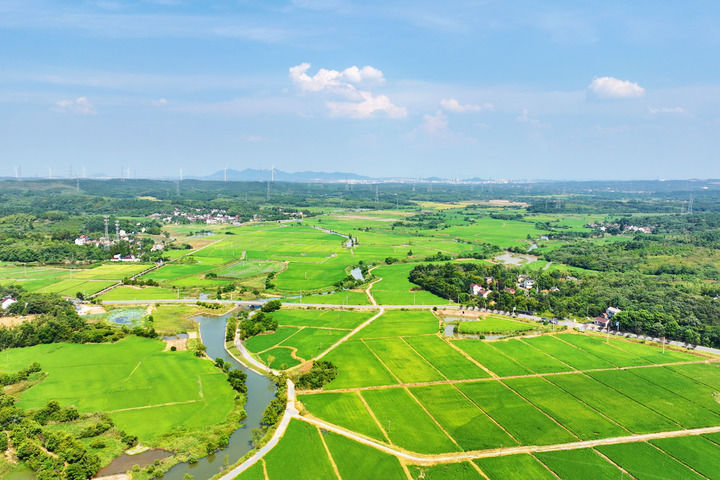
Rice paddies in Hongyang Town, Wanzi District, Wuhu City, Anhui Province, captured on August 9, 2024 (drone photo). Xinhua News Agency (Photo by Wu Qiong).
Jia Xianlan, deputy director of the Hongyang Town Agricultural Comprehensive Service Center, told reporters that, thanks to projects such as high-standard farmland development, formerly hilly and undulating plots have been leveled, making them highly sought after by large-scale grain growers. As a result, these farmers are more eager to lease their land, and both its productivity and economic returns have increased.
As the primary birthplace of China’s rural reform, Anhui has continuously deepened its rural reforms. In recent years, it has steadily advanced the improvement of high-quality farmland, having now built approximately 64 million mu of high-standard farmland—nearly 80 percent of its total cultivated land. The constraints posed by fragmented land holdings, which have long hindered large-scale operations, are gradually being addressed, and the “separation of three rights” reform for rural land is being carried out in depth. As of September this year, the province’s farmland transfer rate has reached 63.2 percent.
The Third Plenary Session of the 20th CPC Central Committee proposed to improve and strengthen a convenient, efficient agricultural socialized service system. In recent years, Anhui Province has consistently regarded agricultural socialized services as a key lever for refining the basic rural operating system and transforming the mode of agricultural development, resulting in a favorable trend characterized by diversified actors, vigorous competition, and rapid expansion of agricultural socialized service organizations.
In Fengtai County, Huainan City, the Yuezhangji Town Agricultural Socialized Services Alliance was established in 2020. As a member of the alliance, Xu Huaibiao, chairman of the Fengtai County Huaibiao Agricultural Machinery Service Professional Cooperative, together with four other cooperatives in the township, provides services to 15,000 mu of high-quality farmland.
“On 15,000 mu of land, two or three rice varieties are planted, and fertilizers and agrochemicals are procured centrally. Farmers can opt for full‑service management or entrust specific stages—such as tillage, planting, field management, and harvesting—while the harvested grain remains in the farmers’ possession and they retain control over sales,” said Xu Huaibiao. Compared with traditional small‑scale, individual farming, integrating into large‑scale modern agriculture and leveraging collective, extensive management not only cuts labor and input costs but also boosts per‑mu grain yields by nearly 100 kilograms.
Agricultural socialized service organizations are also expanding. Last year, Anhui Province had 56,000 such organizations, providing entrusted management services across 250 million mu of farmland and serving 4.6 million smallholder households.
Improving the agricultural management system is inseparable from fostering and developing agricultural operators.
On the eve of the autumn planting season, the Large-Scale Grain Growers Association of Taihe County, Fuyang City, conducted technical training sessions for its members, organized by geographic area. President Xu Congxiang stated that since the association’s establishment in 2022, it has set up local councils in each township and village, guiding large-scale grain growers to establish hundred‑mu demonstration plots and thousand‑mu model fields. “Through fully mechanized farming, standardized production, contract‑based sales, and industrialized development, we serve as a model for farmers and work alongside them, helping more large-scale grain producers grow and thrive,” he said. He added that the association now counts nearly one thousand member households.
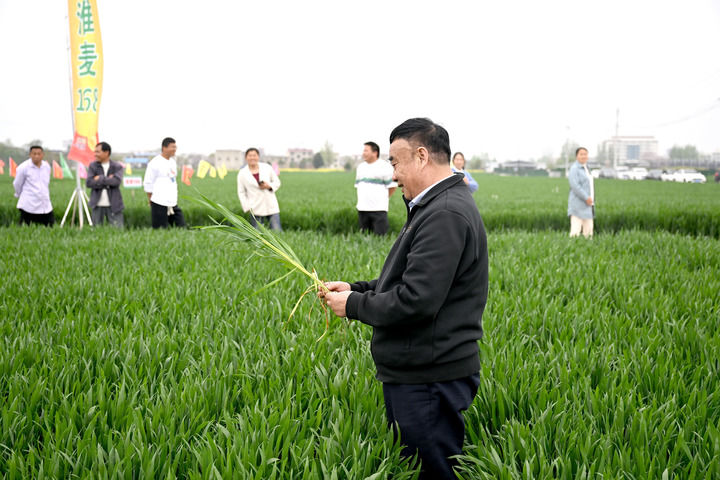
On April 11, 2024, large-scale grain farmers affiliated with the Tahe County Grain Growers Association in Fuyang City, Anhui Province, visited the demonstration field of Xu Congxiang (front). Photo by Xinhua News Agency reporter Huang Bohan.
To ensure the smooth implementation of reforms and accelerate the development of the Jianghuai Granary, Anhui has introduced a series of concrete measures, including strengthening agricultural subsidy policies and substantially increasing investment in high-standard farmland construction. Since the beginning of this year, the province has allocated 10.6 billion yuan for subsidies to protect arable land fertility and for the purchase of agricultural machinery. Additionally, 340 million yuan has been earmarked—up 37.2% year on year—to encourage large-scale grain producers to help small farmers grow more grain and produce higher‑quality crops.

Do a good job of strengthening the industrial chain.
In early winter, the new season’s rice seeds have already been harvested. Zhou Hongying, deputy director of the Rice Research Institute at Hefei Fengle Seed Industry Co., Ltd., is busy in the laboratory conducting seed evaluations and analyzing the factors that determine yield.
High-temperature stress has become a major threat to the yield of medium‑grain indica rice in recent years. This year, the new variety she spearheaded developed combines high yield, excellent grain quality, disease resistance, and heat tolerance, achieving a commendable yield of over 800 kilograms per mu.
In recent years, Fengle Seed Industry, where Zhou Hongying works, has partnered with seven institutions, including the Chinese Academy of Rice Research, to establish the Joint Rice Breeding and Innovation Institute. “Under this collaborative breeding framework, we have achieved several breakthroughs. For example, a new late-season rice variety—developed three years ago and endowed with both lodging resistance and exceptionally high yield potential—has received national approval, delivering about 100 kilograms more per mu than conventional varieties. Currently, it is cultivated across roughly 800,000 mu,” said Zhou Hongying.
Seeds are the “chips” of agriculture and the starting point of the food supply chain.
In its efforts to build a leading province in the seed industry, Anhui has vigorously implemented the Seed Industry Revitalization Initiative, accelerating the breeding, promotion, and renewal of new varieties. Data show that the coverage rate of improved varieties for grain crops across the province exceeds 98%, and this year, high-quality, specialty wheat accounted for approximately 85% of the total harvested area.
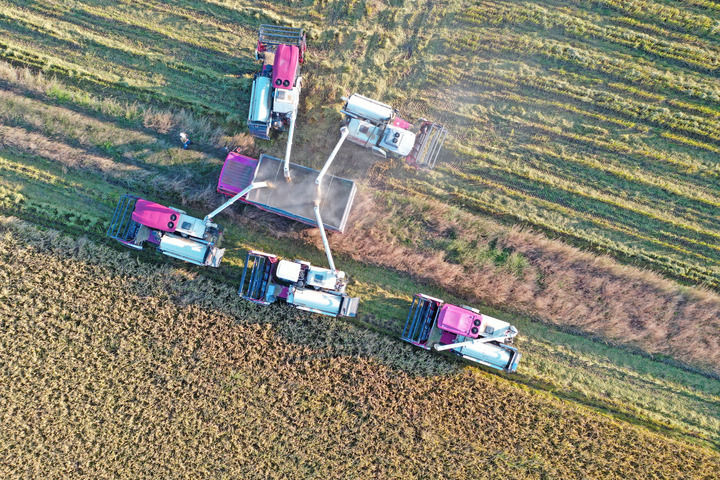
On October 23, 2024, a combine harvester reaps rice in the mechanized direct-seeding demonstration field of Huayanghe Farm Co., Ltd., Anhui Provincial Agricultural Reclamation Group (drone photo). Xinhua News Agency.
Strengthening the industrial chain is a key strategy for building the Jianghuai Granary.
A number of large-scale, high‑value grain processing projects are being implemented to build a green food industry cluster. By fostering leading enterprises and industrial consortia and promoting the integrated development of the grain sector, efforts are underway to establish complete, value‑added grain industry chains in major grain‑producing counties under the “One County, One Specialty” initiative. E‑commerce platforms are being developed through multiple channels, while distinctive cultural resources tied to grain are being tapped to cultivate new business models in the grain industry. At present, Anhui Province is coordinating the integrated development of the grain sector across the pre‑production, in‑production, and post‑production stages; scaling up leading enterprises; optimizing the layout of grain‑processing operators and storage facilities; and advancing the grain industry chain toward superior production, procurement, storage, processing, and marketing.
At Anhui Zhongyu Food Co., Ltd. in Funan County, Fuyang City, within its dedicated flour-processing workshop capable of handling 300,000 tons of high-quality wheat annually, two production lines are operating around the clock without interruption.
General Manager Wang Shijie stated that, at present, projects for the deep processing of high-quality wheat—such as protein‑powder extraction, erythritol production, and protein‑based animal feed—are being rapidly advanced, leveraging local and surrounding premium wheat resources. In the future, this site will develop a comprehensive wheat industry chain encompassing cutting‑edge breeding, contract farming, primary processing, and advanced value‑added processing.
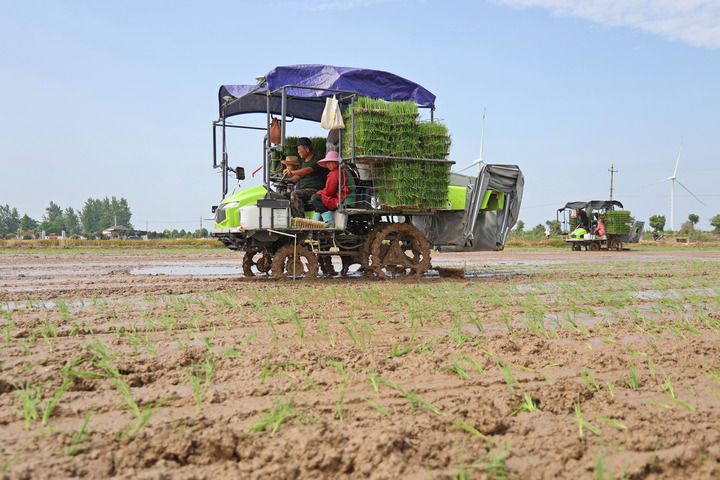
On June 12, 2024, at Huayanghe Farm Co., Ltd. of Anhui Provincial Agricultural Reclamation Group, workers carried out machine-transplanted rice seedlings. Xinhua News Agency photo.
Anhui has continued to implement policies such as the High-Quality Grain Project, the Grain Risk Fund, and preferential agricultural electricity rates, striving to build a modern grain industry system and gradually establishing a development pattern characterized by “leading enterprises + industrial clusters + grain production bases.” In the first three quarters of this year, the province’s grain and oil processing output value reached 224.3 billion yuan, up 7.8% year on year.
After a winter rain, tender green wheat seedlings are thriving across the Jianghuai Plain; in processing workshops, one “Anhui Good Grain and Oil” product after another is freshly produced… Grounded in the present and looking to the future, China’s confidence in filling its “Chinese bowl” with high-quality grain is growing stronger.

Text reporters: Jiang Gang, Shui Jinchen
Video Reporter: Jin Jian
Poster Design: Qian Cheng
Coordinated by: Xu Man, Wang HuaJuan, Fang Sixian, and Wang Wenyuan
[Editor-in-charge: Shi Ge]
Source: Xinhua News Agency
Tags:
More information
Contact Us
Address:
No. 1, No. 1, New District Road No. 1, Gaocheng District, Shijiazhuang City, Hebei Province
WeChat/WhatsApp:
Phone:
Email:
