


-
About UsHebei Derui Chemical Co., Ltd. (hereinafter referred to as Derui Chemical) was established in January 2006 with a registered capital of RMB 51.8 million. The company specializes in the production and sale of agrochemicals, with its main products including thiamethoxam technical grade, imidacloprid technical grade, spirotetramat technical grade, and related formulated products.

-
Product CenterThe company is committed to building and continuously improving its management systems, and in 2020 it obtained certifications under GB/T 19001-2016/ISO 9001:2015, GB/T 24001-2016/ISO 14001:2015, and GB/T 45001-2020/ISO 45001:2018. Derui Chemical has consistently upheld the corporate mission of “pursuing green development and serving global agriculture,” while adhering to the core values of “integrity, innovation, pragmatism, and gratitude.” The company is eager to collaborate with its partners to contribute to the advancement of global agriculture.
-
BlogThe company places great emphasis on standardized management and sustainable development, successfully obtaining certification for its three major management systems—quality, environment, and occupational health and safety—in 2020. These certifications align with GB/T 19001-2016/ISO 9001:2015, GB/T 24001-2016/ISO 14001:2015, and GB/T 45001-2020/ISO 45001:2018. Derui Chemical remains committed to its corporate mission of promoting green development and serving global agriculture, upholding the core values of “integrity, innovation, pragmatism, and gratitude.” We look forward to partnering with stakeholders from all sectors, pooling our strengths, and advancing together to support the steady growth of global agriculture.

Financial Focus | Why Are Prices Rising? When Will They Stabilize? — An Insight into Current Vegetable Price Trends
Release Date:
2024-08-22
“Vegetable prices have surged to ‘New Year‑level’ highs,” “Cucumbers have jumped 150%,” “During peak periods, loofah and red peppers both reached 20 yuan per kilogram”... Recently, many netizens have reported on social media that prices for certain vegetables have risen sharply. A recent survey conducted by reporters in Beijing, Shandong, Guizhou, Hainan, and other regions found that a combination of factors—such as high temperatures and heavy rainfall—has driven up vegetable prices. However, once the short‑term, shock‑induced, seasonal effects subside, prices are expected to gradually stabilize.
Vegetable prices have risen more sharply than in the same period of previous years.
At Beijing’s Xinfadi Agricultural Products Wholesale Market, the reporter observed rows of refrigerated trucks and box vans with their rear doors wide open, displaying neatly stacked bundles of vegetables. “Baby bok choy used to sell for 80 cents per jin, but this month it’s risen to over four yuan,” said vendor Ms. Wang. The baby bok choy she sources comes from Xianghe in Hebei; heavy rains there have not only slashed yields but also made procurement more challenging.
A responsible official at the Xinfadi Market told reporters that on August 19, the weighted average wholesale price of vegetables at the market was 4 yuan per kilogram, up 37.93% from last month and 28.21% year-on-year. According to statistics, prices in mid-August this year reached their highest level for the same period in the past five years.
In traditional summer and autumn vegetable-producing regions such as the Huanghuaihai Plain, the middle and lower reaches of the Yangtze River, and the Bohai Rim area, vegetable prices have also risen. According to the monthly assessment of the Shouguang Agricultural Products Logistics Park’s vegetable index, seven out of the ten major vegetable categories monitored in July recorded price increases. During the week of August 12–18, nine of the ten major vegetable categories tracked saw price hikes, with the most pronounced gains observed in cabbage, beans, leafy greens, and aquatic vegetables.
At a supermarket in Anqing, Anhui Province, many residents were shopping in the produce section. Ms. Wang told reporters that vegetable prices have risen overall over the past two weeks, with particularly sharp increases for fresh leafy greens such as spinach and Shanghai green.
From May to October each year is the off-season for vegetable production in Hainan. With limited local output, supplies must be brought in large quantities from outside the island. “This year, excessive rainfall in the major vegetable-producing provinces has dampened yields, further driving up prices; currently, the average purchase price of various vegetables has risen by 1 to 1.5 yuan per jin,” said Chen Jianhua, head of the farm‑base division at Haikou City Vegetable Basket Food Engineering Co., Ltd.
According to data from the National Bureau of Statistics, in July, fresh vegetable prices rose 9.3% month-on-month and 3.3% year-on-year. Meanwhile, the Ministry of Agriculture and Rural Affairs reported that the national wholesale price index for “vegetable basket” products increased from 111.57 on June 20 to 134.11 on August 20, a rise of 20.2%; the average price of the 28 key monitored vegetable varieties climbed from 4.32 yuan per kilogram to 6.09 yuan per kilogram, an increase of 40.97%.
Multiple factors combined to drive up vegetable prices.
Historically, vegetable prices have exhibited seasonal fluctuations. During July and August, hot, rainy weather typically hampers the growth of field-grown vegetables, causing prices to trend upward at this time of year.
Why have vegetable prices risen more sharply this year?
Extreme weather is a major factor. Zhang Jing, an associate researcher at the Institute of Agricultural Information of the Chinese Academy of Agricultural Sciences, explained that this summer, China experienced above‑average rainfall overall. Provinces such as Hunan, Shandong, Sichuan, and Anhui saw heavy downpours, thunderstorms, and strong winds—typical severe convective weather—and some areas were even hit by flooding, disrupting local vegetable production, harvesting, and transportation to markets.
Adverse weather has severely affected many vegetable growers. “This summer’s extreme heat, high humidity, and other volatile conditions have led to a surge in pests and diseases, resulting in lower vegetable quality and a corresponding drop in yields,” said Zhang Chunbao, head of the Chenglin Vegetable Professional Cooperative in Shouguang City, Shandong Province.
Xin Dengqing, a vegetable farmer from Xinjiaqiao Village in Hualong Town, Shouguang, who has more than a decade of experience in vegetable cultivation, told reporters that frequent rainfall combined with sustained high temperatures has resulted in poorer growth compared to previous years. To mitigate the impact of the heat, he has installed shade nets and cooling agents on the greenhouse films, which has helped reduce heat‑related damage but also increased production costs.
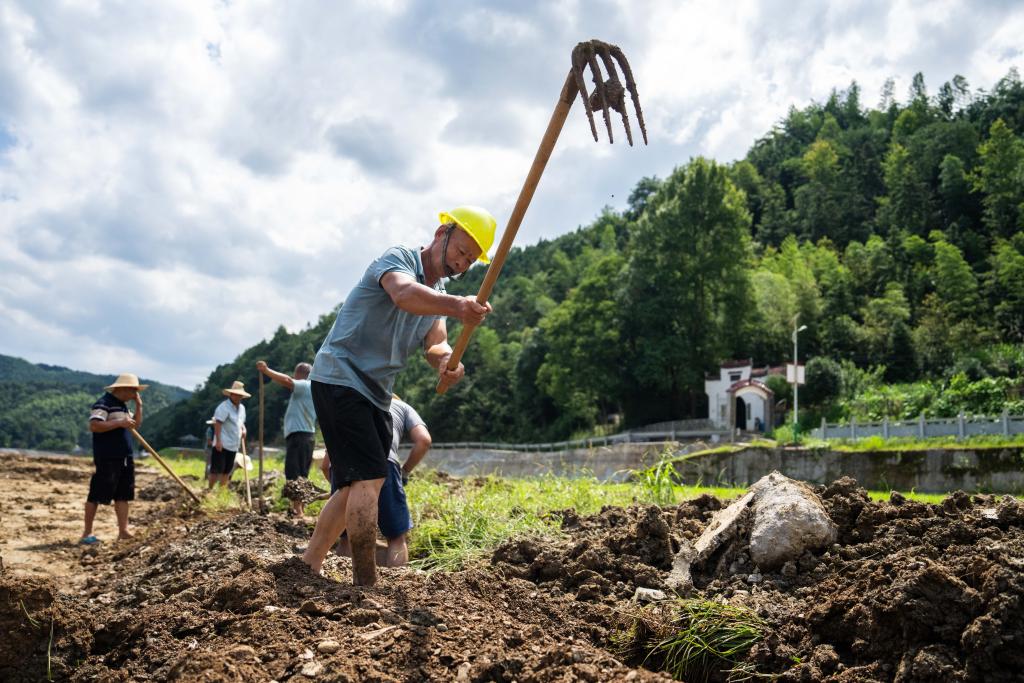
On July 5, in Zhoufang Village, Jiayi Town, Pingjiang County, Hunan Province, villagers were clearing silt from agricultural canals. Photo by Xinhua News Agency reporter Chen Sihan.
High temperatures and prolonged heavy rainfall have not only reduced vegetable yields but also compromised vegetable quality, while increasing harvesting difficulties and storage‑preservation costs. Moreover, China’s vegetable production and consumption regions are relatively geographically separated, and interregional transportation further drives up logistics expenses.
“The leading vegetable-producing provinces account for a substantial share of the national supply. This summer, severe rainfall and other adverse weather conditions have disrupted the inter‑regional distribution of vegetables, particularly fresh leafy greens, driving up procurement and logistics costs and, in turn, temporarily pushing up retail vegetable prices,” said Guo Liyan, deputy director of the Institute of Economics at the China Academy of Macroeconomic Research.
However, industry insiders point out that this year’s rise in vegetable prices differs from earlier market‑driven price‑manipulation episodes such as the “Ginger You Jun” and “Garlic You Hen” phenomena. Fresh leafy vegetables face high cold‑storage and cold‑chain costs and significant spoilage rates; moreover, with local governments firmly enforcing the “vegetable basket” mayoral accountability system, the legal penalties for price gouging and hoarding are substantial, making speculative price‑manipulation by capital unlikely.
Prices are expected to gradually stabilize.
What will be the future trend of vegetable prices? Industry analysts point out that vegetables have relatively short growth cycles. As the short-term, shock‑induced and seasonal factors subside, vegetable production in areas previously hit by disasters is gradually recovering, and crops that were delayed in coming to market are now being released steadily. Consequently, market supply is expected to continue rising, and prices should gradually stabilize.
According to data from the Ministry of Agriculture and Rural Affairs, the nationwide area under vegetable cultivation currently stands at 106 million mu, up 900,000 mu year on year, remaining at a relatively high level for the year, thereby providing a solid foundation for stable production and supply.
“Although seasonal price increases persist and some varieties may face disruptions in supply-chain transitions, cooler-season vegetables in northern regions as well as in mountainous and plateau areas are gradually entering their peak harvest period, ensuring ample market supply. As a result, we expect limited room for further increases in vegetable prices,” said Zhang Jing.
Shanghai has organized vegetable production bases to strengthen field management and harvesting operations, rushing to plant heat-tolerant, fast-growing vegetables such as choy sum and amaranth. Meanwhile, Beijing has coordinated major wholesale markets like Xinfadi to further expand supply channels and urged large chain supermarkets and direct‑supply enterprises to ramp up direct procurement from production bases. From the production front end to the retail last mile, localities across the country are taking a multi‑pronged approach to stabilize residents’ “vegetable baskets.”
Shouguang in Weifang, Shandong Province, is a major national base for vegetable production and a key distribution hub. At the Shouguang Agricultural Products Logistics Park, activity is already in full swing by 3 a.m. Tomatoes, cucumbers, Chinese cabbage, celery, zucchini, and other vegetables from Hebei, Inner Mongolia, Ningxia, Shanxi, Shaanxi, and the Northeast are traded here, with daily turnover currently around 6,000 tons.
“To cope with the heat, we’ve accelerated our procurement and shipment cycles, reducing the time vegetables spend at the market. At the same time, to keep vegetable prices stable, the logistics park has been stepping up efforts to better align production with sales and enhance vegetable distribution, employing measures such as reallocating supplies from nearby areas and increasing the share of shelf‑stable varieties, ensuring that residents across the region can fill their “vegetable baskets” with greater confidence,” said Wang Haitao, a member of the Party Leadership Group of the Shouguang Municipal Bureau of Commerce.
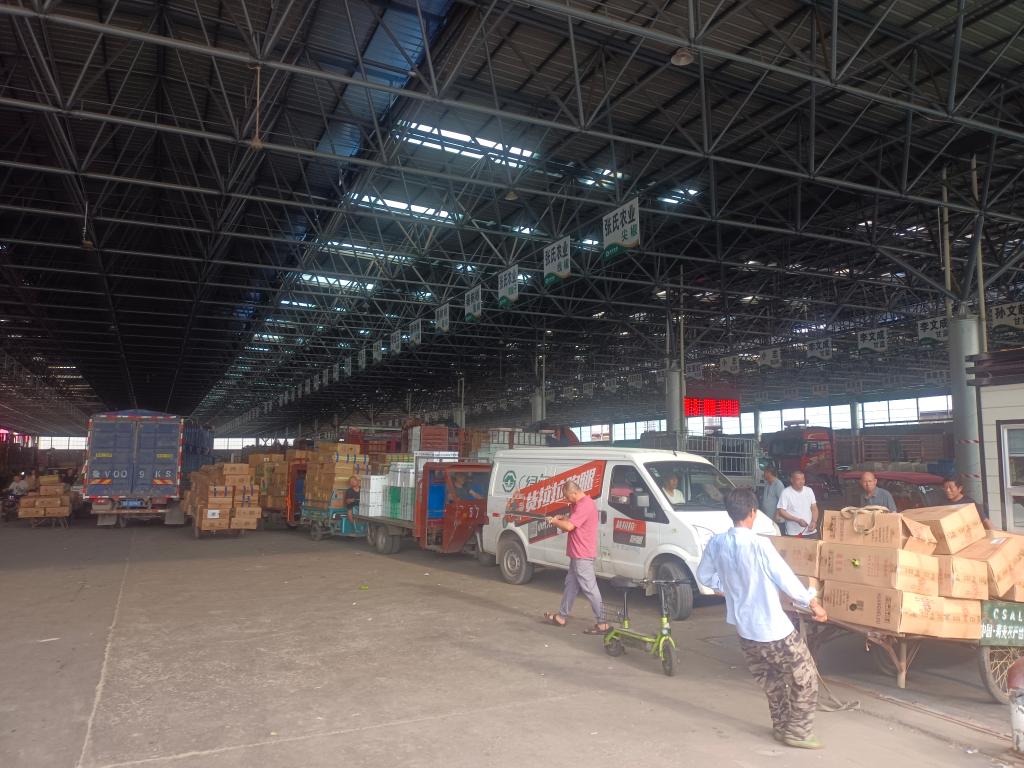
At the Shouguang Agricultural Products Logistics Park in Shandong, staff members are hard at work. (Photo provided by the interviewee.)
In Wening County, Guizhou Province, large-scale vegetable farmer Liu Zhizheng is busy shipping 20 tons of cabbage to Chengdu, Sichuan. “At elevations above 2,000 meters, our region is well-suited for growing out-of-season vegetables. The produce we’re harvesting now is shipped directly to other provinces—cabbage and pea shoots, for instance, are mainly sent to Sichuan and Chongqing, while red stem mustard is supplied to Shanghai, Beijing, Xi’an, Wuhan, and other cities,” Liu said.
An official from the Ministry of Agriculture and Rural Affairs stated that, in response to recent adverse weather conditions, the “vegetable basket” mayoral responsibility system will be firmly implemented and strengthened. This includes appropriately adjusting the structure of vegetable varieties, optimizing planting scales and timing of market releases, guiding major production areas and large and medium-sized cities to further enhance supply‑demand coordination, and intensifying monitoring of production conditions and market dynamics for “vegetable basket” products to ensure adequate supplies and stable prices.
[Editor-in-charge: Wang Di]
Source: Xinhua Net
Tags:
More information
Contact Us
Address:
No. 1, No. 1, New District Road No. 1, Gaocheng District, Shijiazhuang City, Hebei Province
WeChat/WhatsApp:
Phone:
Email:
