


-
About UsHebei Derui Chemical Co., Ltd. (hereinafter referred to as Derui Chemical) was established in January 2006 with a registered capital of RMB 51.8 million. The company specializes in the production and sale of agrochemicals, with its main products including thiamethoxam technical grade, imidacloprid technical grade, spirotetramat technical grade, and related formulated products.

-
Product CenterThe company is committed to building and continuously improving its management systems, and in 2020 it obtained certifications under GB/T 19001-2016/ISO 9001:2015, GB/T 24001-2016/ISO 14001:2015, and GB/T 45001-2020/ISO 45001:2018. Derui Chemical has consistently upheld the corporate mission of “pursuing green development and serving global agriculture,” while adhering to the core values of “integrity, innovation, pragmatism, and gratitude.” The company is eager to collaborate with its partners to contribute to the advancement of global agriculture.
-
BlogThe company places great emphasis on standardized management and sustainable development, successfully obtaining certification for its three major management systems—quality, environment, and occupational health and safety—in 2020. These certifications align with GB/T 19001-2016/ISO 9001:2015, GB/T 24001-2016/ISO 14001:2015, and GB/T 45001-2020/ISO 45001:2018. Derui Chemical remains committed to its corporate mission of promoting green development and serving global agriculture, upholding the core values of “integrity, innovation, pragmatism, and gratitude.” We look forward to partnering with stakeholders from all sectors, pooling our strengths, and advancing together to support the steady growth of global agriculture.

Li Qiang: Resolutely curb the trend of frequent and successive safety accidents.
Release Date:
2024-01-27
BEIJING, Jan. 26 (Xinhua) — On the afternoon of January 26, the State Council convened a national video and teleconference on work safety. Li Qiang, member of the Standing Committee of the Political Bureau of the CPC Central Committee and Premier of the State Council, emphasized at the meeting that it is essential to thoroughly implement the important instructions of General Secretary Xi Jinping on work safety, uphold the principle of putting the people first and life above all else, draw profound lessons from past incidents, firmly assign and enforce responsibilities, conduct meticulous hazard inspections, ensure rigorous implementation of all measures, and resolutely curb the frequent and successive occurrence of various safety accidents. This will safeguard the lives and property of the people, maintain overall social stability, and ensure that the public enjoys a joyful and peaceful Spring Festival.
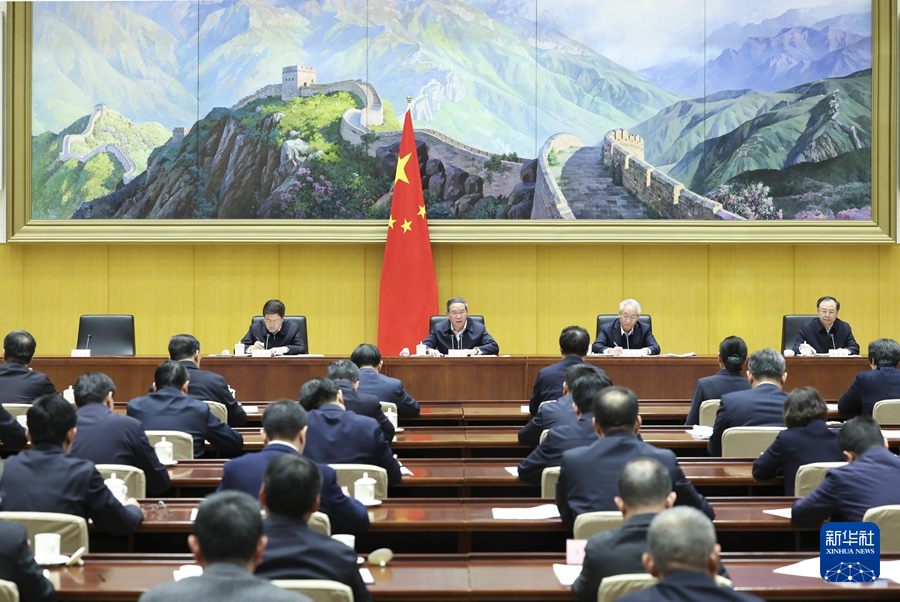
On the afternoon of January 26, the State Council convened a national video and teleconference on work safety. Li Qiang, member of the Standing Committee of the Political Bureau of the CPC Central Committee and Premier of the State Council, attended the meeting and delivered a speech. Photo by Xinhua News Agency reporter Huang Jingwen.
Li Qiang pointed out that recently, multiple serious workplace safety accidents have occurred in various localities, resulting in significant casualties—a deeply distressing situation that underscores profoundly sobering lessons. With the Spring Festival approaching, a range of safety risks is on the rise. All regions and departments must remain acutely vigilant, resolutely overcome complacency and wishful thinking, clearly recognize the grave challenges facing workplace safety, and squarely identify existing problems, shortcomings, and potential hazards. They must adopt stronger, more targeted measures to ensure that workplace safety is rigorously and effectively managed.
Li Qiang emphasized the need to conduct a comprehensive, large-scale inspection of workplace safety risks and hazards, with particular focus on risks and hazards affecting the public, those in key industries and sectors, and those in priority regions, striving to address potential risks at their earliest stages. He stressed the importance of adhering to the principles of “regularity” and “long-term effectiveness,” employing a combination of routine inspections, targeted spot checks, and巡回督查 (rotating supervisory inspections) to strengthen follow-up and performance evaluation. Furthermore, he called for the proactive application of next-generation information technologies to advance intelligent risk management and digital transformation of safety oversight. Finally, he underscored the need to coordinate disaster prevention, mitigation, and relief efforts, upholding both bottom-line and extreme‑scenario thinking, making preparations well in advance, enhancing monitoring and early warning systems, strictly implementing the coordinated early‑warning response mechanism, and carrying out emergency rescue and disaster relief operations in a scientific and efficient manner.
Li Qiang emphasized the need to firmly grasp the “key link” of the accountability system, rigorously enforce safety production responsibilities, and genuinely translate the sense of responsibility—“always feeling uneasy”—into decisive action that ensures “every task is handled with confidence.” By ensuring accountability is fully in place, we can drive the effective implementation of safety systems and measures. We must uphold the principles of “joint Party‑government responsibility, dual responsibility for each post, concerted efforts by all parties, and accountability for dereliction of duty,” as well as the “three controls and three musts,” to strengthen enterprises’ principal responsibility and urge them to accelerate the improvement of their safety‑responsibility frameworks. We must comprehensively implement a full‑chain regulatory mechanism, clearly define divisions of responsibility, refine working procedures, and promote joint oversight, thereby effectively closing regulatory gaps and forging synergistic enforcement. We should remain pragmatic and results‑oriented, prioritizing outcomes over processes, and adopt a solid, rigorous work style to reverse the passive situation in workplace safety. Finally, we must firmly consolidate the grassroots foundation, enhance local emergency management capabilities, advance the professionalization and standardization of grassroots emergency response, improve the safety awareness and skills of frontline personnel, and build a robust people’s defense line for workplace safety.
Zhang Guoqing presided over the meeting, while Wang Xiaohong and Wu Zhenglong attended.
[Editor-in-charge: Jiao Peng]
Source: Xinhua Net
Tags:
More information
Contact Us
Address:
No. 1, No. 1, New District Road No. 1, Gaocheng District, Shijiazhuang City, Hebei Province
WeChat/WhatsApp:
Phone:
Email:
