


-
About UsHebei Derui Chemical Co., Ltd. (hereinafter referred to as Derui Chemical) was established in January 2006 with a registered capital of RMB 51.8 million. The company specializes in the production and sale of agrochemicals, with its main products including thiamethoxam technical grade, imidacloprid technical grade, spirotetramat technical grade, and related formulated products.

-
Product CenterThe company is committed to building and continuously improving its management systems, and in 2020 it obtained certifications under GB/T 19001-2016/ISO 9001:2015, GB/T 24001-2016/ISO 14001:2015, and GB/T 45001-2020/ISO 45001:2018. Derui Chemical has consistently upheld the corporate mission of “pursuing green development and serving global agriculture,” while adhering to the core values of “integrity, innovation, pragmatism, and gratitude.” The company is eager to collaborate with its partners to contribute to the advancement of global agriculture.
-
BlogThe company places great emphasis on standardized management and sustainable development, successfully obtaining certification for its three major management systems—quality, environment, and occupational health and safety—in 2020. These certifications align with GB/T 19001-2016/ISO 9001:2015, GB/T 24001-2016/ISO 14001:2015, and GB/T 45001-2020/ISO 45001:2018. Derui Chemical remains committed to its corporate mission of promoting green development and serving global agriculture, upholding the core values of “integrity, innovation, pragmatism, and gratitude.” We look forward to partnering with stakeholders from all sectors, pooling our strengths, and advancing together to support the steady growth of global agriculture.

National Energy Conservation Public Awareness Week
Release Date:
2023-07-11
BEIJING, July 11 (Xinhua) — Headline: Boosting “Green Content” While Enhancing “Economic Value”—A Snapshot of Accelerated Energy-Saving and Carbon-Reduction Efforts Among Key Industry Enterprises
Xinhua News Agency reporters Wang Maling, Wu Tao, and Qin Huajiang
During National Energy Conservation Publicity Week 2023, on the 11th, the National Development and Reform Commission and other departments organized promotional activities to advance energy-saving and carbon-reduction initiatives among key industries and enterprises. Through on-site interviews with companies across multiple regions, reporters found that the “green content” of energy conservation and carbon reduction is steadily translating into “value-added” for corporate growth, painting a vibrant picture of high-quality, green development.
As a large-scale energy equipment manufacturer with more than 120 years of history, Shanghai Electric was named on the “Shanghai Top Ten Green and Low-Carbon Innovative Technology Products of 2023” list on the 10th. The product recognized was not conventional thermal or nuclear power equipment, but rather an offshore wind turbine unit.
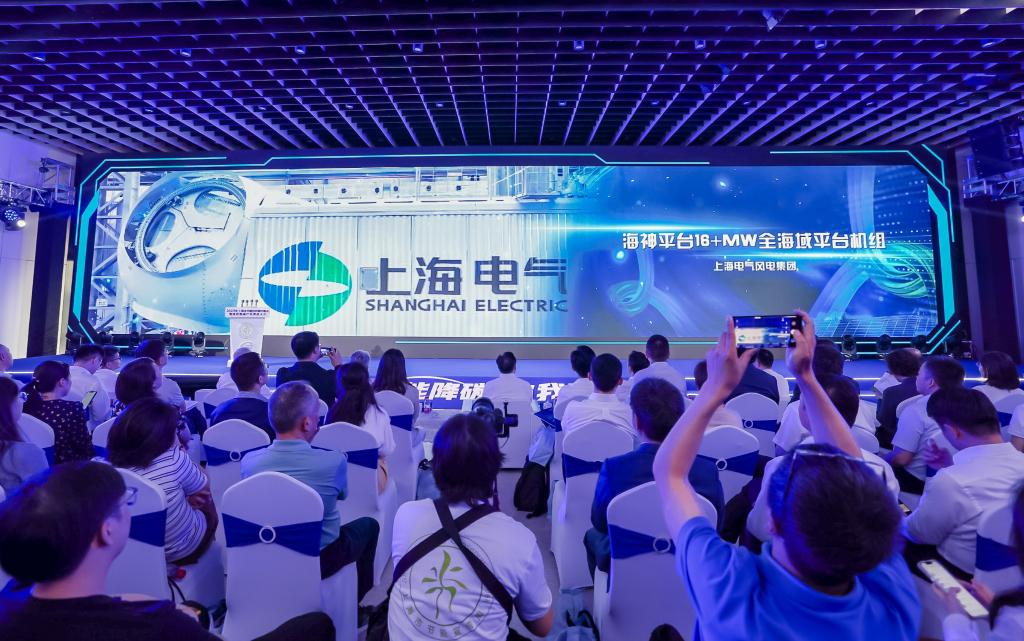
On July 10, Shanghai Electric’s offshore wind turbine was selected for the “Shanghai Top Ten Green and Low-Carbon Innovative Technology Products of 2023” list. Photo by Xinhua News Agency reporter Wang Molling.
“The newly launched next-generation Haishen platform, featuring 16-megawatt, full‑sea‑area, high‑capacity wind turbines, currently holds the record for the largest single-unit capacity and the largest rotor diameter among all projects that have been awarded contracts,” a Shanghai Electric spokesperson told reporters. “Each turbine can generate more than 66 million kilowatt-hours of clean electricity annually, equivalent to reducing coal consumption by 22,000 tons and cutting carbon dioxide emissions by 54,000 tons.”
From thermal power equipment to wind turbine units, the low-carbon transition has spurred green innovation across the industry. Today, Shanghai Electric has developed an integrated energy‑system solution that seamlessly combines wind, solar, hydro, thermal, and energy‑storage resources.
On the 10th, at the launch ceremony of the 33rd National Energy Conservation Public Awareness Week, leaders from 12 industry associations and 19 enterprises spanning the power, steel, building materials, petrochemicals, nonferrous metals, textiles, light industry, coal, energy conservation and environmental protection, and circular economy sectors jointly signed and released the “Declaration on Peaking Carbon Emissions and Achieving Carbon Neutrality in Key Industries and Sectors.”
Jiang Wei, vice president of the China Iron and Steel Association, stated that in the course of the economic and social transformation toward a green transition, all sectors and key enterprises bear significant responsibility. They must accelerate the shift in development models and the reorientation of growth drivers, and make every effort to take new steps forward in promoting high-quality development.
At the Line Work Area of the Guangdong Hengqin Power Supply Bureau of China Southern Power Grid in the Hengqin Guangdong–Macao In-Depth Cooperation Zone, a building whose rooftop is entirely covered with photovoltaic panels stands out as particularly striking.
“With ‘zero carbon emissions’ as our goal, we have undertaken the planning and construction of a ‘zero‑carbon’ building. The structure features extremely low energy consumption, a high share of on‑site green energy, and flexible control capabilities,” said Li Jianbiao, the technical lead for the Southern Power Grid’s Zhuhai Power Supply Bureau’s “zero‑carbon” building project. He added that this is the Southern Power Grid’s first medium‑sized “zero‑carbon” building energy management system, which was commissioned in March this year and has since passed acceptance testing.
From carbon reduction to “zero carbon,” the “green intensity” at the industrial front line continues to rise. In Zhuhai’s Hengqin, the “zero‑carbon” building energy management system integrates not only generation and consumption but also an energy‑storage component, with a total storage capacity of 600 kilowatt-hours. This enables the building to store surplus photovoltaic power generated during holidays, facilitating local consumption.
“If we compare a building’s energy‑generation capacity to water inflow and its energy‑consumption demand to outflow, the ideal state is one in which both inflow and outflow remain stable and balanced. Achieving this equilibrium in the ‘large pool’ of electrical energy may seem straightforward, yet its implementation is complex—something our ‘zero‑carbon’ buildings can deliver,” Li Jianbiao told reporters. “Looking ahead, we will also explore applications of renewable energy sources such as hydrogen and geothermal power in the Hengqin Guangdong–Macao In-Depth Cooperation Zone, scaling up and replicating the energy‑saving expertise gained from our zero‑carbon buildings.”
In the pursuit of green practices and innovation, companies have genuinely reaped the benefits of sustainable development.
Within the freight yard of Jiangsu Yonggang Group in Zhangjiagang, Suzhou, pure‑electric battery‑swap heavy trucks glide smoothly, emitting no exhaust. The shift from fuel to all‑electric power entails a clear economic case for green development.
“Previously, we relied mainly on heavy-duty diesel trucks to handle short‑haul freight transport between our plant and the port. This not only consumed large amounts of diesel, imposing a significant economic burden, but also gave rise to issues such as exhaust emissions and noise pollution,” explained Shi Xueming, Technical Director of the High‑Pressure Energy Management Office at Yonggang Group, to a reporter.
Since 2021, the group has signed a strategic cooperation agreement with State Grid Suzhou Power Supply Company to jointly promote the electrification of its freight trucks. To date, Yonggang Group has put 23 electric heavy-duty trucks into operation, reducing annual diesel consumption by approximately 1.32 million liters, cutting carbon dioxide emissions by about 3,473 tons, and achieving cost savings of roughly RMB 4.2 million. In this way, “green aesthetics” and “golden economic output” coexist and create mutual benefits, helping the Yangtze River region achieve high-quality economic and social development.
According to the latest data from the National Development and Reform Commission, China has sustained an average annual economic growth rate of 6.2% while maintaining an average annual energy consumption growth rate of 3%. Today, the green momentum driving energy conservation and carbon reduction at the industrial frontlines is steadily enhancing the quality and value of high‑quality development.
[Editor-in-charge: Jiao Peng]
Source: Xinhua Net
Tags:
More information
Contact Us
Address:
No. 1, No. 1, New District Road No. 1, Gaocheng District, Shijiazhuang City, Hebei Province
WeChat/WhatsApp:
Phone:
Email:
