


-
About UsHebei Derui Chemical Co., Ltd. (hereinafter referred to as Derui Chemical) was established in January 2006 with a registered capital of RMB 51.8 million. The company specializes in the production and sale of agrochemicals, with its main products including thiamethoxam technical grade, imidacloprid technical grade, spirotetramat technical grade, and related formulated products.

-
Product CenterThe company is committed to building and continuously improving its management systems, and in 2020 it obtained certifications under GB/T 19001-2016/ISO 9001:2015, GB/T 24001-2016/ISO 14001:2015, and GB/T 45001-2020/ISO 45001:2018. Derui Chemical has consistently upheld the corporate mission of “pursuing green development and serving global agriculture,” while adhering to the core values of “integrity, innovation, pragmatism, and gratitude.” The company is eager to collaborate with its partners to contribute to the advancement of global agriculture.
-
BlogThe company places great emphasis on standardized management and sustainable development, successfully obtaining certification for its three major management systems—quality, environment, and occupational health and safety—in 2020. These certifications align with GB/T 19001-2016/ISO 9001:2015, GB/T 24001-2016/ISO 14001:2015, and GB/T 45001-2020/ISO 45001:2018. Derui Chemical remains committed to its corporate mission of promoting green development and serving global agriculture, upholding the core values of “integrity, innovation, pragmatism, and gratitude.” We look forward to partnering with stakeholders from all sectors, pooling our strengths, and advancing together to support the steady growth of global agriculture.

Authoritative Department on the Start of the New Year | High‑Level Safety to Support High‑Quality Development — The Ministry of Emergency Management on Advancing the Modernization of the Emergency Management System and Capabilities
Release Date:
2023-06-09
BEIJING, June 8 (Xinhua) — Title: High-Level Safety Underpins High-Quality Development — The Ministry of Emergency Management on Advancing the Modernization of the Emergency Management System and Capabilities
Xinhua News Agency reporter Zhou Yuan
The report to the 20th National Congress of the Communist Party of China laid out plans for elevating the level of public safety governance and set forth clear requirements for emergency management. At present, what is the state of emergency rescue capabilities? What challenges does emergency management face, and how can they be addressed?
At the “Authoritative Departments Discuss the Start of the New Year” series of thematic press conferences held by the State Council Information Office on the 8th, a relevant official from the Ministry of Emergency Management outlined progress in advancing the modernization of the emergency management system and capabilities.
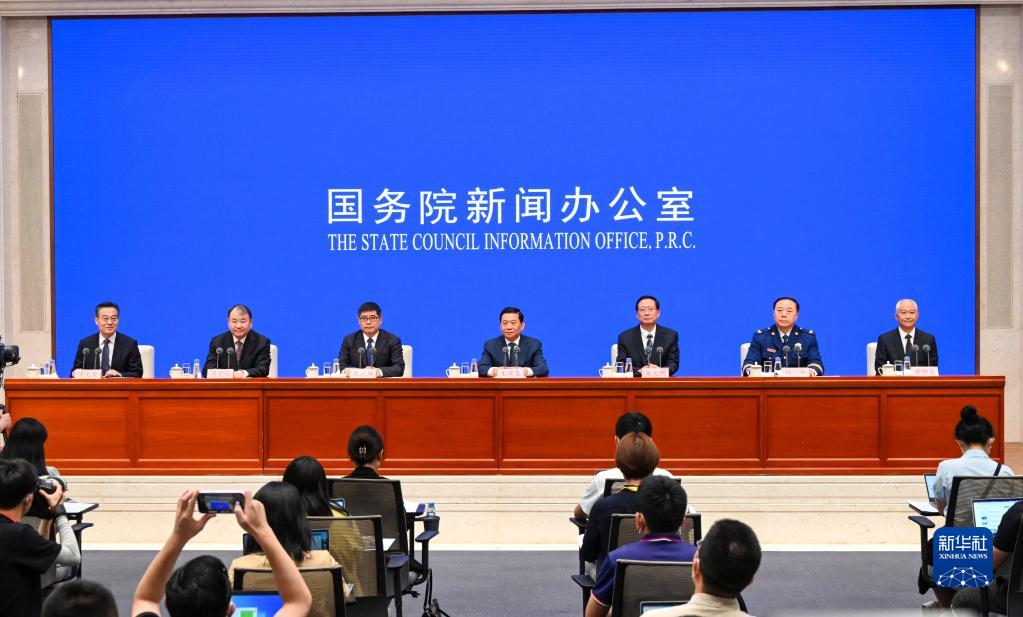
On June 8, the State Council Information Office held a series of thematic press conferences under the “Authoritative Departments Discuss the Start of the New Era” initiative. Minister of Emergency Management Wang Xiangxi, Vice Ministers Song Yuanming and Wang Daoxi, Political Commissar of the National Fire and Rescue Bureau Xu Ping, Director of the China Earthquake Administration Min Yiren, and Director of the National Mine Safety Supervision Administration Huang Jinsheng briefed the media on efforts to implement the major decisions and arrangements adopted at the 20th National Congress of the Communist Party of China and to advance the modernization of the emergency management system and capabilities, and then answered questions from reporters. Photo by Xinhua News Agency reporter Chen Yehua.
The overall situation regarding disaster prevention, mitigation, and relief remains stable.
The Ministry of Emergency Management was established in 2018 as part of the deepening reform of Party and state institutions, and it assumes the critical responsibilities of preventing and mitigating major safety risks and promptly responding to and handling all types of disasters and accidents.
“Over the past few years, we have worked in close coordination with relevant authorities to effectively prevent, defuse, and manage risks, ensuring overall stability in national workplace safety as well as disaster prevention, mitigation, and relief efforts,” said Wang Xiangxi, Minister of Emergency Management. From 2018 to 2022, the total number of workplace accidents and the associated death toll nationwide fell by 80.8% and 51.4%, respectively, compared with the previous five-year period, while the number of deaths and missing persons caused by natural disasters declined by 54.3% over the same timeframe.
Since the beginning of this year, the Ministry of Emergency Management has strived to support high-quality development with a high level of safety and to underpin the new development paradigm with a new security framework. Wang Xiangxi stated that efforts are being focused on four key areas:
— Striving to improve the system. This year, priority will be given to strengthening the accountability framework, optimizing command mechanisms, refining the rule-of-law system, and bolstering grassroots emergency management. To address the challenge of ensuring effective implementation of responsibilities, efforts will be made to guide localities in clearly defining lists of duties for Party and government leaders regarding workplace safety and disaster prevention and mitigation.
— Prioritizing prevention. Greater emphasis is placed on preventive measures, proactively shaping a security environment conducive to development. At present, online monitoring has been implemented for over 6,900 enterprises handling hazardous chemicals with major hazard sources, 3,400 coal mines, and 2,400 tailings ponds of Grade III or above, with automatic alerts triggered upon detection of anomalies and prompt response and remediation.
— Focusing on targeted remediation. A nationwide special campaign, the 2023 Action for the Identification and Rectification of Major Accident Hazards, has been launched to address pressing safety concerns in mining, fire safety, and hazardous chemicals. Twenty comprehensive inspection teams have been dispatched to various localities to provide oversight and guidance, ensuring the effective implementation of these remediation efforts.
— Striving to enhance capabilities. We will continue to implement key projects for natural disaster prevention and control, building a Chinese‑style emergency rescue system that places the national integrated fire and rescue teams at its core, with specialized rescue forces providing coordination, military emergency response units serving as rapid‑response shock troops, and social organizations offering supplementary support. At present, construction has commenced on all six national regional emergency rescue centers.
Emergency rescue capabilities have improved significantly.
In light of the requirements for “all‑hazard, large‑scale emergency response,” how can we enhance our emergency rescue capabilities?
Emphasizing the strengthening of the national integrated fire and rescue force, more than 5,000 specialized teams have now been established for water rescue, mountain operations, and earthquake response. Coordinating the development and deployment of diverse rescue resources, 102 national emergency rescue teams for workplace safety have been set up in collaboration with relevant enterprises, while also integrating civilian resources into the rescue system, resulting in approximately 2,300 teams comprising nearly 50,000 personnel. An emergency rescue command mechanism has been systematically established, and the National Emergency Command Headquarters has been completed…
“Over the past few years, our emergency rescue capabilities have improved markedly, and we have successfully handled a series of major natural disasters as well as several extremely serious accidents. For example, last year’s Luding earthquake in Sichuan and the firefighting efforts in Chongqing were both carried out with great effectiveness and in an orderly manner,” said Wang Xiangxi.
The National Earthquake Intensity Rapid Reporting and Early Warning Project is a major initiative to significantly enhance China’s capacity for earthquake prevention and disaster reduction, aiming to provide nationwide minute‑level instrumental earthquake intensity reports and second‑level earthquake early warnings in key regions.
Min Yiren, Director of the China Earthquake Administration, announced the latest progress of the project: the main construction work has been completed, with 15,391 earthquake early‑warning stations, three national‑level centers, 31 provincial‑level centers, and 173 prefecture‑level information dissemination centers now in place. The project is expected to be fully completed and pass acceptance by the end of this year.
Once the project is commissioned, it will establish a “first line of defense” for earthquake relief and disaster response, helping to reduce casualties. Min Yiren stated that following a destructive earthquake, China’s earthquake early‑warning network will disseminate alert information through multiple channels, providing users in targeted areas with several seconds to tens of seconds of advance warning to facilitate emergency evacuation.
Focus on addressing weaknesses, plugging loopholes, and eliminating potential hazards.
At present, China’s work on workplace safety and disaster prevention and mitigation remains generally stable; however, the overall situation remains severe and complex, with “black swan” and “gray rhino” events potentially occurring at any time, posing significant challenges to emergency management.
From the perspective of workplace safety, decades of rapid industrialization and urbanization have left many sectors with a substantial backlog of latent risks. Meanwhile, new energy sources and emerging business models are continually emerging, giving rise to additional risks.
Facing severe risks and challenges, Wang Xiangxi stated that the Ministry of Emergency Management will unswervingly implement the holistic national security outlook, proactively identify, adapt to, and seek change, focus on addressing weaknesses, plugging loopholes, and eliminating hidden dangers, and ensure the thorough and meticulous implementation of all preventive and response measures, thereby continuously enhancing the level of public safety governance.
At present, many regions across the country are entering the peak flood season. Since the beginning of this year, the National Flood Control and Drought Relief Headquarters has verified and publicly announced the names of 2,521 administrative officials responsible for flood control and drought relief nationwide, and dispatched eight inspection teams to conduct on-site checks in 17 key provinces spanning the seven major river basins, striving to secure a decisive victory in the critical battle against floods and droughts.
Wang Daoxi, Vice Minister of the Ministry of Emergency Management, stated that in the next phase, all responsibilities for flood and drought prevention will be firmly enforced, with local authorities urged to refine the five-tier responsibility system for flood control. Close monitoring of evolving flood and drought conditions will be maintained, and the direct, grassroots‑level “call-and-response” early warning mechanism will be further strengthened. Vigilance and defensive patrols will be intensified to ensure that potential hazards are identified and addressed promptly, while emergency response and evacuation efforts will be bolstered to ensure that all those who should be evacuated are moved out without delay and as early as possible.
[Editor-in-charge: Qiu Lifang]
Source: Xinhua Net
Tags:
More information
Contact Us
Address:
No. 1, No. 1, New District Road No. 1, Gaocheng District, Shijiazhuang City, Hebei Province
WeChat/WhatsApp:
Phone:
Email:
