


-
About UsHebei Derui Chemical Co., Ltd. (hereinafter referred to as Derui Chemical) was established in January 2006 with a registered capital of RMB 51.8 million. The company specializes in the production and sale of agrochemicals, with its main products including thiamethoxam technical grade, imidacloprid technical grade, spirotetramat technical grade, and related formulated products.

-
Product CenterThe company is committed to building and continuously improving its management systems, and in 2020 it obtained certifications under GB/T 19001-2016/ISO 9001:2015, GB/T 24001-2016/ISO 14001:2015, and GB/T 45001-2020/ISO 45001:2018. Derui Chemical has consistently upheld the corporate mission of “pursuing green development and serving global agriculture,” while adhering to the core values of “integrity, innovation, pragmatism, and gratitude.” The company is eager to collaborate with its partners to contribute to the advancement of global agriculture.
-
BlogThe company places great emphasis on standardized management and sustainable development, successfully obtaining certification for its three major management systems—quality, environment, and occupational health and safety—in 2020. These certifications align with GB/T 19001-2016/ISO 9001:2015, GB/T 24001-2016/ISO 14001:2015, and GB/T 45001-2020/ISO 45001:2018. Derui Chemical remains committed to its corporate mission of promoting green development and serving global agriculture, upholding the core values of “integrity, innovation, pragmatism, and gratitude.” We look forward to partnering with stakeholders from all sectors, pooling our strengths, and advancing together to support the steady growth of global agriculture.

First Observation | Gaining Insights into the General Secretary’s Strategic Guidance on “Three Rural Issues” from the No. 1 Central Document of the New Era
Release Date:
2023-02-15
On February 13, the No. 1 Central Document for 2023 was released. This is the 11th such document issued since the 18th National Congress of the Communist Party of China, outlining plans for agricultural, rural, and farmer-related work in the new year.
Agriculture is the foundation of the state and the cornerstone of national governance.
Since the 18th National Congress of the Communist Party of China, General Secretary Xi Jinping has issued a series of important instructions on “agriculture, rural areas, and farmers” work. These directives have been fully implemented in each of the Central Committee’s No. 1 Documents.
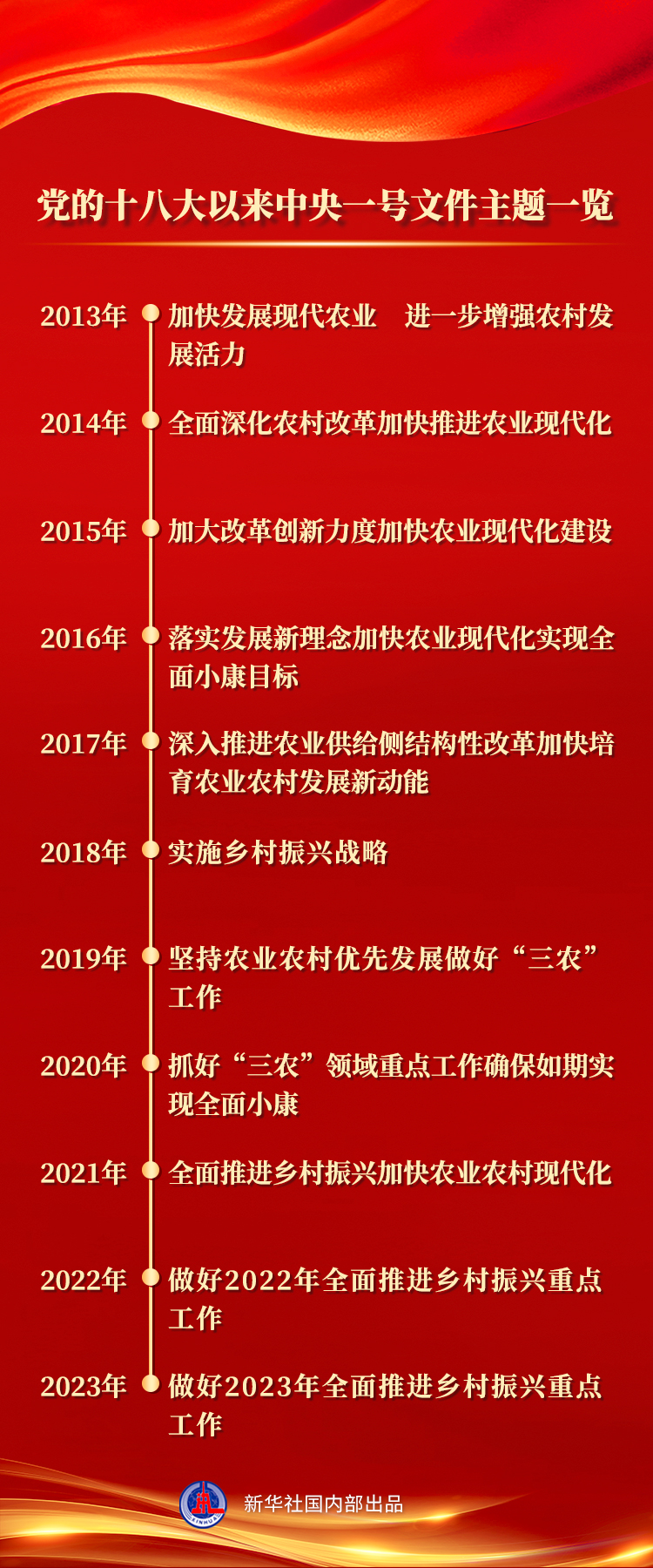
Looking back at the 11 “No. 1 Documents,” one clear theme runs consistently throughout: strengthening agriculture, beautifying rural areas, and enriching farmers.
Having emerged from the loess plateau, General Secretary Xi Jinping possesses a profound understanding and deep affection for agriculture, rural areas, and farmers, and he is keenly aware of the foundational role that agricultural and rural modernization plays in China’s distinctive path to modernization. The General Secretary has pointed out incisively: For China to be strong, agriculture must be strong; for China to be beautiful, rural areas must be beautiful; and for China to be prosperous, farmers must be prosperous.
The No. 1 Central Document of 2013 stated that we must adapt to changing circumstances, follow the laws of development, strengthen our sense of potential risks, and, with the concerted efforts of the entire Party and the whole country, persistently strengthen agriculture, benefit rural areas, and enrich farmers.
In the course of guiding “agriculture, rural areas, and farmers” work in the new era, the General Secretary has put forward a series of important propositions—
“Whether we achieve moderate prosperity or not depends crucially on our fellow villagers.”
The camera pans back to December 2012, when General Secretary Xi Jinping braved wind and snow to visit a poverty-stricken village deep in the Taihang Mountains, paying on-site visits to families in need. During this inspection, he emphasized: “Without moderate prosperity in rural areas—especially in impoverished regions—there can be no all-round moderate prosperity for the entire country.”
Since the 18th National Congress of the Communist Party of China, General Secretary Xi Jinping has visited impoverished areas—rural, ethnic minority, border, and poor regions—to see the real poverty and hear the real hardships. He has convened symposiums on poverty alleviation in numerous provinces, directed the successful battle against poverty, and laid out plans to broaden channels for farmers to increase their incomes and become prosperous, while accelerating the all‑round advancement of rural revitalization.
The fundamental strategy of targeted poverty alleviation and eradication has been implemented, with poverty reduction achieved through five key approaches—boosting production, relocating people to more suitable areas, providing ecological compensation, expanding access to education, and ensuring a social safety net. Over the years, the No. 1 Central Document has laid out a comprehensive framework and refined measures in areas such as rural employment, agricultural operations, and property rights, enabling the vast majority of farmers to enjoy a greater sense of gain.
“Pursuing the Path of Rural Revitalization with Chinese Characteristics”
Shaking off poverty and removing the “poverty‑alleviation” label is not the end, but rather the starting point for a new life and new endeavors.
The 19th National Congress of the Communist Party of China made a major strategic decision to implement the Rural Revitalization Strategy. General Secretary Xi Jinping emphasized that this strategy is a comprehensive, historic task that bears on the overall endeavor of building a modern socialist country in all respects. We must ensure that agricultural modernization and rural modernization are planned and advanced in tandem, so as to enable China to make the transition from a large agricultural country to an agricultural powerhouse.
In line with the overarching goals of “prosperous industries, a livable and eco‑friendly environment, refined rural customs, effective governance, and prosperous livelihoods,” in recent years the Central No. 1 Document has fleshed out a series of measures to consolidate and improve the basic rural operating system, promote green rural development, inherit, develop, and elevate agricultural civilization, and innovate the rural governance system. This year’s No. 1 Document lays out a comprehensive plan for building a strong agricultural nation and advancing the construction of beautiful, livable, and work‑friendly villages, calling for the concerted efforts of the entire Party and society to comprehensively advance rural revitalization and accelerate the modernization of agriculture and rural areas.
“Ensure that the Chinese people’s food security is firmly in their own hands.”
Securing China’s food supply hinges on superior seed varieties. General Secretary Xi Jinping attaches great importance to safeguarding seed security and revitalizing the seed industry, urging that “Chinese grain be secured with Chinese seeds” and that “we firmly hold our staple varieties in our own hands.”
Over the years, the No. 1 Central Document has laid out comprehensive and in-depth plans for the conservation of genetic resources, innovation in seed industry science and technology, the development of new varieties, the integration of breeding, production, and promotion, and the protection of intellectual property rights, with local authorities and relevant departments translating these measures into concrete actions. This year’s No. 1 Central Document underscores the need to vigorously implement the Seed Industry Revitalization Initiative.
“Protect arable land as we protect the giant panda.”
Ensuring China’s food security hinges on arable land, which is the nation’s lifeline. General Secretary Xi Jinping has repeatedly conducted on-site inspections to promote the protection of black soils and the scientific development and utilization of saline‑alkali lands.
In implementation of the important instructions of the General Secretary, over the years, the Central No. 1 Document has laid out a systematic framework for balancing farmland occupation and replenishment, constructing high-standard farmland, protecting black soil, and ensuring accountability for farmland conservation. Through the concerted efforts of all parties, China has firmly safeguarded the red line of 1.8 billion mu of arable land, with comprehensive improvements in the quantity, quality, and ecological sustainability of its farmland.
“The fundamental solution for ensuring stable and increased production lies in science and technology.”
In October 1998, Comrade Xi Jinping, then Deputy Secretary of the Fujian Provincial Party Committee, conducted an in-depth field investigation in Nanping, thereby sowing the “seed” of the science and technology special commissioner system.
“A single spark can start a prairie fire; today, “science and technology special envoys” are present throughout China. Agriculture is vibrant and full of vitality, and rural revitalization depends on the deep advancement of science and technology,” General Secretary Xi Jinping emphasized during his inspection and research visit to Fujian in 2021.
Since the 18th National Congress of the Communist Party of China, the system of science and technology special envoys has been repeatedly highlighted in the “No. 1 Document.” Moreover, over the years, the “No. 1 Document” has also laid out measures to strengthen scientific and technological support and material equipment for modern agriculture, promote independent innovation in areas such as the bio‑seed industry, heavy agricultural machinery, smart agriculture, and green agricultural inputs, and improve mechanisms for talent evaluation and mobility, thereby enabling farmers to shoulder the “golden burden” of prosperity.
“Establish a holistic view of food”
General Secretary Xi Jinping emphasized that the public’s dietary needs have become increasingly diversified, calling for a shift in mindset and the adoption of a holistic approach to agriculture and food—drawing calories and protein from arable land, grasslands, forests, and the ocean, as well as from plants, animals, and microorganisms—and pursuing all‑round, multi‑pronged development of food resources.
“We must adopt a holistic approach to food security,” a key directive that has been consistently implemented in recent years’ No. 1 Central Documents, translated into detailed plans for the development of industries such as fruits, vegetables, meat, eggs, and dairy. This year’s No. 1 Document further elaborates on this vision, calling for the accelerated establishment of a diversified food supply system that integrates grain, cash crops, and feed production; combines agriculture, forestry, animal husbandry, and fisheries; and promotes the coordinated development of plants, animals, and microorganisms, with implementation plans tailored to each sector.
“Agro‑literary civilization is our soft power.”
“Deeply implement the project for the inheritance and protection of agricultural culture, and strengthen the conservation and sustainable use of important agricultural cultural heritage.” This directive appeared in this year’s No. 1 Document.
Nostalgia for one’s hometown and the unique charm of rural life, along with farming culture, have long been matters of great concern to General Secretary Xi Jinping. He has emphasized that “Chinese civilization is rooted in agricultural civilization” and that “we must delve deeply into, inherit, and innovate our fine traditional local cultures.”
Over the years, the No. 1 Central Document has laid out a comprehensive plan for the inheritance and protection of agricultural culture, while time-honored rural customs—such as fostering close family ties, promoting neighborly harmony, and upholding integrity and propriety—have been steadily upheld. From the snowy villages of Northeast China to the ethnic minority hamlets of Southwest China, from the grasslands of Northwest China to the water towns of Jiangnan, villages across the country have become increasingly beautiful and livable.
“To do a good job in rural affairs and achieve rural revitalization, the key lies with the Party.”
Haojiabiao Village in Suide County, Yulin, Shaanxi Province, was once a model village identified by the Suide Prefectural Party Committee of the CPC in the spring of 1943. In September 2021, General Secretary Xi Jinping visited Haojiabiao Village for an inspection and highlighted three key lessons in Party building, one of which is: “Strengthen Party branches, select capable leaders, adhere to the mass line, and mobilize the people’s enthusiasm, raise their awareness, and elevate their understanding, so that together we can advance our cause.”
“The people are the country; the Communist Party fights to win and safeguards it, guarding the hearts of the people and striving to ensure they lead a good life. At no time must we neglect agriculture, forget the farmers, or grow indifferent to rural areas,” General Secretary Xi Jinping emphasized with heartfelt earnestness.
Go deep into the grassroots and stay closely connected with the people, fostering a strong culture of investigation and research; give full play to the farmers’ role as the main actors; effectively reduce the burdens on the grassroots—such as preparing for inspections, filling out forms and reporting data, and excessive record-keeping—and encourage them to focus their primary efforts on pursuing development, strengthening governance, and delivering tangible benefits to rural residents; ensure that secretaries at all five levels take charge of rural revitalization… In recent years, the “No. 1 Document” has set forth clear requirements and concrete plans to ensure that work related to agriculture, rural areas, and farmers is carried out with diligence and effectiveness.
“A strong country must first have a strong agriculture; only when agriculture is strong can the nation be strong.” At the Central Rural Work Conference held in December 2022, General Secretary Xi Jinping emphasized the need to press ahead with unwavering determination, ensure the effective implementation of all tasks related to agriculture, rural areas, and farmers—with rural revitalization as the central focus—and vigorously advance the modernization of agriculture and rural areas, striving to accelerate the building of a powerful agricultural nation.
Clear guidance has been provided, outlining the roadmap for “agriculture, rural areas, and farmers” work in the coming year.
As spring returns to the land, all things awaken. The fields, growing ever more vibrant in color, embody the earnest hopes of farmers and extend into the happy lives of hundreds of millions of people. Guided by General Secretary Xi Jinping’s important expositions and strategic plans for advancing “agriculture, rural areas, and farmers” work, we must act with a sense of urgency while also committing to sustained effort; only then can we continue to achieve new victories in the endeavor to accelerate the building of a strong agricultural nation.
Planning: Huo Xiaoguang
Lead Authors: Yu Wenjing, Yan Fujing
Coordinated by: Zou Wei, Wang Xuan
Visuals | Editors: Wu Jingjing, Yuan Rui
Produced by the Domestic Department of Xinhua News Agency
Produced by Xinhua News Agency Studio No. 1
Tags:
More information
Contact Us
Address:
No. 1, No. 1, New District Road No. 1, Gaocheng District, Shijiazhuang City, Hebei Province
WeChat/WhatsApp:
Phone:
Email:
