


-
About UsHebei Derui Chemical Co., Ltd. (hereinafter referred to as Derui Chemical) was established in January 2006 with a registered capital of RMB 51.8 million. The company specializes in the production and sale of agrochemicals, with its main products including thiamethoxam technical grade, imidacloprid technical grade, spirotetramat technical grade, and related formulated products.

-
Product CenterThe company is committed to building and continuously improving its management systems, and in 2020 it obtained certifications under GB/T 19001-2016/ISO 9001:2015, GB/T 24001-2016/ISO 14001:2015, and GB/T 45001-2020/ISO 45001:2018. Derui Chemical has consistently upheld the corporate mission of “pursuing green development and serving global agriculture,” while adhering to the core values of “integrity, innovation, pragmatism, and gratitude.” The company is eager to collaborate with its partners to contribute to the advancement of global agriculture.
-
BlogThe company places great emphasis on standardized management and sustainable development, successfully obtaining certification for its three major management systems—quality, environment, and occupational health and safety—in 2020. These certifications align with GB/T 19001-2016/ISO 9001:2015, GB/T 24001-2016/ISO 14001:2015, and GB/T 45001-2020/ISO 45001:2018. Derui Chemical remains committed to its corporate mission of promoting green development and serving global agriculture, upholding the core values of “integrity, innovation, pragmatism, and gratitude.” We look forward to partnering with stakeholders from all sectors, pooling our strengths, and advancing together to support the steady growth of global agriculture.

69 items! More than 10 of them pertain to fertilizers, pesticides, and seeds!
Release Date:
2022-04-12
On April 11, the Ministry of Agriculture and Rural Affairs issued Opinions on Further Deepening the “Delegation, Regulation, and Service” Reform. The document stipulates that by the end of 2022, a nationwide, tiered‑responsibility administrative licensing list system will be established, ensuring uniformity across matters and clear delineation of powers and responsibilities. All administratively licensed items legally established will be brought under list‑based management, with implementation standards to be formulated and published for each item on the list. In addition, a basic catalog of government services in the agriculture and rural affairs sector will be compiled, significantly enhancing the service capabilities of government service platforms; and electronic certification standards for commonly used certificates and licenses in this field will be developed and refined, promoting the application and sharing of electronic credentials. Specific details are as follows:
Opinions of the Ministry of Agriculture and Rural Affairs on Further Deepening the “Delegation, Regulation, and Service” Reform In order to further deepen the “delegation, regulation, and service” reform in the agricultural and rural sectors, continuously optimize the business environment, and thoroughly implement the requirements set forth in the State Council’s Guiding Opinions on Accelerating the Standardization, Normalization, and Facilitation of Government Services (Document No. 5 [2022] of the State Council), the General Office of the State Council’s Notice on Fully Implementing List-Based Management of Administrative Licensing Matters (Document No. 2 [2022] of the General Office of the State Council), and the General Office of the State Council’s Opinions on Accelerating the Expansion of Applications for Electronic Certificates and Licenses and Their Nationwide Interoperability and Mutual Recognition (Document No. 3 [2022] of the General Office of the State Council), the following opinions are hereby put forward.
I. General Requirements
(1) Guiding Principles. To deepen the “delegation, regulation, and service” reform in the agricultural and rural sectors, we must be guided by Xi Jinping Thought on Socialism with Chinese Characteristics for a New Era, fully implement the spirit of the 19th National Congress of the Communist Party of China and all plenary sessions of the 19th CPC Central Committee, earnestly carry out the decisions and arrangements of the CPC Central Committee and the State Council, continuously advance the modernization of the government governance system and governance capacity, strictly enforce list-based management of administrative licensing matters, strengthen comprehensive, end-to-end, and cross-sectoral oversight before, during, and after the event, and persistently promote the standardization, regularization, and facilitation of government services. In doing so, we will further unleash market vitality and social creativity, genuinely enhance the sense of gain among market entities in the agricultural and rural sectors, and provide strong support for the full implementation of the rural revitalization strategy.
(II) Work Objectives. By the end of 2022, a nationwide administrative licensing checklist system will be established, featuring unified national coordination, tiered responsibility, standardized procedures, and clear delineation of powers and responsibilities. All administratively licensed matters prescribed by law will be brought under checklist management, with implementation standards developed and published for each item on the list. A basic catalog of government services in the agriculture and rural areas will be compiled, significantly enhancing the service capabilities of government service platforms. Standards for electronic certificates and licenses commonly used in the agricultural and rural sectors will be formulated and refined, promoting their application and sharing. By 2025, the same administrative licensing matter will be managed according to uniform criteria and processed under consistent standards across different regions and administrative levels; online and offline government services will develop in a coordinated manner, with substantial improvements in standardization, regularization, and convenience; and the institutional framework for the use of electronic certificates and licenses will be progressively improved, enabling cross‑hierarchical, cross‑regional, and cross‑departmental sharing, mutual recognition, and mutual trust.
II. Basic Principles
(1) Uphold convenience and efficiency. Strengthen the service mindset, innovate service delivery methods, and, guided by the needs of businesses and the public, remove unreasonable barriers that impede business development, facilitate enterprises and individuals in their production, operations, and administrative procedures, and put into practice the principle of serving the people wholeheartedly.
(II) Uphold market orientation. Properly balance the roles of government and the market, ensuring that the market plays a decisive role in resource allocation while the government fulfills its functions more effectively, thereby fostering a stable, fair, transparent, and predictable environment for market entities and unleashing market vitality and social creativity.
(3) Uphold the guiding role of the rule of law. Strengthen rule-of-law thinking, safeguard the legitimate rights and interests of all types of market entities in accordance with the law, consolidate and deepen the achievements of the “delegation, regulation, and service” reform through legal means, enhance the precision and effectiveness of regulatory oversight, and ensure that reform progresses in tandem with the building of a law-based government and the advancement of law-based administration, so that the two reinforce each other.
4. Uphold a systematic approach. Establish and refine a coordinated, efficient mechanism for advancing the “delegation, regulation, and service” reform, with tiered responsibilities and seamless inter‑agency collaboration, ensuring that streamlining administration and delegating power, combining deregulation with effective oversight, and optimizing public services are closely aligned with the comprehensive implementation of the rural revitalization strategy, planned holistically, and advanced in a coordinated manner.
III. Strictly implement the management of the list of administrative licensing items.
(1) Compile lists of administrative licensing items in accordance with the law. Prepare and publicly release four-tiered lists of administrative licensing items at the national, provincial, municipal, and county levels, thereby establishing a unified list system. Local agricultural and rural affairs departments at all levels shall, in compliance with the responsibilities, procedures, and requirements for list preparation, review administrative licensing items established by higher authorities but implemented locally, as well as those set forth in local regulations and provincial government rules, and compile their own departmental lists of administrative licensing items. Each item must clearly specify essential elements such as the item’s name, the competent authority, the implementing agency, and the legal basis for its establishment and implementation. Administrative licensing items established by higher authorities but implemented locally, along with their corresponding basic elements, must not exceed the scope of the higher‑level list, ensuring consistency and uniform standardization. When drafting or revising draft laws, regulations, or rules that propose the creation or modification of administrative licenses, agricultural and rural affairs departments at all levels shall conduct thorough research and justification, and provide a dedicated explanation in the explanatory notes. If adjustments to the list of administrative licensing items are required due to amendments to laws, regulations, or rules, or as part of efforts to deepen reforms of the administrative approval system, relevant procedures must be followed to submit an adjustment request. Whenever the higher‑level list undergoes dynamic adjustments, the lower‑level lists shall be promptly updated accordingly. Upon adjusting the list of administrative licensing items, a concurrent application for revising the basic catalog of government service items must be submitted, so as to ensure data consistency, dynamic updates, and coordinated management across all government service items.
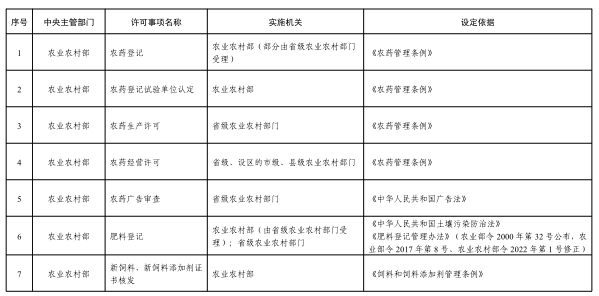
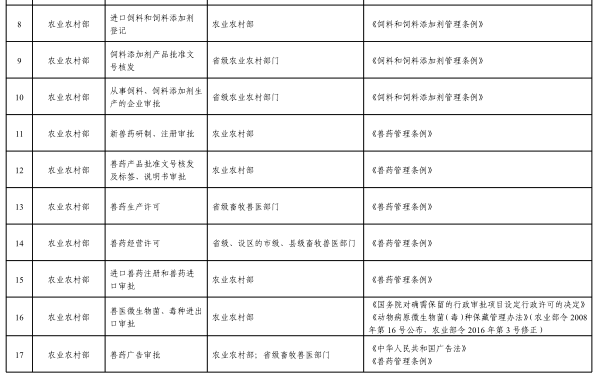
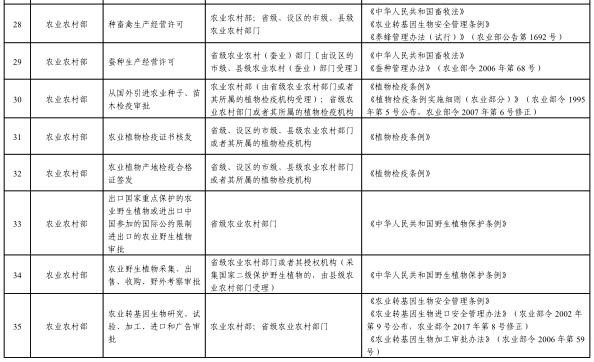
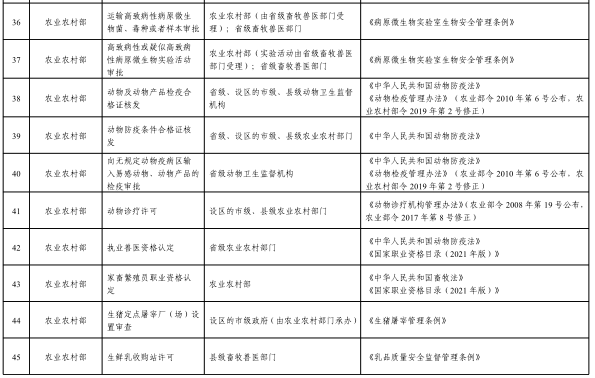
(II) Scientifically formulate implementation standards for administrative licensing. The relevant departments and bureaus of the Ministry of Agriculture and Rural Affairs responsible for administrative approval shall, for each item listed in the “List of Administrative Licensing Matters Established by Laws, Administrative Regulations, and Decisions of the State Council (2022 Edition, Agricultural and Rural Affairs Department)” (hereinafter referred to as the “Agricultural and Rural Affairs Department List”; see attachment), develop specific implementation standards. Adhering to the principles of law-based administration, business‑friendliness, and precision and standardization, they shall individually define sub‑items and processing steps, clearly specifying licensing conditions, application materials, intermediary services, approval procedures, approval time limits, fees, license documents, quantity restrictions, annual inspections, annual reports, and other relevant matters, so as to prevent omissions, misclassifications, or ambiguities. By the end of May 2022, the relevant departments and bureaus shall submit these implementation standards to the Department of Legislation of the Ministry of Agriculture and Rural Affairs for review, after which they will be forwarded to the Government Function Transformation Office of the General Office of the State Council for examination. By the end of June, the standards shall be publicly announced in a centralized manner on the website of the Ministry of Agriculture and Rural Affairs and the National Integrated Government Services Platform, subject to public oversight. Local agricultural and rural affairs authorities shall, in accordance with unified arrangements at the local level, formulate implementation standards for administrative licensing matters established by local regulations and provincial government rules. Where discrepancies exist among regional implementation standards for the same matters, the relevant departments and bureaus of the Ministry of Agriculture and Rural Affairs shall promptly identify and resolve such differences, devise coordination mechanisms, and promote consistent management and standardized processing of administrative licensing matters across different regions and administrative levels.
(3) Optimize and refine administrative licensing service guides. The relevant departments and bureaus of the Ministry of Agriculture and Rural Affairs responsible for administrative approval shall, in accordance with the standards for implementing administrative licenses, optimize and improve the service guides for administrative license matters under the Ministry’s jurisdiction. These guides shall be submitted to the Department of Regulations of the Ministry of Agriculture and Rural Affairs for review by the end of August 2022 and publicly released via the Ministry’s website and the National Integrated Government Services Platform by the end of September. Service guides may not arbitrarily add requirements such as additional licensing conditions, application materials, intermediary services, approval procedures, fees, or quantitative restrictions; however, they may incorporate reasonable optimizations and adjustments that favor the parties subject to administrative regulation.
(4) Implement administrative licensing in accordance with laws and regulations. Once the standardized procedures and service guides are promulgated, agricultural and rural departments at all levels shall strictly comply with them, establish and improve oversight mechanisms, and prevent illegal practices such as arbitrarily imposing additional conditions or requirements, exceeding statutory time limits for processing, or engaging in corruption and extortion during the approval process. The requirement that no administrative license may be lawfully imposed outside the prescribed list must be rigorously enforced, and any disguised forms of licensing carried out under the guise of filing, certification, lists, plans, planning, designation, accreditation, annual inspections, or similar measures must be identified and rectified. Efforts should be strengthened to publicize, train on, and fully implement the Measures for the Administration of the Implementation of Administrative Licenses of the Ministry of Agriculture and Rural Affairs, standardizing the establishment and adjustment of administrative licensing criteria, strictly adhering to procedural requirements for application, acceptance, review, and decision‑making, and rigorously investigating and addressing any irregularities in the administration of administrative licenses.
IV. Strengthen end-to-end, cross-sector regulation throughout the entire process—before, during, and after events.
(1) Clarify regulatory priorities. For matters listed on the agricultural and rural affairs authorities’ roster, agricultural and rural departments at all levels shall implement targeted, differentiated regulatory policies to enhance the precision and effectiveness of oversight. With respect to key areas that directly affect public safety and health, or that pose significant potential risks and high social risks, priority regulation shall be exercised in accordance with laws and regulations, firmly safeguarding the bottom line of quality and safety. Regulatory matters corresponding to administrative licensing items shall be incorporated into the dynamic management system for regulatory items on the “Internet Plus Regulation” platform.
(2) Clarifying Regulatory Authorities. Agricultural and rural affairs departments at all levels shall, in strict accordance with laws, regulations, and the “Three Determinations” provisions, designate the competent regulatory authorities. Where laws, regulations, or the “Three Determinations” do not explicitly assign regulatory responsibilities, the principle of “whoever approves is responsible for oversight, whoever oversees is responsible for management” shall be applied to determine the regulatory authority. In areas where a reform to consolidate administrative licensing powers has been implemented, regulatory responsibilities shall be determined in line with the relevant reform plan.
(3) Improve regulatory rules and standards. The relevant departments and bureaus of the Ministry of Agriculture and Rural Affairs responsible for administrative approval shall, based on the list of items under the purview of the agricultural and rural affairs authorities, formulate and publicly release nationwide uniform, concise, practical, and scientifically sound regulatory rules and standards, item by item or by sector. Local agricultural and rural affairs authorities shall, in accordance with the unified arrangements of the competent authorities at the local level, develop regulatory rules and standards for administrative licensing matters established by local regulations and provincial government rules. For administrative licensing matters that have already been abolished or delegated, further thorough reviews should be conducted; where the level of regulation or the responsible regulatory agency is unclear, or where regulatory rules and standards are lacking or fail to meet current needs, timely supplementation and refinement are required.
V. Continuously advance the standardization, regularization, and facilitation of government services.
(1) Preparation of the Basic Catalogue of Government Services. Government services encompass both administrative powers and public services that are provided upon application. Administrative powers primarily include administrative licensing, administrative confirmation, administrative adjudication, administrative grants, administrative awards, and administrative filing, among others. The relevant departments and bureaus of the Ministry of Agriculture and Rural Affairs shall, within the scope of their respective responsibilities, prepare the basic catalogue of government services implemented by the Ministry or delegated to local authorities, and submit it to the Department of Regulations of the Ministry for review by the end of October 2022. Following review, the catalogue shall be submitted to the General Office of the State Council for examination and unified publication. Local agricultural and rural affairs authorities shall, based on the national basic catalogue of government services and local conditions, revise and refine their own regional basic catalogues of government services.
(II) Promote the standardization of government services. Relevant departments and bureaus of the Ministry of Agriculture and Rural Affairs shall, based on the catalog of government service items in the agricultural and rural sectors, establish clear criteria for breaking down these items. Building on the “four-level, four‑identical” approach—standardizing names, codes, legal bases, and types—they shall work toward progressively achieving nationwide uniformity in such elements as application requirements, target groups, processing procedures, required documents, statutory completion deadlines, and outcomes for each government service item, thereby formulating an implementation list of government service items.
(3) Promote the standardization of government services. Agricultural and rural departments at all levels shall provide service delivery strictly in accordance with the implementation checklist for government service items, and shall not impose additional or disguised requirements regarding procedural steps or application materials. Procedures such as intermediary services, on-site inspections, technical reviews, and hearings or expert consultations shall be managed through a checklist-based approach. Standardize the establishment of government service venues, the configuration of service windows, and the handling of administrative matters; coordinate online service access points; refine online service guidance; and deepen the scope and sophistication of online services.
(4) Promote the facilitation of government services. Except for matters that directly involve national security, state secrets, public safety, ecological and environmental protection, or are closely related to personal health, life and property safety, as well as those with significant external implications—where risks are high, error‑correction costs are substantial, and damages are difficult to remedy—agricultural and rural affairs departments at all levels shall, in accordance with the principle of maximizing business convenience and public benefit, adopt the notification‑and‑commitment system for handling such matters. Furthermore, they should refine the mechanism for accepting applications with missing documents, and, in compliance with laws and regulations, prepare and publicly release a list of government service items eligible for acceptance despite missing documentation, clearly specifying the item name, the principal application materials, and the types of materials that may be accepted provisionally.
(5) Promote the expanded application of electronic certificates and licenses. Agricultural and rural departments at all levels shall, in accordance with the unified deployment of the State Council, accelerate the formulation and refinement of relevant standards and issuance procedures for electronic certificates and licenses in the agricultural and rural sectors; promptly advance the digitalization of existing physical certificates and licenses that are still valid, clarify procedures for handling cases where physical certificate data are incomplete or where the issuing authority has changed, and coordinate the development and improvement of an electronic certificate and license database. Adhering to the principle of “all that should be included must be included,” they shall aggregate electronic certificate and license information onto the National Government Service Platform, continuously enhancing the completeness, accuracy, and practical effectiveness of data sharing. In the course of processing administrative licensing matters, any information that can be obtained through electronic certificates and licenses shall no longer require enterprises or the public to submit corresponding paper documents.
VI. Safeguard Measures
(1) Strengthen organizational leadership. Fully leverage the role of the Leading Group of the Ministry of Agriculture and Rural Affairs for advancing functional transformation and the “delegation, regulation, and service” reform in organizing implementation and addressing major issues, thereby forging a concerted effort to drive reform and development in the agricultural and rural sectors under this framework. Local agricultural and rural departments at all levels should improve their working mechanisms, reinforce accountability, and steadily advance all related tasks.
(II) Strengthen overall coordination. All member units of the Leading Group of the Ministry of Agriculture and Rural Affairs for advancing functional transformation and the “delegation, regulation, and service” reform shall proactively coordinate with and supervise and guide local efforts related to the management of administrative licensing item lists, the application of electronic certificates, and the optimization of government services. Provincial-level agricultural and rural affairs departments should enhance communication and alignment with relevant departments and bureaus within the Ministry, resolve issues encountered in their work, and summarize exemplary experiences and best practices.
(3) Strengthen oversight and implementation. Agricultural and rural departments at all levels shall intensify dynamic assessments and full‑process supervision of the implementation of the administrative licensing item list, ensuring that the application of electronic certificates and licenses progresses safely and in an orderly manner. Channels for complaints and reports shall be kept open, with public oversight facilitated through the “12345 Government Service Hotline,” the government service “satisfaction/dissatisfaction” evaluation system, departmental portal websites, and other platforms.
(4) Strengthen training and publicity. Agricultural and rural departments at all levels shall earnestly study and thoroughly understand the Party Central Committee and the State Council’s series of decisions and arrangements on deepening the “delegation, regulation, and service” reform and optimizing the business environment, and incorporate these into the core content of sector‑specific training. They should intensify efforts to publicize the implementation of the list of administrative licensing items, the application of electronic certificates and licenses, and other related work; promptly address public concerns; and foster a favorable atmosphere.
Ministry of Agriculture and Rural Affairs
April 6, 2022
List of Administrative Licensing Items Established by Laws, Administrative Regulations, and Decisions of the State Council (2022 Edition, Agricultural and Rural Affairs Authorities)

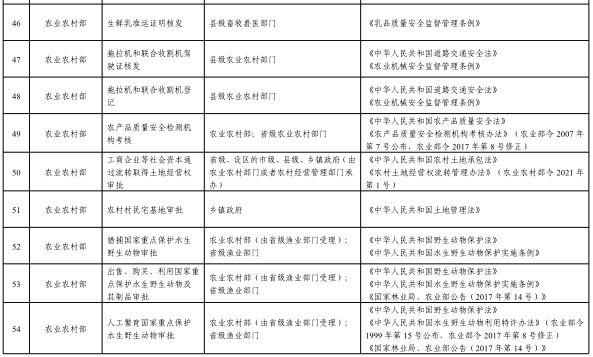

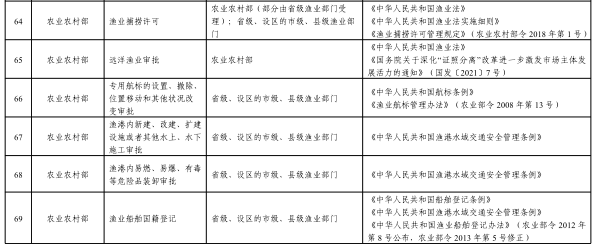
Source: Legislative Affairs Department, Ministry of Agriculture and Rural Affairs Author: Legislative Affairs Department, Ministry of Agriculture and Rural Affairs
Tags:
More information
Contact Us
Address:
No. 1, No. 1, New District Road No. 1, Gaocheng District, Shijiazhuang City, Hebei Province
WeChat/WhatsApp:
Phone:
Email:
