


-
About UsHebei Derui Chemical Co., Ltd. (hereinafter referred to as Derui Chemical) was established in January 2006 with a registered capital of RMB 51.8 million. The company specializes in the production and sale of agrochemicals, with its main products including thiamethoxam technical grade, imidacloprid technical grade, spirotetramat technical grade, and related formulated products.

-
Product CenterThe company is committed to building and continuously improving its management systems, and in 2020 it obtained certifications under GB/T 19001-2016/ISO 9001:2015, GB/T 24001-2016/ISO 14001:2015, and GB/T 45001-2020/ISO 45001:2018. Derui Chemical has consistently upheld the corporate mission of “pursuing green development and serving global agriculture,” while adhering to the core values of “integrity, innovation, pragmatism, and gratitude.” The company is eager to collaborate with its partners to contribute to the advancement of global agriculture.
-
BlogThe company places great emphasis on standardized management and sustainable development, successfully obtaining certification for its three major management systems—quality, environment, and occupational health and safety—in 2020. These certifications align with GB/T 19001-2016/ISO 9001:2015, GB/T 24001-2016/ISO 14001:2015, and GB/T 45001-2020/ISO 45001:2018. Derui Chemical remains committed to its corporate mission of promoting green development and serving global agriculture, upholding the core values of “integrity, innovation, pragmatism, and gratitude.” We look forward to partnering with stakeholders from all sectors, pooling our strengths, and advancing together to support the steady growth of global agriculture.

The Ministry of Ecology and Environment has issued an urgent notice: a nationwide crackdown on hazardous waste has been launched, with local authorities permitted to independently expand the scope of remediation efforts.
Release Date:
2019-10-19
Recently, the Ministry of Ecology and Environment issued the “Notice on Launching a Special Rectification Campaign for Hazardous Waste.” The notice mandates that, by the end of this year, a nationwide assessment be conducted to identify environmental risks associated with hazardous waste at chemical industrial parks, facilities in key industries that generate hazardous waste, and all hazardous waste management entities, with the aim of eliminating potential environmental hazards.
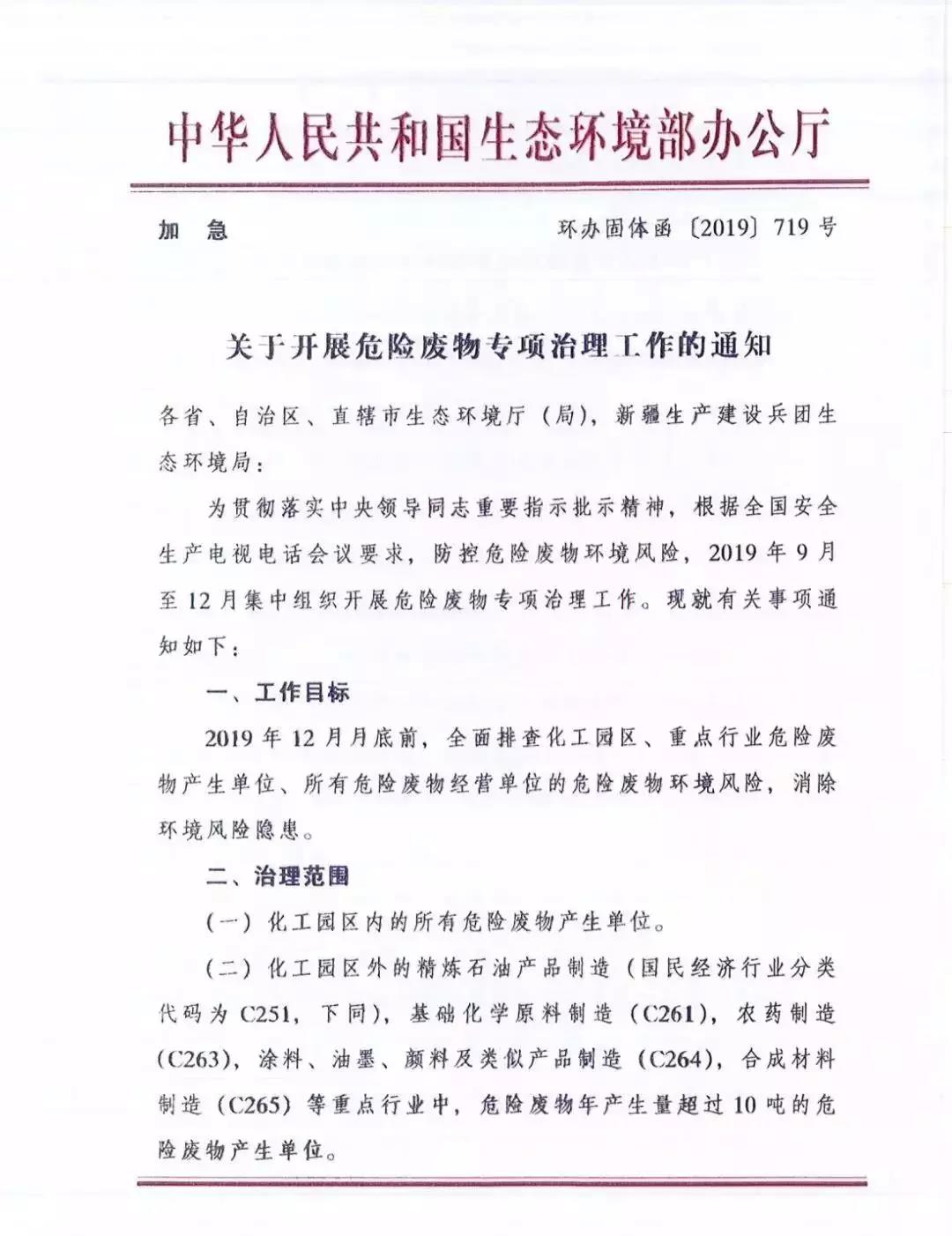
Although the Notice clearly delineates three key areas for hazardous waste remediation—chemical industrial parks, producers of hazardous waste in priority industries, and all hazardous waste management operators—it also stipulates that local authorities may, based on their specific circumstances, expand the scope of remediation. Thus, with regard to the scope of this hazardous waste cleanup effort, the approach is one of expansion rather than contraction.
In addition, based on the scope and content of this rectification campaign, four key characteristics have emerged:
One
Key Inspection System and Standards for Enterprise Hazardous Waste Surveys
An environmental risk assessment will be conducted for enterprises’ hazardous waste. In accordance with the requirements of the standardized management indicator system for hazardous waste, the implementation of environmental management systems for both hazardous waste generators and operators will be inspected, and environmental risks throughout the entire lifecycle—generation, storage, transfer, utilization, and disposal—will be identified. For hazardous wastes declared by enterprises that are flammable, explosive, or release toxic gases under ambient temperature and pressure, compliance with the “Standard for Pollution Control on the Storage of Hazardous Waste” (GB 18597) will be verified, with particular attention paid to whether pre‑treatment has been carried out to stabilize the waste prior to storage; otherwise, such waste must be stored as flammable and explosive materials.
Two
Key inspection and response capabilities for chemical park risk assessments
Environmental risk assessment of hazardous waste in chemical industrial parks: In addition to identifying environmental risks associated with hazardous waste at all enterprises within the park, particular attention shall be paid to verifying whether the treatment capacity of the centralized hazardous waste disposal facilities constructed as part of the park’s infrastructure is sufficient to meet the needs of the park’s enterprises. For parks that have not established such facilities, it must be confirmed whether all hazardous waste generated by the enterprises can be properly utilized or disposed of. Furthermore, the park should fully leverage information technology to monitor and manage environmental risks across all stages—hazardous waste types, generation volumes, flow paths, storage, utilization, and disposal.
Three
Strict law enforcement, effective rectification.
For environmental violations identified during the inspection process, strict penalties shall be imposed in accordance with environmental protection laws and regulations. A checklist shall be established, and the status of inspections and remediation efforts shall be promptly reported through the “Special Governance APP for Hazardous Waste.” With respect to issues uncovered during inspections, corrective measures shall be implemented concurrently with the investigation—rectifying problems immediately upon discovery and closing each case as it is resolved. For issues that cannot be addressed in the short term, enterprises or chemical parks shall be guided and supervised to adopt necessary emergency preventive measures to mitigate environmental risks associated with hazardous waste, and to develop practical, feasible work plans for rectification, advancing implementation according to a set timeline to ensure thorough resolution. For cases where remediation is not completed by the deadline, the local people’s government shall, in accordance with the law, be requested to order suspension of production or closure.
Four
Multi-departmental collaboration
Strengthen communication and collaboration among relevant departments. Local ecological and environmental authorities at all levels shall, in accordance with applicable environmental protection laws and regulations, enhance environmental supervision and management of the collection, storage, transfer, utilization, and disposal of hazardous waste. During inspection activities, any suspected environmental violations or criminal offenses involving hazardous waste must be promptly referred to the public security organs. Additionally, if safety or fire‑related issues are identified, relevant leads should be promptly forwarded to the competent administrative authorities, and enterprises should be required to proactively report such matters to the appropriate administrative bodies.
According to reports, the Jiangsu Provincial Department of Ecology and Environment has circulated the contents of the “Notice” to the ecological and environmental bureaus of all prefecture-level cities. In accordance with the department’s requirements, the ecological and environmental authorities in each prefecture-level city will complete the special rectification campaign on hazardous waste by January 10, 2020—earlier than the deadline of January 31, 2020 stipulated in the Ministry of Ecology and Environment’s “Notice.”
Source: Suzhou Environmental Protection Guide Author: Suzhou Environmental Protection Guide Editor: bianji2
Tags:
More information
Contact Us
Address:
No. 1, No. 1, New District Road No. 1, Gaocheng District, Shijiazhuang City, Hebei Province
WeChat/WhatsApp:
Phone:
Email:
