


-
About UsHebei Derui Chemical Co., Ltd. (hereinafter referred to as Derui Chemical) was established in January 2006 with a registered capital of RMB 51.8 million. The company specializes in the production and sale of agrochemicals, with its main products including thiamethoxam technical grade, imidacloprid technical grade, spirotetramat technical grade, and related formulated products.

-
Product CenterThe company is committed to building and continuously improving its management systems, and in 2020 it obtained certifications under GB/T 19001-2016/ISO 9001:2015, GB/T 24001-2016/ISO 14001:2015, and GB/T 45001-2020/ISO 45001:2018. Derui Chemical has consistently upheld the corporate mission of “pursuing green development and serving global agriculture,” while adhering to the core values of “integrity, innovation, pragmatism, and gratitude.” The company is eager to collaborate with its partners to contribute to the advancement of global agriculture.
-
BlogThe company places great emphasis on standardized management and sustainable development, successfully obtaining certification for its three major management systems—quality, environment, and occupational health and safety—in 2020. These certifications align with GB/T 19001-2016/ISO 9001:2015, GB/T 24001-2016/ISO 14001:2015, and GB/T 45001-2020/ISO 45001:2018. Derui Chemical remains committed to its corporate mission of promoting green development and serving global agriculture, upholding the core values of “integrity, innovation, pragmatism, and gratitude.” We look forward to partnering with stakeholders from all sectors, pooling our strengths, and advancing together to support the steady growth of global agriculture.

Financial Focus | “Loan Transparency Sheets”: How Do They Help Businesses Keep Clear Accounts on Financing?
Release Date:
2025-08-21
Faced with a myriad of fees associated with financing, how can we help businesses maintain transparent financial records? Starting in September 2024, the People’s Bank of China launched a pilot program to explicitly disclose the comprehensive cost of corporate loans. Through the “Loan Transparency Sheet,” businesses can clearly see, accurately calculate, and readily compare various financing charges, thereby further enhancing the quality and effectiveness of financial services in supporting the real economy.
Over the past year of the pilot program, the “Loan Information Disclosure Sheet” has been quietly enhancing the business financing environment, steadily improving transparency and alignment in lending, driving a sustained reduction in overall financing costs, and helping enterprises move forward with lighter burdens.
Costs are clear at a glance—say goodbye to “seeing flowers through the fog.”
“When I went to the bank to apply for a loan, the total costs I would actually have to pay—including interest—were clear at a glance,” Wu Jinhua, head of Fujian Quanzhou Yanglei Technology Co., Ltd., told reporters. The company urgently needed 500,000 yuan to expand production and operations. After completing the “Loan Information Sheet” at the local China Construction Bank, she discovered that the bank does not charge any so‑called “channel fees” whatsoever—otherwise, she might have been tricked by intermediaries into paying more than 20,000 yuan extra.
Behind securing a loan, many enterprises not only have to pay interest but also often face a host of additional fees—such as collateral‑valuation charges, guarantee fees, appraisal fees, notarization costs, and intermediary service fees—each levied by different entities.
The “loan information sheet” mentioned by Wu Jinhua is, in fact, a comprehensive list of the total financing costs associated with corporate loans.
To ensure that corporate financing costs are transparent, the People’s Bank of China has launched a pilot program in five provinces—Shanxi, Jiangxi, Shandong, Hunan, and Sichuan—to explicitly disclose the total cost of corporate loans. Banks in the pilot regions have introduced “Loan Transparency Sheets” that itemize borrowers’ interest expenses and all non‑interest charges, along with details such as the charging entities, payment methods, and payment schedules, enabling enterprises to clearly understand the various financing fees they will incur during the application process.
“Breaking down barriers of information asymmetry can effectively curb hidden fees and unreasonable price hikes, thereby promoting transparency in the pricing of overall financing costs,” says Tian Xuan, Dean of the National Institute of Financial Research at Tsinghua University. He adds that completing the “Loan Information Disclosure Form” helps enterprises gain a comprehensive understanding of banks’ loan products and the sources of financing charges, clearly grasp the breakdown of each fee, and accurately assess their actual cost burden, thus fully safeguarding their right to information and the legitimate rights and interests of financial consumers.
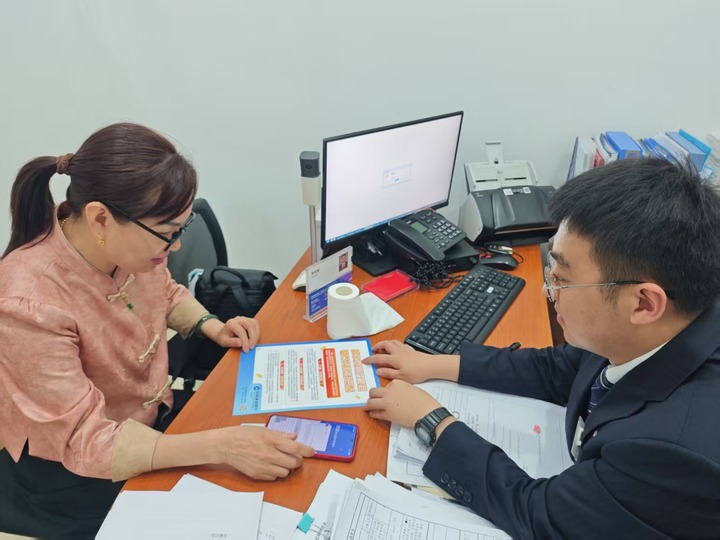
Staff from the Yibin Branch of China Construction Bank briefed customers on the pilot program to disclose the comprehensive financing costs of corporate loans. (Photo by Liu Zhixin)
Precise policy implementation helps businesses move forward with a lighter burden.
Some time ago, Shandong Binzhou Huanghe Baoshan Concrete Co., Ltd. found itself in a difficult predicament: on the one hand, it had to make advance payments for goods; on the other, its loans were approaching maturity. The company’s head, Zhang Xiaotao, even considered turning to intermediaries to secure bridge financing to repay its debts, but the “bridge fee” of more than 30,000 yuan gave him pause.
“ICBC, after learning about our needs through the ‘Loan Information Sheet,’ promptly processed a RMB 5 million loan renewal, saving us substantial costs such as bridge‑loan fees, mortgage registration fees, and appraisal fees, with overall financing expenses reduced by nearly 40%,” said Zhang Xiaotao.
Tian Xuan stated that, through the “Loan Information Sheet,” financial institutions can gain a more comprehensive understanding of enterprises’ financing needs and offer more tailored financial services, while enterprises can also clearly identify the preferential policies offered by banks, thereby helping them secure greater relief and fee reductions.
“This ‘Loan Information Sheet’ is far from being filled out carelessly. The detailed list clearly states that both the 500‑yuan appraisal fee and the 80‑yuan mortgage registration fee will be borne by the bank, so we don’t have to pay any additional charges,” Mr. Wu, a small‑business owner in Fujian, told our reporter. He applied for a 2‑million‑yuan personal business loan from the bank, noting that the bank’s pricing is transparent and free of hidden fees, which helps him make more precise financial plans and compare financing options.
According to the Sichuan Provincial Branch of the People’s Bank of China, in June, among the loan‑issuing entities participating in the province’s pilot program, the non‑interest‑related weighted average rate for enterprises and merchants stood at 0.55%, a decrease of 57 basis points from the program’s initial phase, reflecting a significant reduction in non‑interest costs.
Liu Xiaofeng, deputy general manager of the Binzhou Branch of the Industrial and Commercial Bank of China in Shandong Province, stated that by refining fee disclosures and standardizing charging practices, it is possible to reduce gray areas in the financing chain, making overall financing costs more open and transparent. This, in turn, helps ensure that policy benefits are channeled precisely to the real economy, enabling enterprises to move forward with lighter burdens and accelerate their development.
Enhancing mutual trust between banks and enterprises to optimize the financial ecosystem.
“I never expected that simply filling out a single form would save me more than 6,000 yuan—this measure is really great,” Li Ping, head of the Fushuang Family Farm in Tongcheng City, Anhui Province, told our reporter. In June, she had been preparing to sign a loan agreement with an interest rate of 4.3% and a principal of nearly 500,000 yuan. However, while completing the “Loan Information Sheet,” staff at the Agricultural Bank of China determined that, given her circumstances, she could qualify for an even lower rate. They helped her switch to a business‑loan product, reducing the interest rate to 3%.
Hao Xiangsong, head of the Anqing Tongcheng Branch of the Agricultural Bank of China, stated that, as customer managers guide clients in completing the “Loan Information Sheet,” they can work with enterprises to analyze the disbursement details of each loan. This approach enables the bank to tailor its services to meet the specific needs of each company, while also strengthening mutual trust between banks and businesses and deepening mutually beneficial cooperation.
According to the People’s Bank of China, since the beginning of this year, the pilot program aimed at explicitly disclosing the comprehensive financing costs of corporate loans has continued to expand. Provinces and municipalities including Anhui, Hainan, Hebei, and Liaoning have joined the initiative, with the pilot now covering the vast majority of China’s provinces and yielding increasingly tangible results.
As of the end of July, in Fujian, local financial institutions had cumulatively reported nearly 50,000 corporate loan transactions, with total loan amounts exceeding RMB 200 billion. In Gansu, the “Loan Information Disclosure Form” has helped enterprises save RMB 564,000 in non‑interest costs. In Sichuan, more than 200 banking institutions have joined the pilot program, serving over 50,000 business entities and supporting loans totaling more than RMB 400 billion.
Experts note that the “Loan Information Disclosure Sheet” has strengthened communication between banking institutions and borrowers, enabling enterprises to gain a clearer understanding of their actual financing costs and fee breakdowns, while allowing banks to proactively refine their financial services. This, in turn, helps foster a healthy financial ecosystem and instills confidence and momentum for businesses to pursue long-term, stable operations.
[Editor-in-charge: Wu Jingze]
Source: Xinhua Net Xinhua News Agency reporters Wu Yu and Hu Xu
Tags:
More information
Contact Us
Address:
No. 1, No. 1, New District Road No. 1, Gaocheng District, Shijiazhuang City, Hebei Province
WeChat/WhatsApp:
Phone:
Email:
