


-
About UsHebei Derui Chemical Co., Ltd. (hereinafter referred to as Derui Chemical) was established in January 2006 with a registered capital of RMB 51.8 million. The company specializes in the production and sale of agrochemicals, with its main products including thiamethoxam technical grade, imidacloprid technical grade, spirotetramat technical grade, and related formulated products.

-
Product CenterThe company is committed to building and continuously improving its management systems, and in 2020 it obtained certifications under GB/T 19001-2016/ISO 9001:2015, GB/T 24001-2016/ISO 14001:2015, and GB/T 45001-2020/ISO 45001:2018. Derui Chemical has consistently upheld the corporate mission of “pursuing green development and serving global agriculture,” while adhering to the core values of “integrity, innovation, pragmatism, and gratitude.” The company is eager to collaborate with its partners to contribute to the advancement of global agriculture.
-
BlogThe company places great emphasis on standardized management and sustainable development, successfully obtaining certification for its three major management systems—quality, environment, and occupational health and safety—in 2020. These certifications align with GB/T 19001-2016/ISO 9001:2015, GB/T 24001-2016/ISO 14001:2015, and GB/T 45001-2020/ISO 45001:2018. Derui Chemical remains committed to its corporate mission of promoting green development and serving global agriculture, upholding the core values of “integrity, innovation, pragmatism, and gratitude.” We look forward to partnering with stakeholders from all sectors, pooling our strengths, and advancing together to support the steady growth of global agriculture.

Standing Committee of the National People’s Congress | Laying a Solid Institutional Foundation for “Access to Medical Care When Sick”: Draft Law on Medical Security Submitted for Deliberation for the First Time
Release Date:
2025-06-24
BEIJING, June 24 (Xinhua) — By reporters Peng Yunjia and Xu Penghang: Medical security is a major institutional arrangement that alleviates the financial burden of medical care for the public, enhances people’s well-being, and safeguards social harmony and stability. On the 24th, a draft Law on Medical Security was submitted to the 16th Meeting of the Standing Committee of the 14th National People’s Congress for its first review, with a focus on defining the framework of the medical security system and its basic institutions.
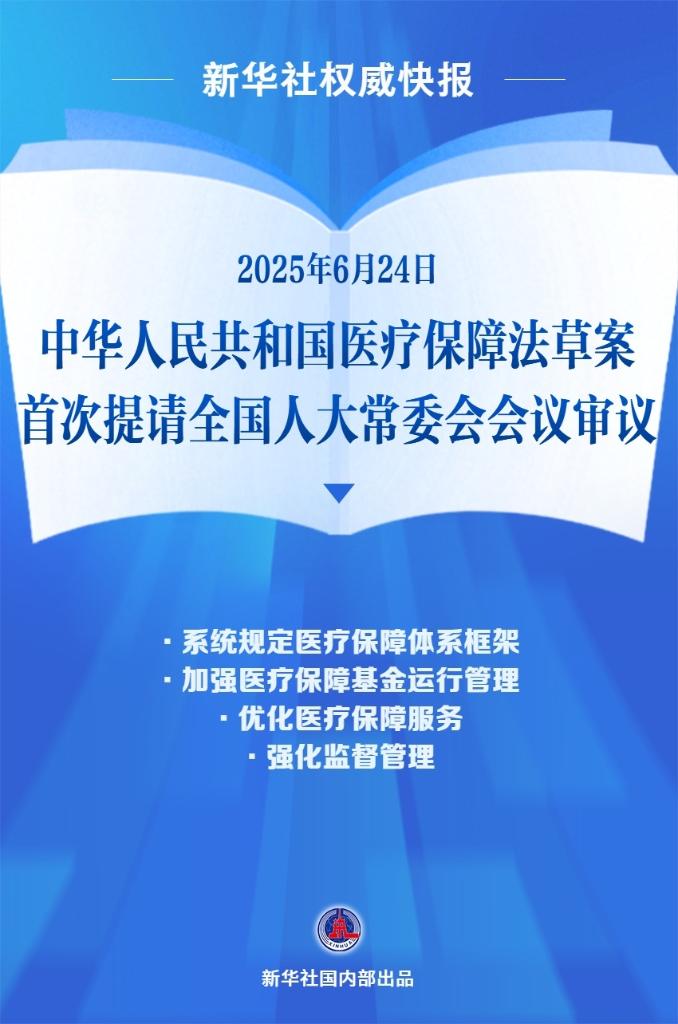
The draft, submitted for deliberation for the first time, comprises seven chapters and 50 articles, systematically outlining the framework of the medical security system, strengthening the management and operation of medical security funds, optimizing medical security services, and reinforcing oversight and regulation. It aims to support the lawful improvement of the universal basic medical insurance system, effectively safeguard the legitimate rights and interests of insured persons, and lay a solid institutional foundation for ensuring that all people have access to medical care when they fall ill.
Zhang Ke, Director of the National Healthcare Security Administration, stated that the draft includes a dedicated chapter that systematically outlines the framework of the medical security system. For the relatively mature and well-established systems—employee basic medical insurance, urban and rural resident basic medical insurance, and maternity insurance—the draft clearly defines the scope of coverage, funding mechanisms, and benefit provisions.
To ensure the safe and stable operation of the medical security fund, the draft stipulates that the fund shall adhere to the state‑wide unified financial and accounting systems, be used exclusively for its designated purposes, and be managed within the fiscal special account for social security funds. It also clarifies the principled requirements for defining the scope of coverage under the basic medical insurance fund, taking into account the fund’s capacity while meeting the reasonable medical needs of insured persons, and standardizes the use of the medical security fund by designated medical institutions and insured individuals.
With regard to optimizing healthcare security services, the draft stipulates that the state shall establish and improve a public service system for healthcare security, standardize and unify the list of public service items, and ensure full coverage of such services across both urban and rural areas. It also calls for the establishment of a direct settlement mechanism for medical expenses that seamlessly integrates basic medical insurance, supplementary medical insurance, and medical assistance, and for the refinement of the system for direct settlement of medical expenses incurred when seeking care in another locality.
The draft strengthens oversight of the revenue and expenditure management of medical security funds by establishing a supervisory framework that integrates oversight by the people’s congresses, regulatory oversight by relevant departments, and public scrutiny, while also ensuring smooth channels for reporting and lodging complaints. It implements dynamic, intelligent monitoring of fund utilization to enhance the effectiveness of oversight and employs a comprehensive array of measures—ranging from fines and suspension of medical services involving fund usage to suspension of online settlement of medical expenses and termination of service agreements—to impose stricter penalties for violations.
[Editor-in-charge: Liu Ziya]
Source: Xinhua Net
Tags:
More information
Contact Us
Address:
No. 1, No. 1, New District Road No. 1, Gaocheng District, Shijiazhuang City, Hebei Province
WeChat/WhatsApp:
Phone:
Email:
