


-
About UsHebei Derui Chemical Co., Ltd. (hereinafter referred to as Derui Chemical) was established in January 2006 with a registered capital of RMB 51.8 million. The company specializes in the production and sale of agrochemicals, with its main products including thiamethoxam technical grade, imidacloprid technical grade, spirotetramat technical grade, and related formulated products.

-
Product CenterThe company is committed to building and continuously improving its management systems, and in 2020 it obtained certifications under GB/T 19001-2016/ISO 9001:2015, GB/T 24001-2016/ISO 14001:2015, and GB/T 45001-2020/ISO 45001:2018. Derui Chemical has consistently upheld the corporate mission of “pursuing green development and serving global agriculture,” while adhering to the core values of “integrity, innovation, pragmatism, and gratitude.” The company is eager to collaborate with its partners to contribute to the advancement of global agriculture.
-
BlogThe company places great emphasis on standardized management and sustainable development, successfully obtaining certification for its three major management systems—quality, environment, and occupational health and safety—in 2020. These certifications align with GB/T 19001-2016/ISO 9001:2015, GB/T 24001-2016/ISO 14001:2015, and GB/T 45001-2020/ISO 45001:2018. Derui Chemical remains committed to its corporate mission of promoting green development and serving global agriculture, upholding the core values of “integrity, innovation, pragmatism, and gratitude.” We look forward to partnering with stakeholders from all sectors, pooling our strengths, and advancing together to support the steady growth of global agriculture.

What are the latest trends in telecom fraud, and how can we safeguard the public’s finances?
Release Date:
2024-07-10
The “little sister” who sweet-talks in the video—could she actually be a scammer? Could large‑value orders placed at brick‑and‑mortar stores be linked to money laundering? And those calls about rebooking airline tickets—could they be scams?
At present, telecom and online fraud crimes are exhibiting new trends and characteristics. Recently, the “National Anti-Fraud Campaign” — themed “Beware of New Fraud Schemes; Don’t Become an Enabler of Telecom Fraud” — officially launched its month-long intensive publicity drive, further bolstering public awareness and the ability to recognize scams by continuously stepping up anti-fraud outreach efforts.
Promotional and traffic‑driving campaigns are shifting offline—stay vigilant about new trends and emerging characteristics of telecom fraud.
Recently, Ms. Zhang from Zhejiang received a call from someone claiming to be an officer with the XX Municipal Public Security Bureau, who alleged that she was implicated in a fraud case. The caller said that all other suspects involved had already been apprehended and that, to cooperate with the investigation, she needed to withdraw all funds from her bank account for verification purposes. Consequently, Ms. Zhang withdrew all the cash from her card. A few hours later, a man collected the money. It was only when Ms. Zhang tried to inquire about the status of the fund‑verification process that she realized she had been scammed and promptly reported the incident to the police.
“‘No face-to-face meetings’ and ‘no direct contact’ are hallmark features of most telecom‑network fraud cases. However, in some areas a new type of scam has emerged: suspects impersonate ‘police officers,’ ‘after‑sales staff,’ ‘sales representatives,’ and the like, directly approaching victims in person to collect money, which makes the scheme even more deceptive and leads victims to fall for the ruse, resulting in financial losses,” explained the investigating police officer.
In recent years, in the face of ever‑evolving and increasingly sophisticated telecom fraud schemes, public security organs nationwide have launched a series of targeted operations—including “Cloud Sword,” “Card‑Cutting,” “Flow‑Stopping,” and “Nail‑Pulling”—to crack down rigorously and relentlessly on telecom and online fraud and related criminal activities in accordance with the law.
“Lead generation” serves as the “front-end service” in the telecom fraud chain. Victims are first lured by various lead‑generation tactics to join designated WeChat groups, QQ groups, or other online communities, after which the fraudsters carry out order‑boosting rebate scams and fraudulent investment‑and‑wealth‑management schemes against group members.
Recently, public security authorities have observed that, as online regulatory efforts continue to intensify, an increasing number of fraud‑related promotional and traffic‑generation activities are shifting offline. Not long ago, Ding and Wu, residents of Luliang County in Yunnan Province, came across a part-time job advertisement on WeChat Moments. Following the instructions, they set up a makeshift stall at a night market to attract customers, handing out small gifts to passersby and inviting them into various chat groups. Upon receiving a tip-off, police promptly brought Ding and Wu in for questioning and uncovered a cyber‑fraud ring operating behind the scenes.
“In such cases, some individuals, though aware that the ‘traffic‑directing’ activities are unlawful, succumb to financial incentives and become entangled. In essence, these actions amount to aiding telecom fraud perpetrators in carrying out their scams. Under the law, they may be suspected of either the crime of assisting in cybercrime or the crime of fraud,” said the investigating police officer.
Strengthen early warning and dissuasion, as well as payment freezes, to continuously tighten and fortify the protective network.
One evening, Ms. Wang from Benxi City, Liaoning Province, received a phone call from someone claiming to be an “customer service representative” of an e‑commerce platform. The caller said that the item Ms. Wang had purchased had quality issues and that the manufacturer would issue her a refund. Just as Ms. Wang was following the “customer service agent’s” instructions, an early‑warning call came in from the Investigation Unit for Telecommunications and Cyber Fraud Cases of the Benxi Municipal Public Security Bureau: “You may have received a scam call impersonating an e‑commerce customer service representative—do not believe it under any circumstances…”
“In our daily work, we promptly reach out to individuals identified by the system as being at potential risk of fraud, alerting them that they have received a scam call or accessed a fraudulent app, and advising them not to transfer funds and to remain vigilant against scams,” explained Zhao Yun, head of the Telecommunications and Cyber Fraud Investigation Unit of the Benxi Municipal Public Security Bureau.
In Jiangsu Province, more than 1,600 dedicated prevention teams are safeguarding the public’s financial security. “If door-to-door interventions lag behind, we often miss the critical window for timely response to early warning alerts,” said Sun Yuan, deputy director of the Zhujiang Road Police Station under the Suyu Branch of the Suqian Municipal Public Security Bureau. He explained that these specialized prevention officers operate under a “first-response accountability system” for fund‑related alerts, with each anti‑fraud team striving to complete in-person visits, take appropriate action, and provide feedback as quickly as possible—ensuring that preventive resources are focused squarely on victims.
Even a delay of just one minute—or sometimes mere seconds—in issuing an early warning or initiating intervention can make a world of difference to the public’s financial security. This sense of urgency, where every second counts, is also evident in the swift process of halting payments.
Recently, upon receiving a report from victim Mr. Zhang, the Anti-Fraud Center of the Changning Branch of the Shanghai Public Security Bureau promptly activated its payment‑stop mechanism and, in coordination with local banks, froze the relevant accounts, successfully freezing RMB 200,000 of Mr. Zhang’s defrauded funds in a primary account. “By refining our rapid payment‑stop procedures, we have implemented, across the stages of early warning, incident reporting, and investigation, measures such as temporary protection of high‑risk accounts, swift suspension of completed transfers, and the recovery and return of funds involved in fraud, thereby minimizing financial losses for the public,” said Shen Anjun, head of the Ninth Detachment of the Criminal Investigation Corps of the Shanghai Public Security Bureau. Since the beginning of this year, leveraging front‑end early‑warning systems and fund‑blocking mechanisms, authorities have successfully intercepted more than 79,000 fraudulent transfers, directly preventing economic losses exceeding RMB 1.71 billion.
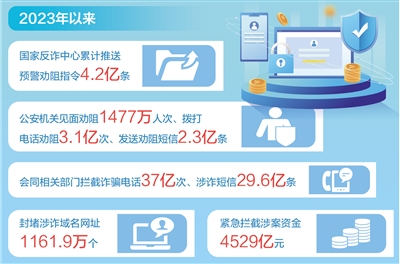
In recent years, public security organs have vigorously carried out early warnings and dissuasion, as well as payment freezes, continuously strengthening and expanding the protective network. Since 2023, the National Anti-Fraud Center has issued a cumulative total of 420 million early-warning and dissuasion instructions; public security authorities have conducted in-person dissuasion with 14.77 million individuals, made 310 million phone calls for dissuasion, and sent 230 million warning text messages. In coordination with relevant departments, they have intercepted 3.7 billion fraudulent calls and 2.96 billion fraudulent text messages, blocked 11.619 million domain names and websites associated with fraud, and urgently halted the transfer of RMB 452.9 billion in funds linked to criminal activities.
Carry out anti-fraud awareness campaigns to enhance the public’s ability to recognize and prevent fraud.
With a cup of tea and a few slices of watermelon, on a sweltering summer afternoon, Ma Yupu, a community police officer at the Longhu Police Station of the Xinzheng City Public Security Bureau in Henan Province, set up a “Peaceful Tea Stand” in his jurisdiction.
“If you receive a call from an unknown number, be sure to call back to verify; and if you realize you’ve been scammed, report it to the police immediately…” Ma Yupu explained basic fraud‑prevention tips to passing residents. Everyone gathered in a circle, sharing their own clever strategies for staying safe. “I’ve handed out community‑police contact cards—anyone who encounters a suspicious situation can call me anytime,” Ma Yupu said.
One evening, Ma Yupu received a call for help from Ms. Wang, a local business owner. Ms. Wang reported that someone had asked her to send her ID information and verification codes under the pretext of checking whether her business was operating in compliance. Just as she was about to enter the details, she recalled the anti-fraud awareness campaigns Ma Yupu regularly conducts and promptly called to verify the situation. After learning more, Ma Yupu quickly determined that it was a scam. “Our business owners’ identity information is linked to our bank accounts,” Ms. Wang said gratefully. “Fortunately, Officer Ma intervened in time; otherwise, the losses could have been unimaginable.”
Intangible cultural heritage flower-drum performances, anti-fraud skits in the “three‑sentence‑half” style… Inside the Zongzhai Cultural Hall in Futian Subdistrict, Yiwu City, Zhejiang Province, a vibrant array of anti-fraud arts and entertainment took to the stage, met with enthusiastic applause. On June 25, the Yiwu Municipal Public Security Bureau, in collaboration with multiple organizations, launched a series of events marking Anti-Fraud Awareness Week 2024. At the event site, residents could participate in a variety of anti-fraud–themed games and activities, gaining a deeper understanding of fraud prevention through interactive experiences.
Staff from the Yiwu Branch of the Bank of China, who participated in the event, explained that anti-fraud information boards have also been set up at bank branches, enabling customers visiting to conduct transactions to gain a clear understanding of the latest fraud schemes and preventive measures, while reminding everyone to safeguard their personal information and financial security.
Launching the “Anti-Fraud Awareness on Campus” campaign and organizing public screenings of outstanding anti-fraud films in rural areas and primary and secondary schools nationwide… Recently, public security organs across the country have vigorously carried out diverse anti-fraud awareness initiatives, while collaborating with relevant industry departments to disseminate anti-fraud knowledge and enhance the public’s ability to recognize and prevent scams. (Reporter Zhang Tianpei)
[Editor-in-charge: Zhou Chuqing]
Source: People’s Daily
Tags:
More information
Contact Us
Address:
No. 1, No. 1, New District Road No. 1, Gaocheng District, Shijiazhuang City, Hebei Province
WeChat/WhatsApp:
Phone:
Email:
