


-
About UsHebei Derui Chemical Co., Ltd. (hereinafter referred to as Derui Chemical) was established in January 2006 with a registered capital of RMB 51.8 million. The company specializes in the production and sale of agrochemicals, with its main products including thiamethoxam technical grade, imidacloprid technical grade, spirotetramat technical grade, and related formulated products.

-
Product CenterThe company is committed to building and continuously improving its management systems, and in 2020 it obtained certifications under GB/T 19001-2016/ISO 9001:2015, GB/T 24001-2016/ISO 14001:2015, and GB/T 45001-2020/ISO 45001:2018. Derui Chemical has consistently upheld the corporate mission of “pursuing green development and serving global agriculture,” while adhering to the core values of “integrity, innovation, pragmatism, and gratitude.” The company is eager to collaborate with its partners to contribute to the advancement of global agriculture.
-
BlogThe company places great emphasis on standardized management and sustainable development, successfully obtaining certification for its three major management systems—quality, environment, and occupational health and safety—in 2020. These certifications align with GB/T 19001-2016/ISO 9001:2015, GB/T 24001-2016/ISO 14001:2015, and GB/T 45001-2020/ISO 45001:2018. Derui Chemical remains committed to its corporate mission of promoting green development and serving global agriculture, upholding the core values of “integrity, innovation, pragmatism, and gratitude.” We look forward to partnering with stakeholders from all sectors, pooling our strengths, and advancing together to support the steady growth of global agriculture.

Four departments: Enhance the precision of green finance allocation and guard against “greenwashing” and “sham transitions.”
Release Date:
2024-05-12
Developing green finance is a key component of supporting the green transformation of the real economy and achieving high-quality financial development. On May 11, reporters learned from the People’s Bank of China that the PBOC and three other departments will further strengthen the supply of green financial products and services, enhance the precision of green‑finance allocation, and guard against “greenwashing” and “sham transitions.”
Harnessing the role of green finance to support the building of a Beautiful China is a shared mission and responsibility of the financial system and the ecological environment system. According to reports, the People’s Bank of China, the Ministry of Ecology and Environment, the National Administration of Financial Regulation, and the China Securities Regulatory Commission recently co‑hosted a symposium on green finance’s contribution to building a Beautiful China, where they reviewed and outlined plans for the next phase of work. The meeting emphasized that financial regulators, environmental authorities, financial institutions, and relevant enterprises should strengthen cross‑departmental and cross‑sectoral coordination and further enhance top‑level design.
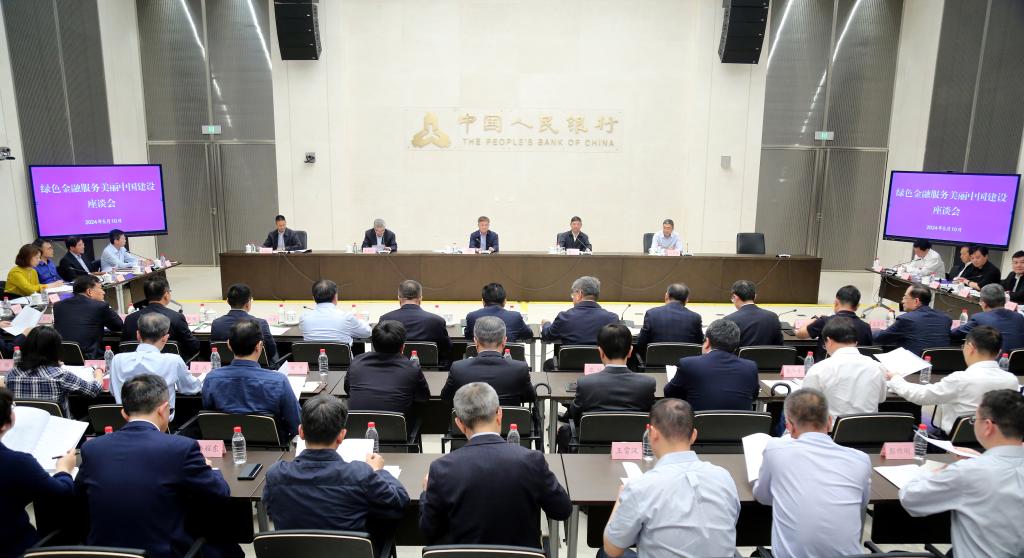
On May 10, the People’s Bank of China, the Ministry of Ecology and Environment, the National Administration of Financial Regulation, and the China Securities Regulatory Commission jointly convened a symposium on green finance services for building a Beautiful China. (Image from the website of the People’s Bank of China.)
In advancing the development of environmental‑factor markets, the four departments have specified that China’s carbon market should progressively expand its sectoral coverage in phases and that the national voluntary greenhouse gas emission reduction trading market should be further refined. Leveraging the specialized expertise of relevant ecological and environmental institutions and entities, technical support will be strengthened in areas such as carbon accounting and third‑party verification and certification. Financial institutions and financial infrastructure will be encouraged to play an active role, thereby providing additional impetus to carbon‑market development. Furthermore, efforts will be intensified to facilitate financing linkages among government, banks, and enterprises, and a joint promotion mechanism will be established to support key projects under the Beautiful China initiative.
To better align with and support the development needs of the green transition in the economy and society, the meeting emphasized that all financial institutions should integrate climate risks into their overall risk management frameworks, strengthen organizational structures to advance green finance, enhance performance assessment and incentive mechanisms, and elevate the professionalism of their financial services.
Relevant authorities have called on financial institutions to broaden the range of project repayment and collateral arrangements, and to explore innovative products such as environmental‑rights‑based pledge loans, environmental‑performance‑linked loans, and green credit asset securitization. At the same time, financial institutions should enhance their information disclosure and carbon accounting capabilities to guard against “greenwashing” and “sham transitions.” While continuing to ramp up financial support for energy conservation, carbon reduction, and ecological protection, they must also ensure appropriate backing for the low‑carbon transformation of high‑carbon sectors like coal‑fired power. (Reporters Wu Yu and Zhang Qianqian)
[Editor-in-charge: Cheng Lan]
Source: Xinhua News Agency
Tags:
Previous:
More information
Contact Us
Address:
No. 1, No. 1, New District Road No. 1, Gaocheng District, Shijiazhuang City, Hebei Province
WeChat/WhatsApp:
Phone:
Email:
