


-
About UsHebei Derui Chemical Co., Ltd. (hereinafter referred to as Derui Chemical) was established in January 2006 with a registered capital of RMB 51.8 million. The company specializes in the production and sale of agrochemicals, with its main products including thiamethoxam technical grade, imidacloprid technical grade, spirotetramat technical grade, and related formulated products.

-
Product CenterThe company is committed to building and continuously improving its management systems, and in 2020 it obtained certifications under GB/T 19001-2016/ISO 9001:2015, GB/T 24001-2016/ISO 14001:2015, and GB/T 45001-2020/ISO 45001:2018. Derui Chemical has consistently upheld the corporate mission of “pursuing green development and serving global agriculture,” while adhering to the core values of “integrity, innovation, pragmatism, and gratitude.” The company is eager to collaborate with its partners to contribute to the advancement of global agriculture.
-
BlogThe company places great emphasis on standardized management and sustainable development, successfully obtaining certification for its three major management systems—quality, environment, and occupational health and safety—in 2020. These certifications align with GB/T 19001-2016/ISO 9001:2015, GB/T 24001-2016/ISO 14001:2015, and GB/T 45001-2020/ISO 45001:2018. Derui Chemical remains committed to its corporate mission of promoting green development and serving global agriculture, upholding the core values of “integrity, innovation, pragmatism, and gratitude.” We look forward to partnering with stakeholders from all sectors, pooling our strengths, and advancing together to support the steady growth of global agriculture.

Xinhua Insight | What common problems were exposed? What will be the focus of future inspections? — A spotlight on the Central Ecological and Environmental Inspection
Release Date:
2024-01-13
The first batch of the third round of central ecological and environmental protection inspections recently concluded its on-site phase, with 25 typical cases publicly reported. What common issues did the inspections expose? And what steps will be taken next? Xinhua Viewpoint reporters have compiled and interviewed to shed light on these questions.
Illegal discharge and concentrated mining activities are rampant, and some longstanding issues remain unresolved.
“Compared with previous inspection rounds, the severity of similar cases has been somewhat alleviated, reflecting a marked increase in the attention local authorities are paying to ecological and environmental protection. However, there remains a considerable gap between the current situation and the requirements of the CPC Central Committee, as well as the public’s aspirations for a beautiful ecological environment,” said an inspector.
The inspection team publicly disclosed 25 typical cases from five provinces—Fujian, Henan, Hainan, Gansu, and Qinghai—covering illegal and non-compliant discharge of pollutants in chemical industrial parks, unauthorized mining, inadequate collection and treatment of domestic wastewater, and insufficient protection of coastal shelterbelts. Since the start of this round of inspections, the five provinces have held talks with 623 Party and government officials and held 289 officials accountable. Wherever the inspection team goes, it draws widespread public attention.
The “sharp sword” of inspection has once again been drawn, effectively transmitting pressure and driving high-quality development. However, it has also revealed a number of recurring, widespread systemic issues, with some localities grappling with long‑standing environmental and ecological problems that remain unresolved or have been addressed only superficially without fundamental improvement.
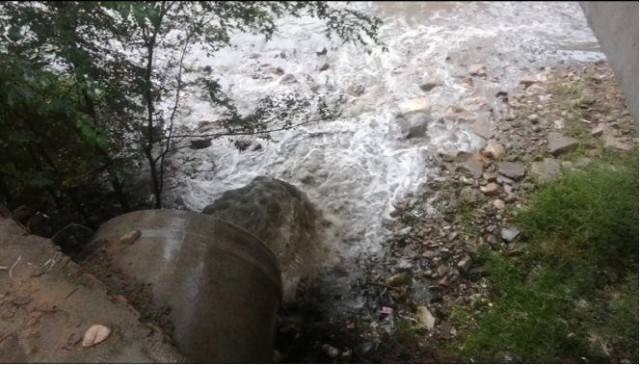
On October 11, 2023, an unannounced inspection by the supervisory team revealed that a discharge outlet at the northwest corner of Tianjin Bridge in Chengbei District, Xining City, Qinghai Province, was directly discharging wastewater into the Beichuan River. Photo provided by the supervisory team.
First, the shortcomings in environmental infrastructure remain pronounced.
The inspection found that all five provinces suffer from insufficient attention to environmental infrastructure development and inadequate overall planning, as well as delays in the construction of centralized domestic wastewater treatment facilities and poor operation and maintenance.
In Danzhou City, Hainan Province, there is a severe lack of main trunk lines for collecting domestic wastewater; as a result, urban stormwater culverts are used to convey this wastewater. During the rainy season, large volumes of combined stormwater and sewage are discharged directly into the Guangji River, leading to black, malodorous water downstream. In Xining and Haidong cities, Qinghai Province, longstanding deficiencies in domestic wastewater collection and treatment infrastructure have resulted in delayed construction of sewage treatment plants. Moreover, within the drainage networks, stormwater and sewage pipes are frequently improperly connected or misaligned, causing sewage overflows or direct discharges that degrade the water quality of nearby rivers.
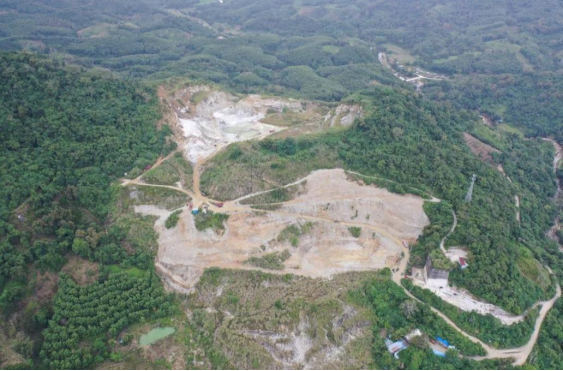
On November 30, 2023, during an on-site inspection, the inspection team used a drone to capture images showing that ecological restoration at the Shiyun Hongxing Quarry in Qiongzhong County has yet to achieve any substantial progress. Photo provided by the inspection team.
Secondly, illegal mining activities and the practice of exploiting mineral resources under the guise of ecological restoration—resulting in ecological damage—are frequently occurring.
Illegal quarrying activities that damage the ecosystem have been detected within Hainan Tropical Rainforest National Park. The Shiyun Hongxing Quarry in Qiongzhong County is located in the park’s general control zone, where mountain‑opening, quarrying, and mining are prohibited. Nevertheless, from October 1 to 17, 2020, the enterprise carried out six unauthorized blasting operations and continued production, with stone‑processing output reaching 37,000 tons in the second half of 2022 alone. In September 2020, Huian County in Quanzhou City, Fujian Province, approved “ecological restoration and remediation” projects for two mines; however, since the projects began, the mines have not only failed to be restored but have also seen their mining areas nearly double in size.
In addition, in some localities, longstanding problems remain unresolved, and corrective measures are not implemented in earnest.
For example, in response to the second round of inspections highlighting groundwater over-extraction in Zhoukou City, Henan Province, the province’s remediation plan stipulated that the South-to-North Water Diversion Project expansion would be completed by the end of 2022 to provide an alternative water source, thereby replacing groundwater with diverted water. However, Shenqiu County has yet to fulfill this commitment. From 2009 to 2020, the governments at both the prefectural and county levels of Gangcha County in Haibei Prefecture, Qinghai Province, along with relevant enterprises, formulated seven different remediation plans aimed at ecological restoration and management of mining sites. Each plan set deadlines for completing measures such as backfilling open-pit mines, treating spoil heaps, and restoring landforms and vegetation. Nevertheless, inspection findings revealed that progress on these efforts has remained slow: two mining areas have been exploited over an extended period, resulting in eight interconnected open-pit mines; large quantities of waste rock are piled along the slopes, leaving the mountain landscape scarred in multiple places.
Regarding issues with inadequate rectification, some members of the inspection teams have acknowledged that local authorities have addressed the easier problems, but often fall short when it comes to more complex issues fraught with conflicting interests. In some cases, long-term mechanisms remain incomplete, with insufficient follow-up funding and measures, leading to half‑hearted implementation and a lack of sustained progress. Particularly in ecological and environmental governance, where financial pressures are significant, certain localities exhibit reluctance and adopt a “let’s hold off for now” attitude.
Categorized rectification and targeted measures are being vigorously advanced.
This round of central ecological and environmental protection inspections has led to the resolution of numerous environmental issues affecting local communities, the investigation and accountability for cases of inadequate rectification or even a resurgence of pollution, and the prompt correction of a range of ecological and environmental violations.
Following the inspection team’s public release of typical cases, Party committees and government leaders across the country attached great importance to the matter. In some localities, provincial Party secretaries and governors conducted on-site supervision and inspections to advance rectification efforts. Relevant cities and counties promptly took action, implementing robust measures to effectively address the identified issues.
— Issues that can be rectified immediately shall be promptly addressed and corrected upon identification.
Following the inspection team’s exposure of serious ecological and environmental issues—such as illegal encroachment on forest land—within Hainan Tropical Rainforest National Park, Hainan Province has initiated ecological restoration on 258.6 mu of illegally reclaimed land, planting over 17,900 native tree seedlings, including Liquidambar formosana and Melaleuca alternifolia, and has launched formal investigations into the unlawful conduct of relevant enterprises. Meanwhile, local authorities and departments are carrying out ecological restoration efforts at mining sites and other affected areas.
In addition to the 25 typical cases publicly reported, the five inspection teams received a total of 19,815 public complaints and reports. After sorting and consolidating duplicate submissions, they forwarded a cumulative total of 13,441 cases to the relevant provinces. As of December 31, 2023, the concerned provinces had concluded or partially concluded 11,457 cases.
For example, Minle County in Gansu Province received a case assignment reporting “a cattle farm with a foul odor.” Local officials conducted an on-site inspection and urged the enterprise to promptly remove all manure stored in open-air piles and in open‑air oxidation ponds within the facility.
— Launch targeted campaigns in key areas to address pressing issues in a concentrated manner.
In some regions, ecological and environmental issues are widespread, have complex causes, and pose significant challenges to remediation, necessitating targeted campaigns to drive solutions. To address shortcomings in environmental infrastructure, Longyan City in Fujian Province has launched a comprehensive overhaul of stormwater and sewage networks in aging urban areas and urban villages, implementing five major special initiatives: tracing and identifying sources, controlling pollution at its source, separating clean and polluted waters, upgrading drainage standards, and enhancing management. In response to the problem of unregulated sand extraction, Gansu Province has also initiated a special rectification campaign in the sand and gravel sector, ensuring that corrective measures are carried out with high quality.
—“One case, one policy,” with each case being closed one by one.
Given that the issue of unregulated sand mining involves numerous enterprises, Gansu Province has mandated a “one mine, one plan” approach to formulate corrective measures, accelerating mine rehabilitation, vegetation restoration, and farmland reclamation to ensure scientifically sound, law-based, comprehensive, and thorough rectification. To address wastewater treatment challenges, Quanzhou City in Fujian Province has developed and implemented a work plan for immediate action and rectification, along with an implementation plan for targeted campaigns, preliminarily defining specific remediation tasks, timelines, and roadmaps, and systematically advancing each item under the principle of “one problem, one plan, one dedicated task force” to ensure effective closure of cases.
How will the inspection team step up its efforts going forward?
An official from the Coordination Bureau of the Central Environmental Protection Inspection stated that, in accordance with the relevant plan, the third round of inspections is scheduled to cover 31 provinces (autonomous regions and municipalities directly under the central government) as well as the Xinjiang Production and Construction Corps, while continuing to include relevant departments of the State Council and pertinent central enterprises among the entities subject to inspection.
The official stated that the CPC Central Committee attaches great importance to ecological and environmental protection in the Yangtze and Yellow River basins, and these two river regions will be a key focus of future inspection efforts.
The reporter learned that, in accordance with relevant directives, the Ministry of Ecology and Environment has annually commissioned the production of environmental‑protection warning films on the Yangtze River Economic Belt since 2018, and, starting in 2021, has concurrently undertaken similar efforts for the Yellow River Basin, using undercover inspections and unannounced visits to highlight ecological and environmental issues in these river basins.
He explained that a notable change in the third round of inspections is the integrated consideration of inspections in the Yangtze and Yellow River basins, with the production of environmental‑alert documentaries on these two major rivers incorporated into the inspection plan and operational framework.
How can we consolidate the outcomes of inspection tours and ensure that corrective measures are effectively implemented? According to the official, a series of institutional mechanisms have been put in place to guarantee that local authorities earnestly carry out rectification work. These include providing guidance on drafting inspection‑related action plans, employing checklist‑based management and prioritizing key cases for close follow‑up, and establishing a system of regular reporting and random inspections to urge localities to enforce corrective actions. Additionally, measures such as instituting an acceptance‑and‑closure mechanism, conducting supervisory interviews and special inspections, and launching “follow‑up” reviews of inspection findings help ensure thorough implementation. Finally, by increasing transparency regarding the results of corrective efforts, these measures harness public oversight and subject the process to public scrutiny.
Previously, the CPC Central Committee and the State Council had already issued the Measures for Implementing Rectification Work Following Central Ecological and Environmental Protection Inspections. The official stated that all localities must earnestly ensure effective implementation, uphold the spirit of perseverance, sustain efforts, maintain unwavering vigilance, and consistently carry out the “second half” of inspection‑based rectification, thereby establishing a closed-loop management system that identifies problems and resolves them.
[Editor-in-charge: Zhang Xinran]
Source: Xinhua Net — Reporters Liang Jun and Gao Jing
Tags:
More information
Contact Us
Address:
No. 1, No. 1, New District Road No. 1, Gaocheng District, Shijiazhuang City, Hebei Province
WeChat/WhatsApp:
Phone:
Email:
